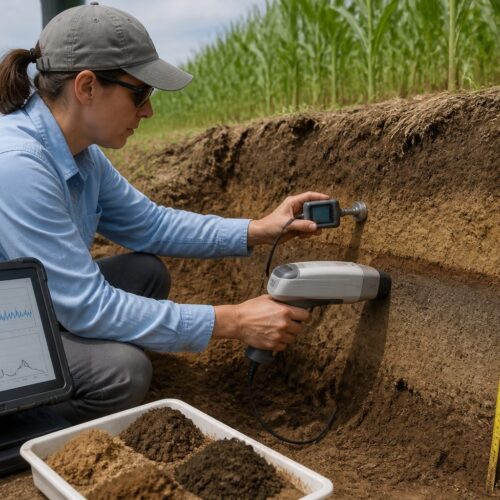


Soil spectroscopy has emerged as a powerful tool in precision agriculture, offering rapid and cost-effective methods for assessing soil properties. However, the reliability of soil spectroscopy results hinges on rigorous validation processes. Ensuring accuracy and consistency is paramount for making informed decisions about nutrient management, irrigation, and other agricultural practices. Without proper soil spectroscopy validation methods, the data obtained from spectral analysis may be misleading, leading to suboptimal or even detrimental actions in the field.
This article will explore the importance of validation, common validation techniques, the use of reference samples, statistical methods for assessing accuracy, and strategies for identifying and addressing sources of error. By understanding and implementing best practices for soil spectroscopy validation methods, practitioners can enhance the quality and trustworthiness of their soil data. This, in turn, supports more precise and sustainable agricultural management.
Ultimately, the goal is to provide a comprehensive guide to soil spectroscopy validation methods that empowers users to generate reliable and actionable insights. These insights will drive improvements in crop yield, resource efficiency, and environmental stewardship. Let’s get started.
The Importance of Validation
Validation is a critical step in any analytical process, including soil spectroscopy. It ensures that the method or model used produces results that are accurate, reliable, and fit for their intended purpose. The significance of soil spectroscopy validation methods cannot be overstated, especially in the context of precision agriculture, where decisions are data-driven.
Without proper validation, the data obtained from soil spectroscopy may be of questionable quality. This can lead to incorrect interpretations and, consequently, poor agricultural management decisions. Think about it like this: if you’re using a faulty scale to measure ingredients for a cake, the final product is unlikely to turn out as expected.
Similarly, if soil spectroscopy data is not validated, farmers might apply the wrong amount of fertilizer. They might also mismanage irrigation, or make other critical errors that can negatively impact crop yield and quality. The economic and environmental consequences of such errors can be significant, highlighting the need for robust soil spectroscopy validation methods.
Moreover, validation helps to identify and correct potential sources of error in the measurement process. This includes issues related to sample preparation, instrument calibration, and data processing. By systematically evaluating each step of the process, validation ensures that the final results are as accurate and reliable as possible.
Common Validation Techniques
Several techniques can be employed to validate soil spectroscopy results, each with its own strengths and limitations. These techniques generally fall into two categories: internal validation and external validation. Internal validation assesses the performance of the model or method using the same dataset that was used to develop it. External validation, on the other hand, uses an independent dataset to evaluate the model’s predictive ability.
One common internal validation technique is cross-validation, where the original dataset is partitioned into subsets. One subset is used for training the model, and the remaining subsets are used for testing. This process is repeated multiple times, with each subset serving as the test set once, to provide a comprehensive assessment of the model’s performance.
External validation typically involves comparing the soil spectroscopy results with data obtained from traditional laboratory analysis. Reference samples are collected from the same fields and analyzed using established methods to provide a benchmark for comparison. The closer the soil spectroscopy results align with the reference data, the more confidence we can have in the accuracy of the soil spectroscopy method.
Another approach involves using certified reference materials (CRMs) with known soil properties to assess the accuracy of the soil spectroscopy method. CRMs are materials that have been carefully characterized by a recognized authority and are used to calibrate and validate analytical methods. By analyzing CRMs using soil spectroscopy and comparing the results with the certified values, users can determine whether the method is producing accurate results.
Using Reference Samples for Validation
Reference samples play a crucial role in validating soil spectroscopy models. These samples, analyzed through traditional laboratory methods, provide a benchmark against which spectral predictions are compared. The quality of these reference samples directly impacts the reliability of the validation process.
Selecting representative reference samples is essential. These samples should cover the full range of soil properties and conditions found in the area of interest. This ensures that the validation process accurately reflects the performance of the soil spectroscopy model across diverse soil types and environmental conditions.
| Soil Property | Traditional Lab Method | Spectroscopy Measurement |
|---|---|---|
| Organic Matter | Loss on Ignition (LOI) | NIR reflectance at specific wavelengths |
| Nitrogen | Kjeldahl Method | NIR absorption related to N-H bonds |
| Phosphorus | Olsen Method | Visible and NIR reflectance influenced by P content |
| Potassium | Ammonium Acetate Extraction | NIR absorption related to K-O bonds |
| Soil pH | Electrode Method | Visible and NIR reflectance correlated with pH |
The process of collecting and preparing reference samples also needs careful attention. Samples should be collected using a consistent protocol to minimize variability. Proper storage and handling are also essential to prevent degradation and contamination, which can compromise the accuracy of the reference data.
Statistical Methods for Assessing Accuracy
Statistical methods are essential for quantifying the accuracy and reliability of soil spectroscopy results. These methods provide a framework for comparing spectral predictions with reference data and for identifying potential sources of error. Several statistical metrics are commonly used to assess the performance of soil spectroscopy models.
One of the most widely used metrics is the coefficient of determination (R²), which measures the proportion of variance in the reference data that is explained by the soil spectroscopy model. An R² value close to 1 indicates a strong relationship between the predicted and observed values, suggesting that the model is accurate. However, R² alone is not sufficient to assess model performance, as it can be artificially inflated by overfitting.
Another important metric is the root mean square error (RMSE), which quantifies the average difference between the predicted and observed values. A lower RMSE indicates better accuracy, as it signifies that the model’s predictions are, on average, closer to the true values. RMSE is particularly useful for comparing the performance of different soil spectroscopy models, as it provides a direct measure of prediction error.
In addition to R² and RMSE, other statistical measures such as the ratio of performance to deviation (RPD) and the residual prediction deviation (RPD) are also commonly used. These metrics provide further insights into the predictive ability of the soil spectroscopy model and can help identify potential issues such as outliers or systematic errors. By carefully evaluating these statistical metrics, users can gain a comprehensive understanding of the accuracy and reliability of their soil spectroscopy results.
Calibration Models and Quality Control
Calibration models are the foundation of soil spectroscopy, linking spectral data to soil properties. Developing accurate and robust calibration models is essential for obtaining reliable results. These models are typically built using a set of reference samples with known soil properties, which are then used to train the model to predict soil properties from spectral data.
Several factors can influence the performance of calibration models, including the quality of the reference data, the selection of spectral features, and the choice of calibration algorithm. Careful attention to these factors is necessary to ensure that the resulting model is accurate and reliable. This ensures that the soil spectroscopy validation methods used are effective.
Quality control measures are also essential for maintaining the accuracy of soil spectroscopy results over time. This includes regular calibration checks using CRMs, as well as routine analysis of quality control samples to monitor the performance of the instrument and the calibration model. By implementing a comprehensive quality control program, users can ensure that their soil spectroscopy data remains accurate and reliable.
Different mathematical approaches can be used to build calibration models, each with its own strengths. Partial Least Squares Regression (PLSR) is a common technique that handles multicollinearity well. Support Vector Machines (SVM) offer non-linear modeling capabilities, and Artificial Neural Networks (ANN) can capture complex relationships. The choice of method depends on the specific soil properties and spectral data characteristics.
Identifying and Addressing Sources of Error
Errors can arise at various stages of the soil spectroscopy process, from sample collection to data analysis. Identifying and addressing these sources of error is crucial for ensuring the accuracy and reliability of the results. Errors can be systematic, affecting all measurements in a consistent way, or random, varying unpredictably.
One common source of error is sample preparation. Inconsistent sample handling, such as variations in drying or grinding techniques, can introduce variability in the spectral data. Careful attention to sample preparation protocols and the use of standardized procedures can help minimize these errors. It’s important to remember that soil spectroscopy validation methods are only as good as the samples they’re validating.
- Inconsistent sample drying
- Variations in grinding techniques
- Instrument drift
- Stray light
- Spectral interferences
Instrument-related errors, such as instrument drift or stray light, can also affect the accuracy of soil spectroscopy measurements. Regular instrument calibration and maintenance are essential for minimizing these errors. It’s also important to be aware of potential spectral interferences, where the spectral signal of one soil property overlaps with that of another.
Best Practices for Validation
To ensure the accuracy and reliability of soil spectroscopy results, it is essential to follow best practices for validation. These practices encompass all stages of the process, from sample collection to data analysis. Adhering to these guidelines will enhance the quality of your soil data and support more informed decision-making in precision agriculture.
Start with careful sample collection, ensuring that samples are representative of the area of interest and collected using a consistent protocol. Proper sample preparation is also critical, as variations in drying, grinding, or sieving can introduce errors. This attention to detail is a cornerstone of effective soil spectroscopy validation methods.
Next, use a well-calibrated instrument and regularly check its performance using certified reference materials. Develop robust calibration models using a representative set of reference samples and appropriate statistical techniques. Implement a comprehensive quality control program to monitor the accuracy of soil spectroscopy results over time.
Finally, document all steps of the validation process, including sample collection, preparation, analysis, and data processing. This documentation will provide a record of the validation process and allow for traceability and reproducibility. By following these best practices, users can ensure that their soil spectroscopy data is accurate, reliable, and fit for its intended purpose.
Future Trends in Soil Spectroscopy Validation
The field of soil spectroscopy is constantly evolving, with new technologies and techniques emerging to improve accuracy and efficiency. Advancements in sensor technology, data processing algorithms, and statistical methods are paving the way for more robust and reliable soil spectroscopy validation methods. Staying abreast of these developments is crucial for practitioners seeking to optimize their soil analysis workflows.
One promising trend is the development of portable and handheld spectrometers. These devices allow for rapid, on-site soil analysis, reducing the time and cost associated with traditional laboratory methods. As these technologies mature, they will likely play an increasingly important role in precision agriculture, enabling farmers to make real-time decisions about nutrient management and irrigation.
Another area of innovation is the use of machine learning algorithms to improve the accuracy of calibration models. Machine learning techniques can identify complex relationships between spectral data and soil properties that may not be captured by traditional statistical methods. This approach has the potential to significantly enhance the predictive power of soil spectroscopy models.
The integration of soil spectroscopy with other data sources, such as remote sensing data and soil maps, is also gaining momentum. By combining these data sources, researchers can develop more comprehensive and accurate assessments of soil properties at larger scales. This integration holds promise for improving soil management practices and promoting sustainable agriculture.
Conclusion
Validating soil spectroscopy results is essential for ensuring the accuracy and reliability of soil data in precision agriculture. By employing appropriate validation techniques, using reference samples, applying statistical methods, and addressing potential sources of error, practitioners can enhance the quality of their soil analysis workflows. This commitment to quality is what makes soil spectroscopy validation methods so important.
The future of soil spectroscopy validation methods looks promising, with advancements in sensor technology, data processing algorithms, and machine learning techniques. As these technologies continue to evolve, they will undoubtedly play an increasingly important role in promoting sustainable agriculture and improving crop yields. Embracing these advancements will ensure that soil spectroscopy remains a valuable tool for precision agriculture.