
Farmers and land managers increasingly turn to biochar as a powerful soil amendment, aiming to boost soil health, enhance crop yields, and sequester carbon. This charcoal-like material offers numerous benefits, from improving water retention to fostering beneficial microbial communities. However, truly understanding biochar’s impact requires precise, efficient assessment methods that go beyond traditional lab tests.
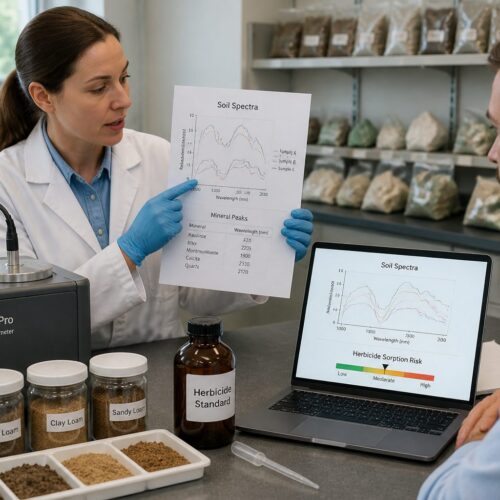
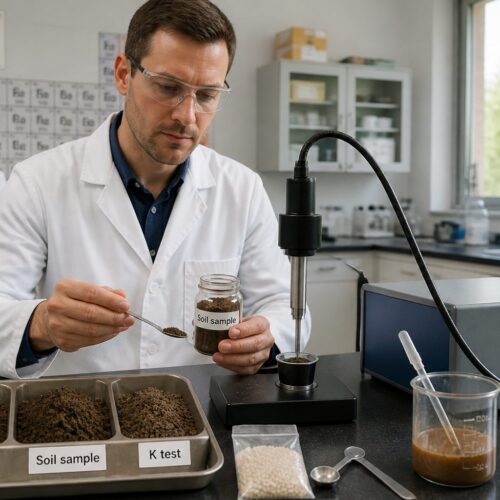
Soil spectroscopy provides a non-destructive, rapid, and cost-effective way to analyze these changes directly in the field or laboratory. It measures how light interacts with soil samples, revealing chemical and physical properties without complex reagents or lengthy processing. This technology is revolutionizing how we approach soil spectroscopy biochar amendments assessment, offering real-time insights.
Implementing spectroscopy allows for continuous monitoring of biochar’s influence on soil characteristics, helping growers optimize application rates and strategies. It gives us a clearer picture of what happens underground, guiding more sustainable and productive agricultural practices. This approach delivers actionable data for better decision-making.
How Biochar Changes Spectral Signatures in Soil
Biochar, with its unique highly aromatic and recalcitrant carbon structure, fundamentally alters how soil reflects and absorbs light. Its dark color and porous nature create distinct spectral fingerprints that differ significantly from native soil components. These changes are readily detectable across various spectral ranges.
The presence of biochar often leads to a general darkening of the soil, which reduces overall reflectance, especially in the visible and near-infrared regions. Beyond just color, the chemical bonds within biochar, such as C=C aromatic structures and various oxygen-containing functional groups, absorb specific wavelengths of light. These absorptions create identifiable dips and peaks in the soil’s spectral signature.
When biochar is incorporated into soil, it doesn’t just sit there; it interacts with minerals, organic matter, and water. These interactions can modify the spectral response of the entire soil matrix, creating a complex but decipherable signal. For instance, biochar can aggregate soil particles, changing their light scattering properties.
The extent of these spectral changes depends on several factors, including the biochar’s feedstock, pyrolysis temperature, and application rate. Higher pyrolysis temperatures generally produce more aromatic biochar, which tends to have a stronger, more distinct spectral signature. This makes comprehensive biochar soil analysis crucial for accurate interpretation.
Researchers can use these altered spectral signatures to identify the presence of biochar and estimate its concentration within the soil. Advanced algorithms and chemometric models are then applied to extract this specific information from the complex spectral data. This allows for precise soil spectroscopy biochar amendments assessment in various agricultural settings.
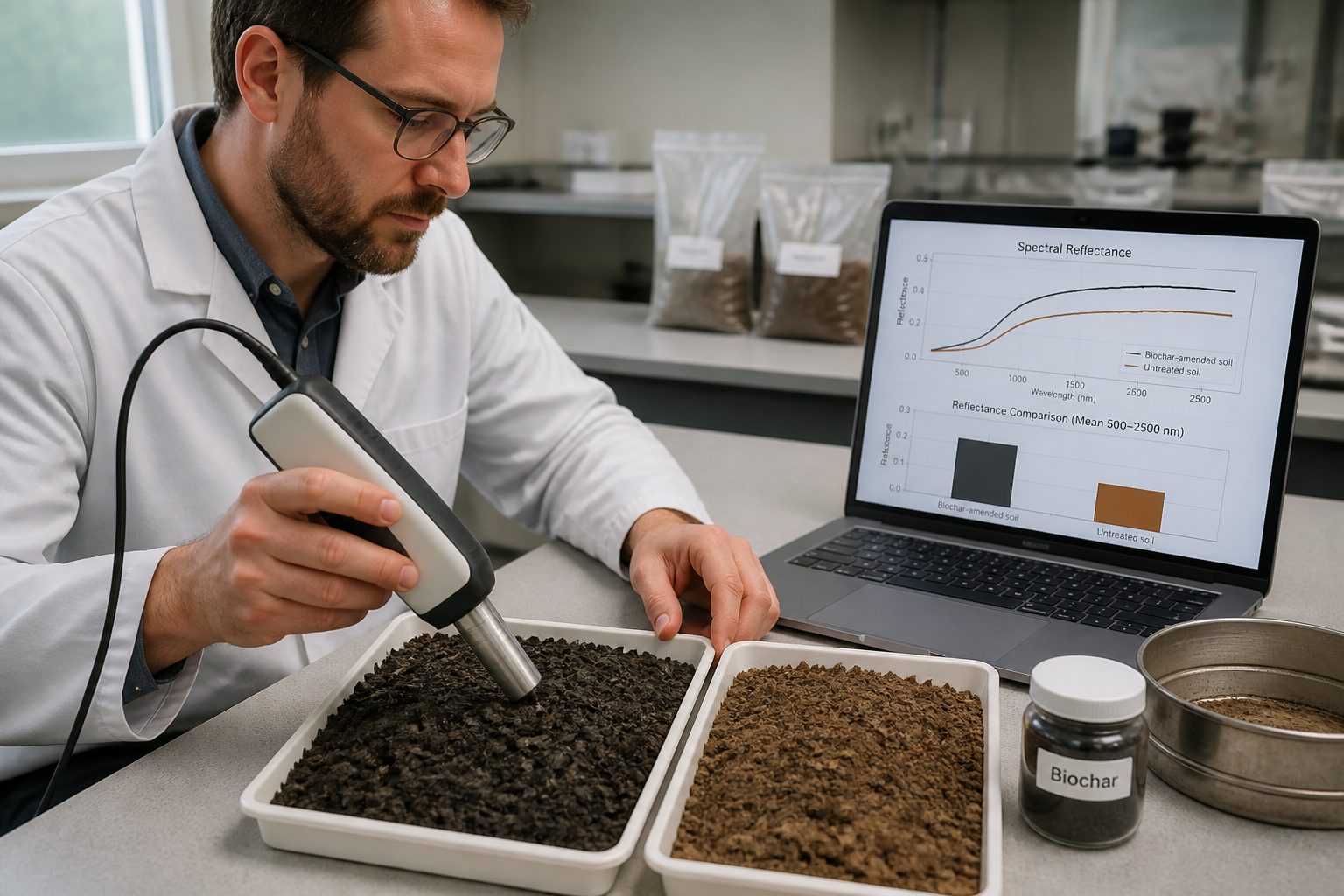
The structural integrity of biochar particles also impacts light interaction, with finer particles potentially having different spectral characteristics than coarser ones. Understanding these nuances helps in developing more robust spectral models for diverse biochar types and application scenarios. It is not a one-size-fits-all approach, requiring careful calibration.
Furthermore, biochar’s influence on soil moisture content and aggregate stability also subtly shifts spectral responses. A soil with improved water retention due to biochar will absorb light differently than a drier, untreated soil. These indirect effects further contribute to the overall spectral modification.
NIR and MIR Markers Used to Detect and Quantify Biochar
Near-infrared (NIR) and mid-infrared (MIR) spectroscopy are particularly effective for biochar detection and quantification due to their sensitivity to organic functional groups. These spectral regions capture vibrations and overtones from various chemical bonds present in biochar and soil organic matter. Specific absorption features act as clear indicators.
In the NIR range, biochar often exhibits broad absorption features related to C-H bonds and aromatic structures, while MIR provides more direct evidence of functional groups like C=C aromatic stretches, C-O bonds, and even condensed aromatic clusters. These precise markers make biochar NIR detection a powerful tool. Leveraging these distinct spectral properties allows scientists to build predictive models for biochar presence and concentration.
| Spectral Region | Key Wavelengths/Wavenumbers | Biochar-Related Functional Groups/Features |
|---|---|---|
| Visible (VIS) | 400-700 nm | Overall darkness, strong light absorption by black carbon |
| Near-Infrared (NIR) | 1100-2500 nm | C-H overtones, aromatic C-H, hydroxyl groups (O-H) |
| Mid-Infrared (MIR) | 2500-15000 nm (4000-667 cm⁻¹) | Aromatic C=C stretching, C-O stretching, aliphatic C-H, carboxylic acids |
| Raman Spectroscopy | Varies (molecular vibrations) | Graphitic carbon, degree of ordering, specific aromatic structures |
Before and After Comparisons: What Spectroscopy Shows Post-Application
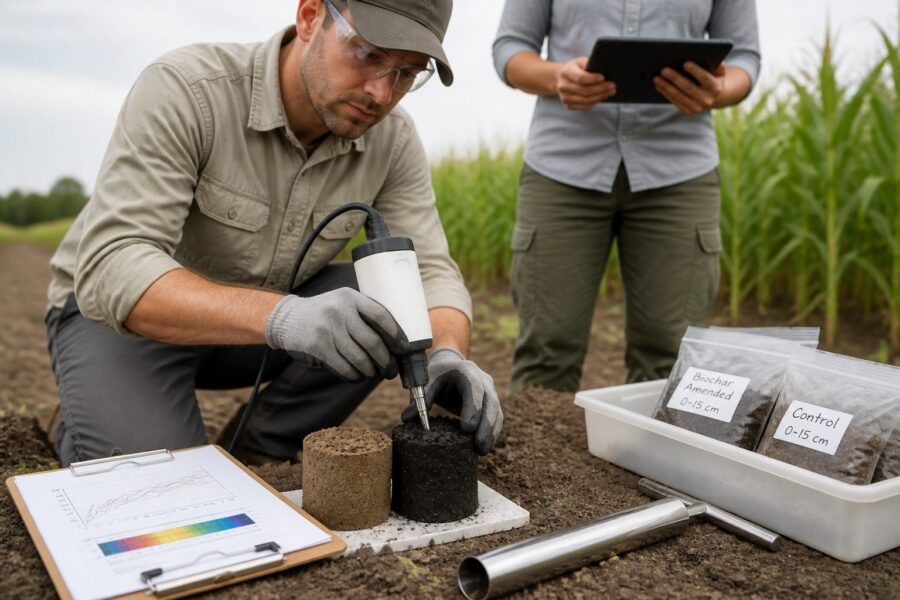
Establishing a baseline spectral profile of the soil before any biochar application is an absolutely critical first step in any successful assessment program. This initial scan provides a reference point against which all subsequent measurements can be accurately compared. Without this baseline, isolating the specific impact of biochar becomes much more challenging.
After biochar has been applied and incorporated into the soil, subsequent spectral scans reveal distinct changes in the soil’s light absorption and reflection patterns. These post-application spectra will show increased absorption across specific wavelengths, particularly those associated with the carbonaceous structure of biochar. The magnitude of these changes often correlates directly with the amount of biochar added.
Spectroscopy allows for both qualitative and quantitative insights from these before-and-after comparisons. Qualitatively, you can observe the emergence of characteristic biochar spectral peaks, confirming its presence in the soil. Quantitatively, advanced chemometric models can convert these spectral shifts into precise measurements of biochar concentration, often expressed as a percentage of soil weight.
These comparisons also offer insights into how evenly the biochar has been distributed within the soil profile. Variations in spectral intensity across different sample points can indicate areas of higher or lower biochar concentration. This information is invaluable for optimizing application techniques and ensuring uniform soil amendment.
Beyond just detecting biochar, the before-and-after approach helps in understanding the broader impact on soil properties. Changes in spectral regions associated with water content, organic matter decomposition, or even nutrient availability can be indirectly observed. This holistic view enhances the value of soil spectroscopy biochar amendments assessment.
Repeated scans over time also provide a dynamic picture, showing how biochar integrates into the soil matrix and potentially changes its own spectral signature as it ages. This temporal monitoring allows for tracking of short-term incorporation and longer-term stability. It helps us understand the immediate and lasting effects of the amendment.
Farmers can use this data to fine-tune their biochar application rates for future seasons, avoiding over-application or ensuring sufficient amendment where needed. This precision agriculture approach saves resources and maximizes the benefits of biochar. It makes the investment in biochar more efficient and effective.
Distinguishing Biochar Carbon From Native Organic Matter
One of the persistent challenges in soil carbon analysis is accurately differentiating recently added biochar carbon from the soil’s existing native organic matter. Both contribute to the overall carbon signature, but their origins, stability, and effects on soil are quite different. Spectroscopy offers a powerful way to make this critical distinction.
Biochar possesses a highly condensed aromatic structure due to its pyrolysis process, making its spectral signature distinct from the more aliphatic and less aromatic native organic matter. These structural differences manifest as unique absorption bands in both the NIR and MIR regions. Learning to recognize these subtle differences is key for accurate spectroscopy carbon amendment analysis.
Researchers employ advanced chemometric techniques, such as Partial Least Squares Regression (PLSR) or Support Vector Machines (SVM), to build models that can separate these overlapping spectral signals. By training these models on samples with known proportions of biochar and native organic matter, they learn to identify the unique contributions of each. This allows for precise quantification of biochar even in complex soil matrices.
Furthermore, the degree of aromaticity and condensation in biochar can be quantified spectrally, providing a proxy for its thermal history and potential stability. Native organic matter, being less thermally altered, will have different spectral characteristics related to its more labile components. This contrast provides a spectral “fingerprint” for each carbon pool.
The ability to distinguish biochar carbon from native organic matter is crucial for accurate carbon accounting in agricultural systems. It helps verify carbon sequestration claims and understand the true impact of biochar on the soil carbon pool, rather than just measuring total organic carbon. This level of detail is essential for environmental reporting and policy.
Some methods also involve pretreating soil samples to enhance the spectral contrast between biochar and native organic matter, though this adds complexity to the protocol. For example, selective chemical oxidation can remove some labile organic matter, leaving the more recalcitrant biochar behind for clearer spectral analysis. However, most field-based approaches strive for minimal sample preparation.
Ultimately, this spectral discrimination allows for a more nuanced understanding of carbon dynamics following biochar application. It moves beyond a simple “total carbon” number to reveal the specific contributions and fate of the added amendment. This advanced insight is a cornerstone of effective soil spectroscopy biochar amendments assessment.
Tracking Biochar Stability and Degradation Over Time
One of the most compelling aspects of biochar is its potential for long-term carbon sequestration in soil, but its actual stability varies depending on environmental conditions and biochar properties. Soil spectroscopy provides a non-invasive method to monitor how biochar’s chemical structure changes as it ages and integrates into the soil environment. This allows for continuous tracking of its persistence.
As biochar degrades or undergoes chemical transformations in the soil, its spectral signature will subtly shift. For instance, the oxidation of biochar can lead to the formation of new oxygen-containing functional groups, which will appear as new or intensified absorption bands in the MIR spectrum. These changes provide direct evidence of its ongoing chemical evolution.
Repeated spectral scans of biochar-amended plots over months or even years can reveal patterns of degradation. A decrease in strong aromatic C=C stretching bands, coupled with an increase in aliphatic C-H or carboxylic acid groups, might indicate a breakdown of the recalcitrant carbon matrix. This longitudinal data is invaluable for understanding real-world biochar stability.
This ability to track degradation is especially important for validating the carbon sequestration potential of different biochar types under varying climatic and soil conditions. It helps differentiate between highly stable biochars and those that might break down more quickly, releasing their stored carbon back into the atmosphere. Such insights directly inform sustainable land management decisions.
Furthermore, understanding the degradation pathways through spectroscopy can help optimize biochar production methods to create more stable products. If certain spectral features correlate with faster degradation, producers can adjust pyrolysis temperatures or feedstocks to minimize those features. This iterative improvement relies heavily on precise analytical feedback.
The long-term monitoring enabled by spectroscopy also allows researchers to study the interaction between biochar and soil microbes. Microbial activity can influence biochar degradation, and spectral changes might indirectly reflect these biological processes over time. This offers a more complete picture of biochar’s ecological role.
Ultimately, tracking biochar stability and degradation through spectroscopy provides crucial data for robust soil spectroscopy biochar amendments assessment. It moves beyond theoretical predictions to offer empirical evidence of how biochar performs in actual agricultural settings. This ensures that biochar applications are truly effective and sustainable.
Practical Scanning Protocol for Biochar-Amended Fields
Implementing a practical scanning protocol for biochar-amended fields requires careful planning and execution to ensure reliable and consistent data collection. The goal is to capture representative spectral information that accurately reflects the biochar’s distribution and concentration across the treated area. Consistency in methodology is paramount for meaningful comparisons.
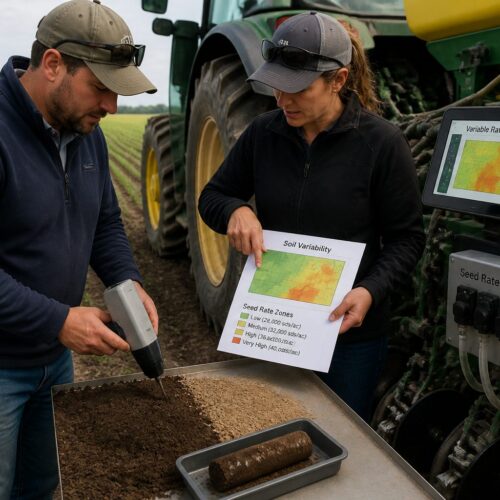
Start by defining your sampling strategy, whether it’s a grid-based approach or targeting specific zones, and ensure you collect enough samples to account for soil heterogeneity. For field-based measurements, handheld or portable spectrometers are ideal, but for detailed analysis, laboratory-based instruments offer higher precision. Proper sample preparation is also key for good results.
- Establish a clear baseline by scanning untreated control plots.
- Collect samples at consistent depths across the field.
- Remove large debris, roots, and stones from soil samples.
- Air-dry samples to a consistent moisture content, or measure moisture spectrally.
- Grind and sieve samples to a uniform particle size (e.g., <2mm) for lab analysis.
- Use a standardized spectrometer calibration procedure.
- Take multiple scans per sample and average the results.
- Record GPS coordinates for each field scan point.
- Store spectral data with detailed metadata (date, location, biochar type, application rate).
What Current Research Says About Spectral Biochar Quantification
Current research overwhelmingly supports the efficacy of soil spectroscopy for quantifying biochar in agricultural soils, with numerous studies demonstrating its potential. Scientists are continuously refining methods to improve accuracy and address complexities like varying soil types and biochar feedstocks. This ongoing work expands the utility of the technology.
Many studies highlight the robustness of MIR spectroscopy for biochar quantification, often achieving R² values above 0.8 when calibrated with traditional lab methods like elemental carbon analysis. NIR spectroscopy also shows promise, particularly for biochar NIR detection, but often requires more sophisticated chemometric models to handle spectral overlaps with native organic matter. The choice of technique often depends on the specific research question.
A significant area of focus is developing universal calibration models that can accurately quantify biochar across a wide range of soil types and biochar properties without needing site-specific recalibration. While challenging, progress is being made through large spectral libraries and advanced machine learning algorithms. This would greatly enhance the scalability of soil spectroscopy biochar amendments assessment.
Researchers are also exploring the use of combined spectral techniques, such as fusing VIS-NIR with MIR data, to leverage the strengths of each region for improved biochar detection and characterization. This multi-sensor approach can provide a more comprehensive understanding of the soil-biochar matrix. It helps overcome the limitations of individual spectral ranges.
The impact of soil moisture and texture on spectral readings remains a challenge that researchers are actively addressing through various correction techniques and modeling approaches. While drying and grinding samples is ideal for lab analysis, field applications require robust methods to account for these environmental variables. This is crucial for practical implementation of biochar soil analysis.
Another exciting development involves using hyperspectral imaging, which captures spectral data for every pixel in an image, allowing for spatial mapping of biochar distribution. This provides visual insights into how biochar disperses and interacts with the soil at a micro-scale. It moves beyond point measurements to visualize heterogeneity.
Despite these advancements, challenges persist in accurately quantifying very low concentrations of biochar or distinguishing biochar from highly degraded organic matter with similar spectral features. Continued research into novel spectral features and more powerful algorithms is essential to push these boundaries further. The scientific community is committed to refining these techniques.
Overall, the trajectory of current research points towards increasingly precise, automated, and field-deployable spectroscopic solutions for biochar assessment. These tools are becoming indispensable for both scientific understanding and practical agricultural management. They promise to unlock the full potential of biochar as a sustainable soil amendment.
The integration of spectroscopy with other precision agriculture technologies, like GPS-guided application equipment, is also a growing area of interest. This allows for real-time monitoring and adjustment of biochar application rates based on immediate soil conditions. Such synergy will further optimize resource use and environmental benefits.
The development of portable and affordable spectrometers also democratizes access to this technology, moving it from specialized laboratories to the hands of farmers and consultants. This accessibility is crucial for widespread adoption of advanced biochar soil analysis techniques. It empowers more people to make data-driven decisions.
Conclusion
Soil spectroscopy stands out as an indispensable tool for understanding and optimizing the use of biochar amendments in agriculture. Its ability to provide rapid, non-destructive, and detailed insights into biochar presence, concentration, and stability makes it invaluable. This technology streamlines the assessment process significantly.
From distinguishing biochar carbon from native organic matter to tracking its long-term fate in the soil, spectroscopy offers a comprehensive suite of analytical capabilities. These insights empower farmers and researchers to make informed decisions that enhance soil health and maximize carbon sequestration benefits. It moves us closer to truly sustainable farming practices.
As research continues to refine spectral models and develop more robust, field-ready instruments, the role of soil spectroscopy in precision agriculture will only grow. It promises to unlock the full potential of biochar, ensuring its effective and responsible deployment across agricultural landscapes worldwide. This is a game-changer for environmental stewardship.