
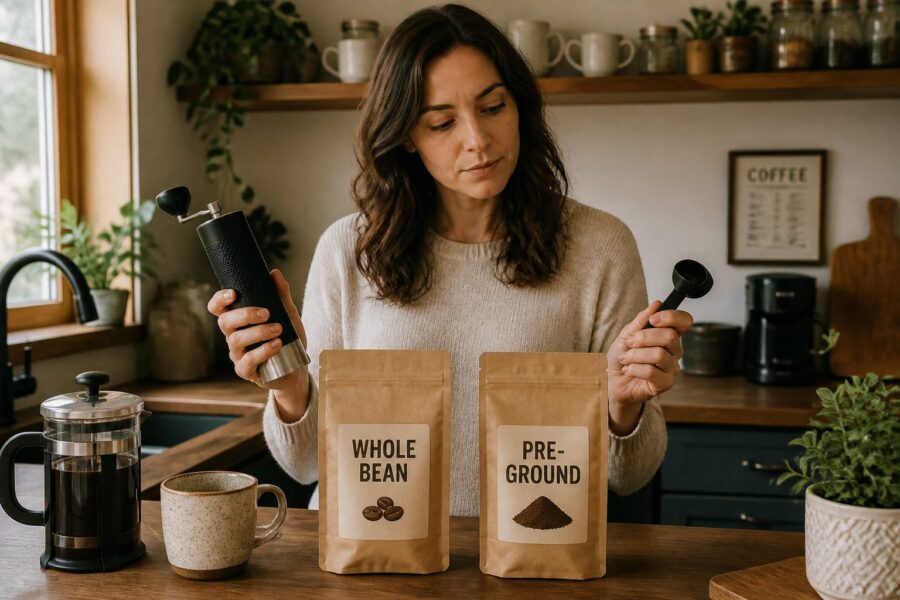
Whole bean and pre-ground coffee can both make a satisfying cup, but they ask different things of your morning routine; whole beans require a grinder and a little extra time, while pre-ground coffee trades that step for convenience.
The choice comes down to freshness after opening, control over grind size, equipment, storage, and how quickly you use a bag; these practical differences are more useful than declaring one format the winner for every household.
What changes when coffee is ground
Grinding breaks whole beans into smaller particles, exposing more surface area to air and making coffee easier to extract during brewing; that exposure also means ground coffee can lose aroma more quickly than intact beans under similar storage conditions.
This does not mean ground coffee becomes unusable as soon as a bag is opened; it means the aroma and flavor can change over time, and the pace depends on packaging, storage, and handling rather than a single universal countdown.
Whole beans keep their structure until you grind them, so you can grind only what you need for a brew; the advantage matters most when you have a grinder and actually use it; a bag of beans left open for a long time still loses freshness.
Whole bean vs ground coffee for freshness and flavor
Freshly ground beans often smell more aromatic because grinding releases volatile compounds just before brewing; whether that difference is worth the extra step depends on your taste, how fresh the coffee was when purchased, and how you store it.
Pre-ground coffee offers less control over particle size, but it can be matched to a familiar brewer when the package identifies an appropriate grind; for many automatic drip routines, using a suitable grind consistently may be more helpful than buying beans you cannot conveniently grind.
No format fixes stale or poorly stored coffee; check the package information, close the bag after opening, keep it away from moisture, strong odors, heat, and direct light, and buy an amount you can use at a comfortable pace.
| Consideration | Whole bean | Pre-ground |
|---|---|---|
| Grinding step | Requires a grinder and extra preparation | Ready to measure and brew |
| Grind control | Can be adjusted for different brewers | Usually fixed to the package grind |
| Aroma after opening | Can be preserved until beans are ground | Ground surface is exposed earlier |
| Storage needs | Keep the bag closed and dry | Keep the bag closed and dry |
| Best fit | People who want grind control and own a grinder | People who value speed or do not own a grinder |
Does whole bean or ground coffee last longer?
Whole bean coffee generally retains its aroma longer than ground coffee when both are stored in comparable conditions, because fewer surfaces are exposed after grinding; that is a relative difference, not a promise that whole beans stay fresh indefinitely.
Packaging, the time since roasting or grinding, how often the bag is opened, and where it is kept all matter; a resealable package stored in a dry cupboard can protect either format better than a loosely folded bag beside a warm appliance.
Avoid moving coffee between cold and warm places repeatedly if condensation could form, and do not store it near ingredients with strong odors; for ordinary home use, a closed container in a cool, dry cupboard is a manageable approach.
Does 12 ounces of whole beans equal 12 ounces of ground coffee?
Yes, 12 ounces by weight of whole beans and 12 ounces by weight of ground coffee represent the same mass of coffee; grinding changes the beans’ size and arrangement, not their weight, aside from small amounts left in the grinder or lost during handling.
Volume is different: a scoop of whole beans and a scoop of ground coffee do not necessarily contain the same amount by weight, because particle size and how the coffee settles affect how much fits in a measure; a scale is the clearer way to compare doses.
This distinction matters when following a recipe; if it specifies grams or ounces by weight, weigh the coffee in the form the recipe calls for; if it uses scoops, recognize that the result may vary with grind and measuring habits.
Match the grind to your brewing method
Different brewers work best with different grind sizes because water contacts the coffee for different amounts of time and moves through it in different ways; a grind that works in a drip machine may not behave the same in a French press or espresso setup.
Whole beans give you the option to change grind size as you switch methods, but only if your grinder supports the range and is easy to adjust; pre-ground coffee narrows that choice, so look for a package intended for your brewer rather than assuming every ground coffee is interchangeable.
If a cup tastes weak, bitter, or uneven, grind size can be one variable among several, including the coffee-to-water ratio and brewing process; avoid changing multiple factors at once; a measured adjustment makes the next cup easier to interpret.
Cost, equipment, and everyday convenience
Pre-ground coffee can cost less in a particular store or package, but prices vary by brand, roast, origin, and size, so there is no dependable price rule that applies to all bags; compare the products you actually buy rather than assuming one form always costs less.
Whole beans add the cost and storage needs of a grinder if you do not already own one; in return, a suitable grinder can let you adjust grind size and prepare only the amount needed for a brew.
Convenience is a real factor, not a lesser way to enjoy coffee; if measuring, grinding, and cleaning would make your routine harder to keep, pre-ground coffee may fit better than a grinder that spends most of its time in a cupboard.
- Choose whole beans if you want to grind close to brewing and value control over grind size.
- Choose pre-ground coffee if quick preparation matters or you do not have a grinder.
- Check that the grind suits your brewer, especially when using a French press or espresso equipment.
- Buy a bag size you expect to finish and store it sealed, dry, and away from heat and strong odors.
- Use a scale when a recipe calls for a weight rather than relying on scoop volume.
How to decide for your own kitchen
Start with the equipment you already have and the frequency of your coffee routine; if you own a grinder and enjoy adjusting a brew, whole beans provide useful control; if speed and fewer steps matter more, ground coffee removes a task without preventing a good cup.
You can also choose based on the brewer; keep the grind type and amount consistent for your usual method, then note whether freshness, convenience, or cup quality is the problem you want to solve before changing formats.
The more practical choice is the one you can store properly and use comfortably; either format can work well when the coffee suits your brewer and your preparation is consistent.
Frequently asked questions
Neither is better for everyone. Whole beans offer grind control and can retain aroma longer before grinding, while pre-ground coffee is quicker to prepare and needs no grinder.
By weight, yes: grinding changes particle size, not the coffee’s mass, although small amounts may remain in a grinder. The same scoop volume may not weigh the same across whole and ground coffee.
Whole beans generally retain aroma longer than ground coffee under comparable storage, but both change over time. Keep either format sealed, dry, and away from heat, moisture, and strong odors.