
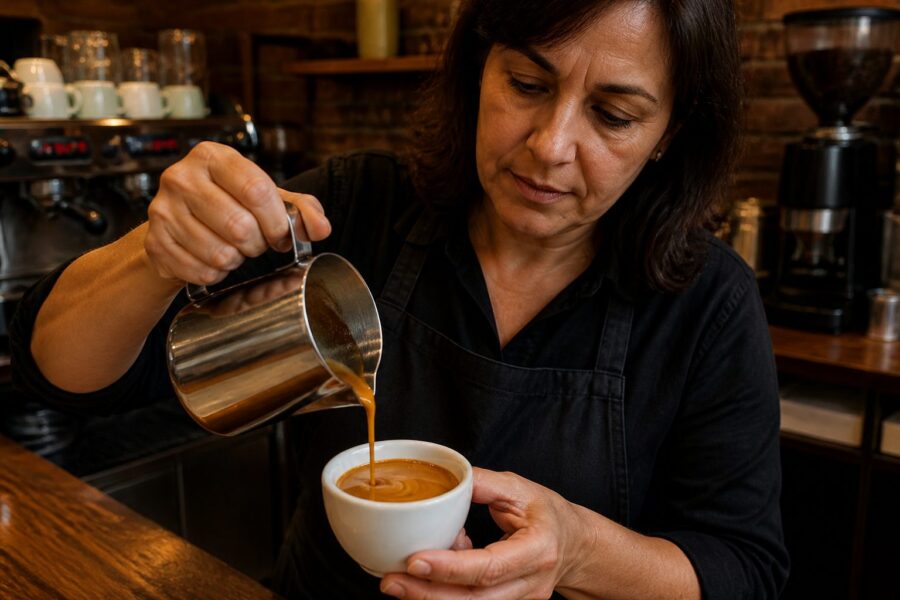
Coffee crema is the tan or golden-brown foam that may sit on top of a freshly pulled espresso.
It forms during pressurized brewing, but its appearance alone cannot tell you whether the shot tastes good.
A crema layer is made from gas bubbles and coffee compounds dispersed in liquid.
Its thickness, color, and persistence vary with the coffee and extraction, which makes it a clue to interpret rather than a score.
What crema is made of
Roasted coffee contains carbon dioxide that remains in the beans after roasting and gradually escapes during storage.
During espresso extraction, pressure and hot water release some of that gas into the drink.
The released gas forms bubbles, while oils and other surface-active compounds from the coffee help stabilize the foam.
The visible layer is therefore part of the brewed coffee, not dairy cream or a separate ingredient.
Crema can carry aromatic compounds and affect the first impression of a sip.
It is also a foam with a texture that differs from the liquid espresso underneath, so stirring or sipping changes the experience.
Crema is associated with espresso because espresso uses pressure to brew finely ground coffee.
Other coffee preparations can produce bubbles or foam, but they are not necessarily the same crema layer.
How crema forms during espresso extraction
In an espresso machine, hot water passes through a compact bed of ground coffee under pressure.
Gas and soluble coffee material enter the liquid, and pressure changes as the espresso reaches the cup.
As the espresso exits and pressure falls, dissolved gas can form bubbles.
Coffee oils and other compounds help those bubbles gather into the surface foam people call crema.
The extraction is affected by more than pressure alone.
Bean age, roast, coffee composition, grind, dose, distribution, water, and machine setup can all influence the appearance of the shot.
A moka pot or another brewer may produce a concentrated drink or surface bubbles, but it does not use the same espresso extraction conditions.
Calling every foam layer crema can blur an important difference in method.
What changes crema’s appearance
Coffee that retains more carbon dioxide can produce a noticeable foam, though a large amount of crema is not automatically a sign of better flavor.
Very fresh beans may behave differently from beans that have rested after roasting.
Roast style can influence the visible layer, as can the coffee’s composition and how it was stored.
A dark appearance or thick foam should not be treated as a precise freshness or quality measurement.
Grind and extraction affect how the espresso flows and what compounds reach the cup.
A shot that runs unusually fast or slowly may have other taste and texture issues, whether its crema looks abundant or sparse.
The coffee blend or origin can also change crema.
Different beans have different characteristics, so two well-prepared coffees need not produce identical color or thickness.
A cup’s shape and lighting affect what the layer looks like to the eye.
Comparing crema across different cups or phone photos is unreliable unless the coffee and viewing conditions are similar.
What crema tastes like
Crema often tastes more bitter or intense than the liquid below it, though the experience depends on the coffee and the person’s palate.
Its fine bubbles can also create a drying or textured sensation.
Some drinkers stir crema into the espresso to make the first sip more uniform.
Others prefer to taste the layers separately, then decide whether the contrast is pleasant.
A thick, bitter foam can dominate a small drink, but removing it does not correct an under- or over-extracted shot.
It changes the sensory balance rather than repairing the brewing process.
Coffee taste involves aroma, acidity, sweetness, bitterness, concentration, and texture.
Crema is only one part of that experience, so a photo of a beautiful layer leaves many important qualities unknown.
Why crema is not a complete measure of shot quality
Crema can provide a small amount of information about the coffee and extraction, but it cannot establish whether the espresso is balanced or enjoyable.
A shot can have a thick layer and still taste harsh or hollow.
A lighter crema does not automatically mean a failed shot.
Bean characteristics, age, roast, and preparation can yield less foam even when the drink tastes balanced to the person drinking it.
Judge the shot by taste and by the consistency of its preparation, not by color alone.
Notice whether it is overly sour, harsh, watery, or pleasing, and make changes based on the cup rather than the visual layer.
Crema thickness is especially easy to misread as a quality badge because it is visible.
That shortcut leaves out the coffee itself, the extraction, and what the drinker actually prefers.
How to get crema on espresso
Use an espresso-capable machine and a coffee suitable for the machine’s basket and recipe.
A brewer that does not create espresso-style pressure may produce a different kind of surface foam.
Start with coffee that is stored well and grind it for the espresso setup.
The grind needs to work with the dose, basket, and machine rather than follow a universal setting.
Distribute the grounds evenly and tamp consistently if the machine uses a portafilter.
Uneven preparation can create uneven water flow, which may affect both the extraction and the resulting cup.
Pull a shot using the machine’s instructions and adjust one variable at a time if the flow or taste is unsatisfactory.
Avoid chasing a specific crema color as a substitute for dialing in flavor.
- Use a clean espresso machine and basket according to the manufacturer’s care instructions.
- Measure a consistent dose and grind for the machine’s basket.
- Distribute and tamp the grounds evenly when the equipment requires it.
- Observe the flow and taste the espresso, then make one measured adjustment.
- Compare crema only alongside flavor, aroma, and texture.
Coffee freshness can change how much gas remains, but there is no universal roast-date window in the research dossier that guarantees a particular crema.
Use the roaster’s information and judge each coffee on its own.
A practical way to read the layer
Look at crema as one observation among several.
Its presence shows that gas and coffee compounds formed a surface foam, but its amount does not certify freshness, caffeine, extraction quality, or flavor.
Taste the espresso while it is fresh, and decide whether the foam’s bitterness and texture suit you.
Stir it in if you prefer a more uniform first sip, or leave it if you like the contrast.
When troubleshooting, record the coffee, dose, grind, and machine settings alongside what the shot tastes like.
This gives you information you can use on the next brew; a crema photograph by itself does not.
Crema is part of what makes espresso visually distinctive, but it is not the whole drink.
Understanding how it forms makes it easier to enjoy the layer without mistaking it for a quality guarantee.
Use an espresso-capable machine, suitable coffee, and a consistent grind, dose, and puck preparation. Crema varies by coffee and recipe, so taste the shot rather than chasing a specific appearance.
It can taste more bitter or intense than the espresso beneath it and may add a foamy texture. The exact impression depends on the coffee and the drinker’s palate.
It is a surface foam formed as pressure-brewed espresso releases gas and disperses coffee oils and other compounds into bubbles.