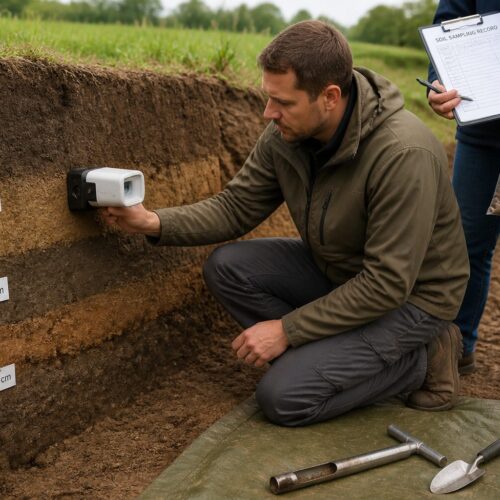


Soil spectroscopy has emerged as a powerful tool in precision agriculture, allowing for the detailed analysis of soil properties through spectral data that can reveal critical information about the soil’s composition and health. However, one of the significant challenges in this field is the mixing problem, which can significantly impact the accuracy of soil component analysis and lead to erroneous conclusions regarding soil conditions.
The mixing problem arises when multiple soil components interact, causing their spectral signatures to overlap in ways that complicate interpretation. This overlap can obscure the individual contributions of each component, leading to inaccuracies in soil assessments and potentially misguided agricultural practices.
Understanding the implications of the mixing problem is crucial for effective soil management and crop production, as it directly affects the reliability of the data that farmers and agronomists rely on. By addressing this issue, farmers and agronomists can make more informed decisions based on precise soil data, which is vital for enhancing crop yields and resource efficiency.
The Mixing Problem in Soil Spectroscopy and Why It Matters
The mixing problem complicates the analysis of soil samples, as it can lead to misinterpretations of spectral data that are essential for understanding soil health. When multiple soil types or components are present, their combined spectra can mask the characteristics of individual constituents, making it challenging to derive accurate information for agricultural planning.
This situation is particularly problematic in heterogeneous landscapes where soil variability is high, such as regions with diverse land use and geological formations. Without addressing the mixing problem, the reliability of soil property estimations is severely compromised, which can have cascading effects on crop management and overall agricultural productivity.
In precision agriculture, accurate soil information is essential for optimizing crop yields and resource use, which can lead to more sustainable farming practices. Therefore, resolving the mixing issue is not just a technical challenge but a fundamental necessity for sustainable agricultural practices that aim to balance productivity with environmental stewardship.
Addressing the mixing problem involves utilizing advanced modeling techniques that can differentiate between overlapping spectral signatures effectively. By employing these methods, researchers can improve the accuracy of soil assessments and enhance decision-making processes, ultimately leading to better management of soil resources.
Ultimately, tackling the mixing problem can lead to more effective soil management strategies that take into account the complexity of soil composition. This ensures that agricultural practices are both efficient and environmentally sustainable, promoting a healthier ecosystem while maximizing crop output.
Linear vs. Nonlinear Spectral Mixing Models for Soil Applications
In soil spectroscopy, two primary spectral mixing models are used: linear and nonlinear models, each with its own assumptions and applications in soil analysis. Linear models, such as the linear mixture model, assume that the observed spectrum is a linear combination of the spectra of individual soil components, which simplifies the analytical process significantly.
This approach simplifies the analysis and is widely used for spectral mixture analysis in soil applications, making it accessible for many practitioners in the field. However, linear models may not adequately capture the complexities of soil interactions, especially in cases of high component variability where nonlinear interactions are prevalent.
Nonlinear models, on the other hand, take into account the interactions between different soil components, providing a more nuanced understanding of spectral data. These models can provide a more accurate representation of spectral data, particularly in heterogeneous soils where simple linear assumptions may fall short.
Choosing between linear and nonlinear models depends on the specific soil conditions and the level of accuracy required for the analysis. Understanding the strengths and weaknesses of each approach is crucial for effective soil analysis, ensuring that the chosen method aligns with the research objectives and the complexity of the soil environment.
Ultimately, the choice of model can significantly influence the results of soil component decomposition, which is vital for many agricultural applications. Therefore, careful consideration must be given to the selection of the appropriate spectral mixing model for each unique application, as this decision can affect the overall outcomes of soil assessments.
Selecting Endmembers for Soil Mixture Analysis
Endmember selection is a critical step in spectral mixture analysis, as it defines the spectral signatures that represent the various soil components being studied. The accuracy of the unmixing process largely depends on the quality and relevance of the selected endmembers, making this a pivotal aspect of the analytical workflow.
Common approaches for endmember extraction in soil spectroscopy include field sampling and spectral libraries, which provide different pathways to obtain the necessary spectral data. Each method has its advantages and limitations, and the choice will depend on the specific context of the study, including the availability of resources and the nature of the soil being analyzed.
| Endmember Extraction Method | Advantages | Limitations |
|---|---|---|
| Field Sampling | Directly measures soil components, ensuring relevance to the study area | Time-consuming and may not represent variability across larger areas |
| Spectral Libraries | Provides a wide range of spectra for different soil types, enhancing the analytical framework | May not capture local soil variations that could affect results |
| Machine Learning Approaches | Can automate the selection process, increasing efficiency and reducing human error | Requires training data and validation to ensure accuracy |
| Expert Knowledge | Utilizes experience and regional data to inform selections, potentially increasing relevance | Subjective and may introduce bias, affecting the reliability of results |
Each method should be evaluated based on the specific goals of the soil analysis, considering factors such as accuracy, ease of use, and the level of detail required. By carefully selecting endmembers, researchers can enhance the accuracy of spectral unmixing results, which is essential for reliable soil assessments.
A well-defined selection process for endmembers is essential for achieving reliable soil component decomposition, as it lays the foundation for subsequent analytical steps. It allows for a more precise quantification of soil properties that are critical for agricultural productivity, ensuring that decisions made based on these analyses are well-informed and effective.
Constrained Least-Squares Unmixing Algorithms for Soil Spectra
Constrained least-squares unmixing algorithms play a pivotal role in improving the accuracy of soil spectral analysis, offering a systematic approach to handling the complexities of mixed soil spectra. These algorithms help to minimize errors in spectral data interpretation by incorporating constraints based on known soil compositions, which enhances the reliability of the results.
By applying these constraints, researchers can enhance the robustness of soil component decompositions, leading to more reliable estimations of soil properties, such as texture and organic matter content. This is particularly important in agricultural settings where precise soil information is critical for effective management and planning.
Constrained least-squares methods are particularly useful when dealing with complex soil mixtures that exhibit substantial variability. They provide a systematic approach to resolving the mixing problem inherent in soil spectroscopy, facilitating more accurate and meaningful analytical outcomes.
In practice, these algorithms are implemented using various software tools tailored for spectral analysis, which can streamline the analytical process. Their effectiveness can significantly improve the outcomes of soil assessments and enhance decision-making in agriculture, ultimately supporting better crop management.
The integration of constrained least-squares unmixing algorithms into routine soil analysis represents a significant advancement in the field of soil spectroscopy. This approach not only improves accuracy but also fosters greater confidence in soil management practices, enabling farmers and agronomists to make decisions based on solid data.
Estimating Sand, Silt, Clay and Organic Matter Fractions Through Unmixing
Estimating soil texture components such as sand, silt, clay, and organic matter is essential for understanding soil health and functionality in agricultural systems. Through spectral unmixing, these components can be quantified accurately from spectral data, providing insights that are crucial for effective soil management.
The process involves analyzing the spectral signatures of soil samples to determine the proportions of each component, which allows for a detailed understanding of the soil’s physical and chemical properties. This quantification is vital not only for assessing soil quality but also for making informed decisions related to crop selection and management practices.
- Sand content estimation
- Silt fraction calculation
- Clay particle analysis
- Organic matter quantification
- Overall soil health assessment
Accurate estimation of these fractions is vital for managing soil health and optimizing crop production, as each component plays a specific role in soil function. By integrating spectral unmixing into soil assessments, agronomists can make informed decisions that promote sustainable agricultural practices, benefiting both the environment and productivity.
Furthermore, the ability to estimate these fractions through non-invasive methods offers significant advantages over traditional laboratory analyses, which often require physical soil sampling and can be time-consuming. This enhances the efficiency of soil monitoring programs and supports timely interventions in agricultural management, ultimately contributing to better crop outcomes.
Handling Soil Moisture as a Spectrally Active Component in Unmixing
Soil moisture is a critical factor that influences soil spectral signatures and can significantly affect the accuracy of unmixing results in soil spectroscopy. When analyzing soil spectra, it is essential to account for moisture variations as they can alter the spectral response of soil components, thereby impacting the quality of the analysis.
By using spectral unmixing on hyperspectral data, researchers can produce detailed maps of soil properties that are crucial for understanding spatial variability in fields. These maps serve as valuable tools for precision agriculture, enabling targeted interventions based on soil variability, which can lead to more efficient use of inputs and better crop management.
Furthermore, applying spectral unmixing to hyperspectral imagery can reveal hidden patterns and trends in soil composition that may not be apparent through traditional analysis. This information is vital for developing effective management practices that improve soil health and enhance agricultural productivity.
As the technology continues to advance, the integration of spectral unmixing in hyperspectral analysis will become increasingly prevalent, allowing for more detailed and comprehensive assessments of soil conditions. This evolution will enhance the ability of farmers and agronomists to monitor and manage soil resources effectively, ultimately supporting sustainable agricultural practices.
Ultimately, the combination of spectral unmixing and hyperspectral imagery presents a promising avenue for enhancing precision agriculture. It empowers stakeholders with the insights needed to optimize productivity while ensuring sustainable practices that protect the environment and promote long-term agricultural viability.
Software Tools and Code Repositories for Soil Spectral Unmixing
Numerous software tools and code repositories are available for researchers and practitioners involved in soil spectral unmixing, providing essential functionalities for data processing, analysis, and visualization. These tools offer a range of features that can cater to the diverse needs of users, making it easier to conduct thorough analyses of soil spectra.
Popular software options include commercial solutions and open-source platforms, catering to various needs and preferences across the scientific community. By leveraging these resources, users can enhance their capabilities in spectral analysis and stay at the forefront of developments in soil spectroscopy.
Common tools for soil spectral unmixing include software like ENVI, MATLAB, and R packages designed for spectral analysis, each offering unique features that can benefit specific aspects of soil spectroscopy. These tools facilitate the manipulation and interpretation of spectral data, helping researchers and practitioners derive meaningful insights from their analyses.
Additionally, online code repositories such as GitHub provide valuable resources for accessing algorithms and sharing best practices among researchers and practitioners in the field. Engaging with these communities can foster collaboration and innovation in soil spectral research, ultimately advancing the field and improving methodologies.
As the field of soil spectroscopy continues to evolve, it’s crucial for practitioners to stay updated on the latest tools and methodologies available. By doing so, they can maximize the effectiveness of their spectral unmixing efforts and contribute to advancements in precision agriculture, ensuring that their practices are based on the best available science.
Particle size analysis provides a direct measurement of soil texture, allowing researchers to benchmark the results obtained through spectral unmixing and assess their validity. This comparison helps to identify any discrepancies and refine unmixing algorithms accordingly, ensuring that the final results are as accurate as possible.
By establishing a solid validation framework, researchers can enhance the credibility of spectral unmixing as a tool for soil analysis, providing confidence in the results produced. It also fosters confidence among agronomists and farmers who rely on these results for decision-making that directly impacts agricultural practices.
Moreover, continuous validation efforts can lead to improvements in spectral modeling techniques, refining the analytical processes used in soil spectroscopy. This iterative process ultimately contributes to more accurate and actionable soil insights, enabling better management of soil resources.
Validation against established methods, such as particle size analysis, is a crucial step in advancing the field of soil spectroscopy, ensuring that the benefits of spectral unmixing are realized in practical agricultural applications. This commitment to validation not only enhances the reliability of spectral data but also supports the ongoing development of innovative techniques in soil analysis.
Applying Spectral Unmixing to Hyperspectral Imagery for Field-Scale Mapping
Hyperspectral imagery provides a wealth of data that can be leveraged for field-scale soil mapping through innovative spectral unmixing techniques. This approach allows for the identification and quantification of soil components across large agricultural landscapes, which is essential for modern precision farming.
By using spectral unmixing on hyperspectral data, researchers can produce detailed maps of soil properties that are crucial for understanding spatial variability in fields. These maps serve as valuable tools for precision agriculture, enabling targeted interventions based on soil variability, which can lead to more efficient use of inputs and better crop management.
Furthermore, applying spectral unmixing to hyperspectral imagery can reveal hidden patterns and trends in soil composition that may not be apparent through traditional analysis. This information is vital for developing effective management practices that improve soil health and enhance agricultural productivity.
As the technology continues to advance, the integration of spectral unmixing in hyperspectral analysis will become increasingly prevalent, allowing for more detailed and comprehensive assessments of soil conditions. This evolution will enhance the ability of farmers and agronomists to monitor and manage soil resources effectively, ultimately supporting sustainable agricultural practices.
Ultimately, the combination of spectral unmixing and hyperspectral imagery presents a promising avenue for enhancing precision agriculture. It empowers stakeholders with the insights needed to optimize productivity while ensuring sustainable practices that protect the environment and promote long-term agricultural viability.
Software Tools and Code Repositories for Soil Spectral Unmixing
Numerous software tools and code repositories are available for researchers and practitioners involved in soil spectral unmixing, providing essential functionalities for data processing, analysis, and visualization. These tools offer a range of features that can cater to the diverse needs of users, making it easier to conduct thorough analyses of soil spectra.
Popular software options include commercial solutions and open-source platforms, catering to various needs and preferences across the scientific community. By leveraging these resources, users can enhance their capabilities in spectral analysis and stay at the forefront of developments in soil spectroscopy.
Common tools for soil spectral unmixing include software like ENVI, MATLAB, and R packages designed for spectral analysis, each offering unique features that can benefit specific aspects of soil spectroscopy. These tools facilitate the manipulation and interpretation of spectral data, helping researchers and practitioners derive meaningful insights from their analyses.
Additionally, online code repositories such as GitHub provide valuable resources for accessing algorithms and sharing best practices among researchers and practitioners in the field. Engaging with these communities can foster collaboration and innovation in soil spectral research, ultimately advancing the field and improving methodologies.
As the field of soil spectroscopy continues to evolve, it’s crucial for practitioners to stay updated on the latest tools and methodologies available. By doing so, they can maximize the effectiveness of their spectral unmixing efforts and contribute to advancements in precision agriculture, ensuring that their practices are based on the best available science.
Incorporating soil moisture as a spectrally active component allows for more accurate interpretations of spectral data, which is especially important in regions where soil moisture levels fluctuate frequently due to climatic conditions or irrigation practices. This consideration not only enhances the accuracy of spectral unmixing but also provides a more comprehensive understanding of soil dynamics related to moisture content.
- Impact on spectral reflectance, which can change with moisture levels
- Influence on soil texture analysis, affecting results if not accounted for
- Role in nutrient availability, as moisture affects nutrient uptake by plants
- Importance for crop growth, since moisture levels are critical for plant health
- Need for moisture monitoring to ensure accurate soil assessments
By effectively managing and interpreting soil moisture data, researchers can improve the outcomes of spectral unmixing, leading to more reliable assessments and better-informed agricultural practices. This integration of moisture data into spectral analysis will become increasingly feasible as technology advances, providing a holistic view of soil health.
As technology continues to advance, integrating moisture data into spectral analysis will become increasingly feasible, allowing for more sophisticated modeling of soil conditions. This integration will further enhance the utility of soil spectroscopy in precision agriculture, equipping farmers with the tools needed to optimize their practices based on accurate soil information.
Validation of Unmixing Results Against Particle Size Analysis
Validation of spectral unmixing results is essential for ensuring the accuracy and reliability of soil assessments, serving as a benchmark for the methodologies employed. One common method for validation is comparing unmixing results with traditional particle size analysis, which provides a direct measurement of soil texture.
Particle size analysis provides a direct measurement of soil texture, allowing researchers to benchmark the results obtained through spectral unmixing and assess their validity. This comparison helps to identify any discrepancies and refine unmixing algorithms accordingly, ensuring that the final results are as accurate as possible.
By establishing a solid validation framework, researchers can enhance the credibility of spectral unmixing as a tool for soil analysis, providing confidence in the results produced. It also fosters confidence among agronomists and farmers who rely on these results for decision-making that directly impacts agricultural practices.
Moreover, continuous validation efforts can lead to improvements in spectral modeling techniques, refining the analytical processes used in soil spectroscopy. This iterative process ultimately contributes to more accurate and actionable soil insights, enabling better management of soil resources.
Validation against established methods, such as particle size analysis, is a crucial step in advancing the field of soil spectroscopy, ensuring that the benefits of spectral unmixing are realized in practical agricultural applications. This commitment to validation not only enhances the reliability of spectral data but also supports the ongoing development of innovative techniques in soil analysis.
Applying Spectral Unmixing to Hyperspectral Imagery for Field-Scale Mapping
Hyperspectral imagery provides a wealth of data that can be leveraged for field-scale soil mapping through innovative spectral unmixing techniques. This approach allows for the identification and quantification of soil components across large agricultural landscapes, which is essential for modern precision farming.
By using spectral unmixing on hyperspectral data, researchers can produce detailed maps of soil properties that are crucial for understanding spatial variability in fields. These maps serve as valuable tools for precision agriculture, enabling targeted interventions based on soil variability, which can lead to more efficient use of inputs and better crop management.
Furthermore, applying spectral unmixing to hyperspectral imagery can reveal hidden patterns and trends in soil composition that may not be apparent through traditional analysis. This information is vital for developing effective management practices that improve soil health and enhance agricultural productivity.
As the technology continues to advance, the integration of spectral unmixing in hyperspectral analysis will become increasingly prevalent, allowing for more detailed and comprehensive assessments of soil conditions. This evolution will enhance the ability of farmers and agronomists to monitor and manage soil resources effectively, ultimately supporting sustainable agricultural practices.
Ultimately, the combination of spectral unmixing and hyperspectral imagery presents a promising avenue for enhancing precision agriculture. It empowers stakeholders with the insights needed to optimize productivity while ensuring sustainable practices that protect the environment and promote long-term agricultural viability.
Software Tools and Code Repositories for Soil Spectral Unmixing
Numerous software tools and code repositories are available for researchers and practitioners involved in soil spectral unmixing, providing essential functionalities for data processing, analysis, and visualization. These tools offer a range of features that can cater to the diverse needs of users, making it easier to conduct thorough analyses of soil spectra.
Popular software options include commercial solutions and open-source platforms, catering to various needs and preferences across the scientific community. By leveraging these resources, users can enhance their capabilities in spectral analysis and stay at the forefront of developments in soil spectroscopy.
Common tools for soil spectral unmixing include software like ENVI, MATLAB, and R packages designed for spectral analysis, each offering unique features that can benefit specific aspects of soil spectroscopy. These tools facilitate the manipulation and interpretation of spectral data, helping researchers and practitioners derive meaningful insights from their analyses.
Additionally, online code repositories such as GitHub provide valuable resources for accessing algorithms and sharing best practices among researchers and practitioners in the field. Engaging with these communities can foster collaboration and innovation in soil spectral research, ultimately advancing the field and improving methodologies.
As the field of soil spectroscopy continues to evolve, it’s crucial for practitioners to stay updated on the latest tools and methodologies available. By doing so, they can maximize the effectiveness of their spectral unmixing efforts and contribute to advancements in precision agriculture, ensuring that their practices are based on the best available science.