
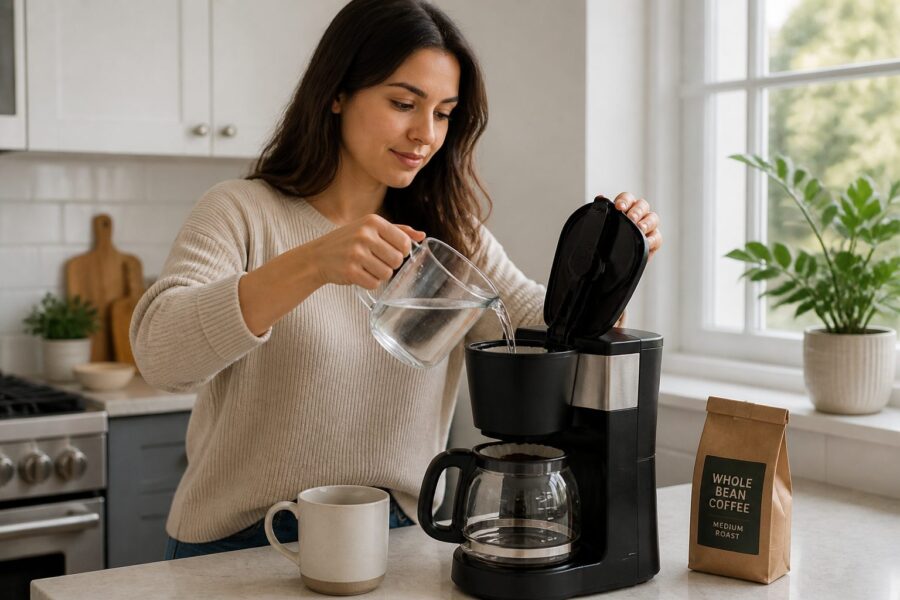
Making a smaller batch in a standard drip coffee maker is mostly a matter of measuring for the water you actually add, then checking how the machine handles that volume.
A half-full carafe does not always brew exactly like a full one, so start with the machine’s own markings and adjust the coffee to match.
The useful distinction is between the amount of water in the reservoir and the brewed coffee you expect in the carafe: grounds absorb some water, and cup markings may refer to smaller servings than a household mug.
Start with the brewer’s minimum batch guidance
Read the manual or markings for your specific machine before choosing a small batch size.
Some brewers are designed to make several cups at once, while others have a setting or process intended for smaller amounts.
If the manufacturer lists a minimum water level, use that as the starting boundary rather than filling below it.
A small amount of water may not distribute through the brew basket as intended in every machine, and the manual is the reliable place to check.
Look for a small-batch mode, a half-pot option, or a brew-strength setting, but treat these as machine-specific controls rather than universal features.
When no such setting exists, keep the batch within the brewer’s marked range and observe the result before changing multiple variables.
Measure water and coffee for the amount you want
Use the carafe or reservoir markings to determine how much water you are brewing, then weigh the grounds if you have a scale.
A scale makes it easier to repeat a batch because spoonfuls can differ with grind, roast, and how tightly the coffee is scooped.
If you prefer scoops, use the same scoop and fill it consistently each time.
The common kitchen tablespoon is a volume measure, not a fixed coffee mass, so a scoop-based recipe is best treated as your own repeatable starting point rather than a precise standard.
A simple ratio calculation can scale a recipe: if a full-batch recipe uses a particular amount of coffee for a particular amount of water, multiply both quantities by the same fraction to make a smaller batch.
For example, halving both ingredients preserves that recipe’s ratio; it does not guarantee the brewer will extract the smaller batch identically.
| What you change | What to keep consistent | What to observe |
|---|---|---|
| Batch size | Coffee-to-water proportion | Whether the cup tastes weaker or stronger |
| Grind setting | Coffee dose and water amount | Brew duration and visible flow |
| Brew setting | The same beans and batch size | Whether the machine changes its cycle |
Why a small batch can taste different
A drip machine moves water through a bed of grounds over a timed cycle, and reducing the amount of water does not necessarily shorten every part of that cycle in proportion.
Spray pattern, basket shape, heating behavior, and the machine’s programming all affect what happens.
Basket geometry matters because a shallow bed of coffee may receive water differently from a deeper bed.
The brewer’s shower head may also distribute water over a fixed area, so test the machine as designed instead of assuming that every full-pot recipe scales perfectly.
Small servings can cool quickly in a broad carafe, especially if the pot sits on a warming plate.
Pouring soon after brewing may preserve the flavor better than leaving a small amount to stand, though taste and equipment differ.
Adjust one variable at a time
If the result is too weak, first confirm that the amount of coffee matches the water you added.
If the amount is right, a slightly finer grind or a modest increase in coffee may be worth testing, but change only one thing so the effect is clear.
If the cup tastes harsh or dry, do not automatically add more coffee.
Check whether the grounds are unusually fine, whether the brewer is clean, and whether the coffee has been sitting on heat; any of these can change the impression of the finished cup.
Keep a short note of the water volume, coffee amount, grind, and result.
A line such as “three marked cups, same beans, slightly finer grind” is enough to make the next brew a useful comparison instead of another guess.
A practical routine for a half pot
If the carafe has several serving lines, choose one and use that same line in future tests instead of switching between markings and poured mugs.
A household cup may hold more than the brewer’s labeled serving, so the water line and the number of people are not always a one-to-one match.
Once the serving line is settled, weigh or scoop the grounds consistently and judge the brewed amount after accounting for what the grounds retain.
- Check the manual for a minimum fill level or small-batch setting.
- Measure water using the brewer’s own carafe or reservoir markings.
- Scale the coffee amount from a recipe you already enjoy, keeping the same proportion as a starting point.
- Use a consistent grind and distribute the grounds evenly in the basket.
- Brew, pour a cup soon after completion, and record how it tastes.
- Change one variable on the next batch if the balance needs adjustment.
For two people, the same approach applies: decide how much coffee each person actually wants, add those servings together, and measure the water and grounds for that total. “Cup” markings vary, so the carafe’s graduation is more useful than assuming it means a standard mug.
Common small-batch mistakes
Filling the reservoir below the machine’s recommended line is one avoidable problem.
Another is using the full-pot coffee dose with half the water, which produces a much stronger proportion than intended.
Changing grind size, dose, and water level all at once makes it hard to tell what helped.
Likewise, judging a small batch only after it has been sitting on a hot plate can confuse brewing issues with holding time.
Do not assume a “four-cup” label means four large mugs; serving sizes on coffee makers are not always the same as the cups used at home.
Check the actual water volume or marked carafe levels on your own brewer.
When another brewing method may be easier
If your machine performs poorly below its minimum batch, a single-cup dripper or another brewer sized for one or two servings may be simpler.
That is a question of fit and routine, not a claim that one method makes better coffee for everyone.
A small drip batch can still be convenient when the brewer supports it and the recipe is measured consistently.
The best first experiment is modest: choose a supported volume, preserve a familiar coffee-to-water proportion, and taste before making a second change.
Check the machine’s minimum fill guidance, measure the water for the amount you want, and scale the coffee from a ratio you already like. Brew within the brewer’s marked range and adjust one variable after tasting.
Add the servings each person wants, then measure water and grounds for that total. Use the brewer’s markings because its “cup” size may not match a household mug.
Often, but the suitable minimum batch depends on the brewer. Check its manual or settings, keep the coffee-to-water proportion consistent, and assess the result before changing grind or dose.