
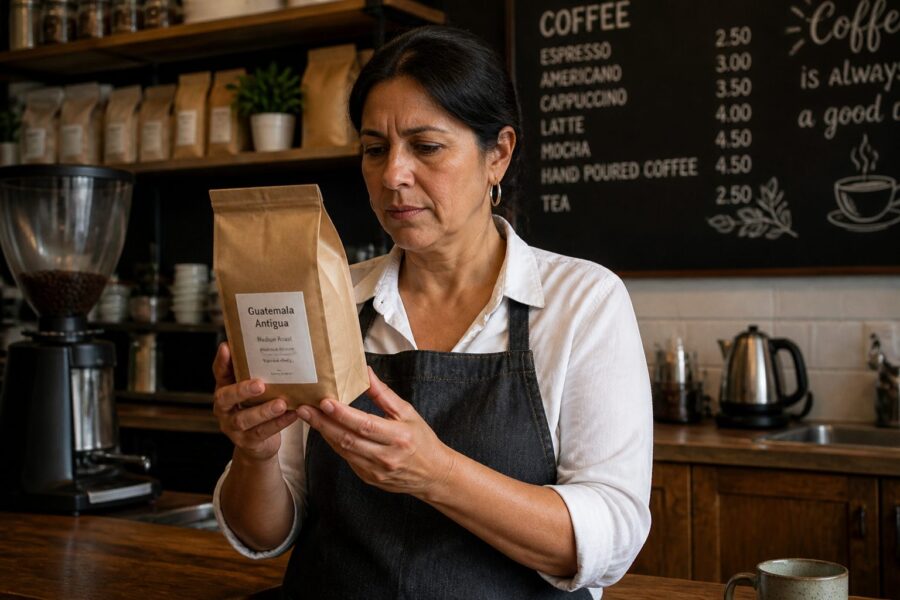
Coffee bean labels can tell you where a coffee came from, how it was processed, how it was roasted, and what flavors the roaster associates with it.
They are useful clues, not guarantees that the brewed coffee will taste exactly like the description.
Learning how to read coffee bean labels is less about memorizing industry terms and more about asking what each detail helps you decide.
Start with origin and process for context, then use roast information, tasting notes, and dates to decide whether the bag sounds suited to your preferences and routine.
Begin with the origin information
A label may name a country, region, growing area, farm, cooperative, producer, or processing mill.
More detail can identify a narrower source, but a short label is not automatically a sign of poor coffee; roasters choose different levels of detail and may have different information available.
Country names help orient you to a broad origin, while a region or farm name narrows the place described.
If the label gives a producer or cooperative, that identifies a person or organization connected with the coffee rather than predicting the flavor by itself.
Origin descriptions are not tasting instructions.
Coffee from the same country can differ because of variety, growing conditions, harvest, processing, roasting, and brewing, so avoid treating a map label as a promise of a fixed profile.
Some bags list elevation, sometimes using meters or feet above sea level.
That is a growing-location detail, but it does not work as a simple quality score or let you know on its own whether you will enjoy the cup.
Understand processing terms
Processing describes steps used after coffee cherries are harvested to separate and prepare the seeds for drying and later roasting.
The label may use words such as washed, natural, or honey to describe a broad approach.
A washed process generally refers to removing fruit material before drying, while natural processing dries the coffee with more of the fruit still around the seed.
Honey processing uses a method in which some sticky fruit material remains during drying; the name does not mean honey has been added.
These are broad descriptions, and practices can differ by producer and mill.
A process term gives context for how the coffee was handled, but it cannot tell the whole story of a particular lot or guarantee one specific flavor.
If you are comparing two bags, note the process alongside origin and roast rather than reading it alone.
One coffee’s process can be interesting to compare with another, but different beans and roasting choices make direct predictions unreliable.
Read roast information as a guide, not a strict scale
Light, medium, and dark are common roast descriptions, yet labels are not always standardized across roasters.
One company’s medium roast may not match another company’s idea of medium, so the label works best as a rough orientation.
A lighter roast is often described as preserving more of the bean’s distinctive character, while a darker roast may bring more pronounced roast flavors.
These are general expectations, not rules that every coffee follows.
Words such as breakfast, espresso, or French roast may refer to a style or intended use rather than a regulated roast measurement.
Read the roaster’s own description and consider how you prepare coffee at home.
If you already know that you enjoy a certain roast style, use that preference as a starting point.
If not, a medium-style option can be a practical place to begin, but it is not guaranteed to be the right choice for every brewer or palate.
Treat tasting notes as descriptive language
Labels may mention flavors such as citrus, chocolate, berry, or caramel.
These notes usually describe impressions perceived in brewed coffee; they do not mean those ingredients were added to the beans.
People can taste the same coffee differently, and brewing changes what stands out.
A citrus note on a bag does not mean the cup will taste like juice, and a chocolate note does not mean the coffee contains chocolate.
Use tasting notes to decide whether a general direction sounds appealing, not to judge your brewing against an exact checklist.
If you do not notice the named flavor, the coffee may still be enjoyable and the label is not necessarily inaccurate.
When a label gives several notes, look for the broad family that attracts you rather than expecting every note to appear at once.
A description is a compact way to set expectations, not a precise sensory test.
Check the roast date and package details
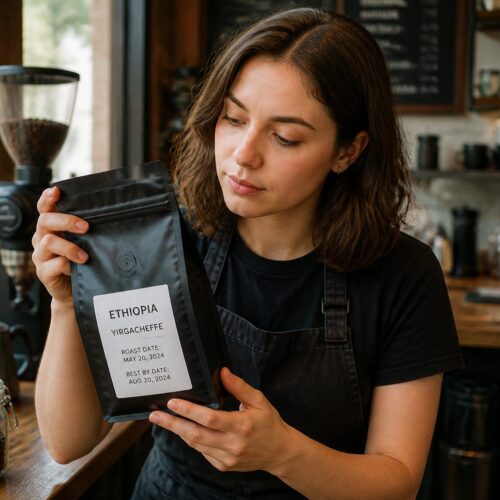
A roast date tells you when the beans were roasted, if the roaster chooses to print it.
A best-by date has a different purpose: it is the producer’s guidance about the packaged product, and it is not interchangeable with a roast date.
When comparing bags, look for the same kind of date on each.
A printed roast date can help you understand how recently the coffee was roasted, while a best-by date alone does not reveal the roast day.
The label may also show net weight, a lot name, a suggested brew method, or a grind selection.
These practical details tell you what is in the package and how the seller frames its intended use, but you can still prepare the coffee with a different method if the grind and equipment fit.
Check whether the package contains whole beans or ground coffee before buying.
Ground coffee can be convenient when you do not have a grinder, while whole beans let you choose when and how to grind them.
A simple way to compare two bags
When two labels compete for your attention, compare like with like and separate concrete information from flavor suggestions.
This small checklist makes the details easier to use:
- Note the origin detail that matters to you, such as country or region.
- Look for a processing term and treat it as context, not a flavor guarantee.
- Compare roast descriptions while remembering that roasters use their own conventions.
- Read tasting notes as impressions rather than added ingredients.
- Check whether the package gives a roast date, a best-by date, or both.
- Confirm whole bean or ground format and any stated grind size.
Imagine one bag lists a country, washed process, medium roast, and citrus notes, while another names a farm, natural process, and a darker roast.
The second label provides more source detail, but that alone does not make it a better match; your preferred roast and the brew method you use may matter more.
For a first purchase, make one or two details your priority.
A reader who dislikes smoky roast flavors might pay attention to roast description, while someone curious about processing could use that term to guide a comparison.
What labels cannot tell you
A bag cannot predict exactly how a coffee will taste in every kitchen.
Water, grinder, recipe, storage, and personal sensitivity all affect the cup, and labels compress a complicated product into a small space.
Terms such as specialty, direct trade, or single origin can have different uses in the market and on individual labels.
Read the explanation attached to a specific bag rather than assuming every seller uses a term in precisely the same way.
If a detail is missing, do not fill the gap with an assumption.
A label that names a country but not a farm may simply be giving a broader origin description, and the absence of a roast date does not reveal when roasting occurred.
Questions about coffee bag labels
It may identify origin, processing, roast style, tasting notes, package weight, and date information. Each detail offers context, but none guarantees exactly how the brewed coffee will taste.
Origin helps identify where the coffee was grown and can make bags easier to compare. It is useful context, not a stand-alone prediction of quality or flavor.
It describes broad steps used to prepare coffee seeds after harvest, such as washed, natural, or honey processing. The term does not mean flavor is guaranteed or that ingredients were added.