
Coffee filter sizes are easiest to choose by matching the filter’s shape and dimensions to the brewer, not by number alone.
Cone and basket filters are formed differently, and size labels such as #2, #4, or a manufacturer’s model code are not interchangeable across every brand.
The brewer’s manual or filter markings are the safest starting point because a filter that is too small may not sit securely, while one that is too large can fold, collapse, or interfere with the basket.
Check the shape first, then the size specified for that brewer.
Cone and basket filters are different shapes
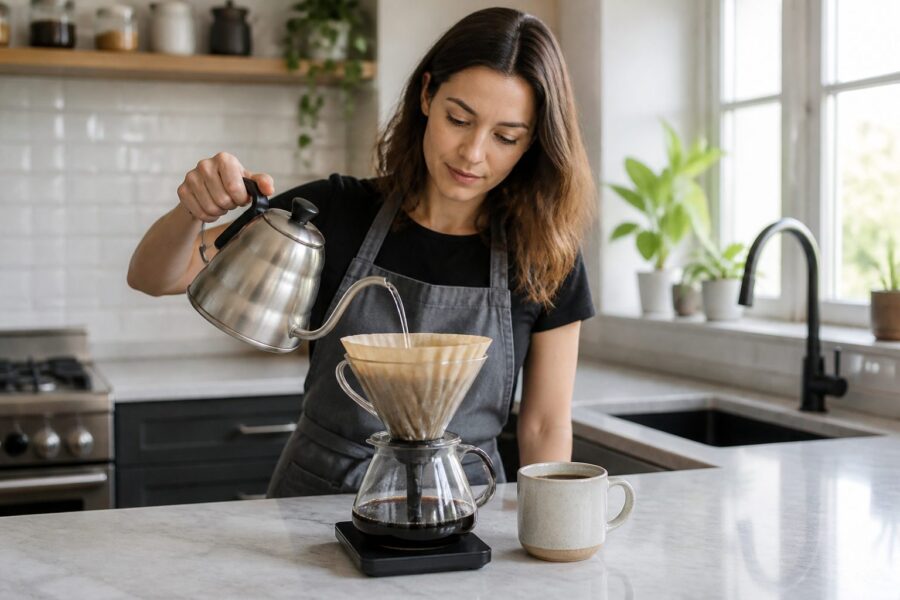
A cone filter narrows toward a point and fits a conical holder.
It is used in many pour-over drippers and some automatic coffee makers.
The cone’s angle and height affect how it sits in the brewer, so a generic cone shape does not guarantee a fit.
A basket filter has a broad, flatter base and sides that rise around it.
Many automatic drip machines use a basket-style holder, but the basket’s diameter and depth still determine which filter size is appropriate.
Some brewers use wave-shaped, flat-bottomed, or proprietary filters.
Those shapes may resemble a familiar cone or basket but have different dimensions or folds.
When a brewer uses a specific filter format, do not assume that another shape will sit correctly just because it looks close.
What filter numbers usually tell you
Numbers on paper filters generally identify a product size or intended brewer range within a particular filter system.
They are helpful when the filter brand and brewer use the same sizing convention, but a number is not a universal inch measurement shared by every manufacturer.
In common cone-filter listings, #2 and #4 appear frequently, and #4 is generally larger than #2 in that convention.
However, packaging guidance differs by manufacturer and brewer, so confirm that the listed size fits your particular dripper or coffee maker.
A #6 designation may also refer to a larger filter in some product lines, but size labels across brands should not be compared without checking the packaging.
The brewer model or a specified compatible filter is more reliable than a number viewed in isolation.
| Filter detail | What to check | Why it matters |
|---|---|---|
| Shape | Cone, basket, flat-bottom, or brewer-specific | The filter must match the holder’s geometry |
| Size label | Brand’s package and brewer manual | Numbers can vary between product systems |
| Capacity range | Manufacturer’s stated brewer compatibility | A filter needs enough height and width for the holder |
| Material | Paper, metal, or cloth instructions | Fit and cleaning needs differ by material |
How to identify the right size for your brewer
Start with the model name or number printed on the coffee maker, dripper, or its manual.
Look for a filter recommendation from that manufacturer, then compare the exact product description on the filter package.
If you no longer have the manual, examine the holder’s shape and dimensions and compare them with the filter package’s fit guidance.
Measuring the holder can narrow the search, but measurements alone may not capture folds, depth, or the way a filter is meant to rest.
For a reusable filter, check both the outer dimensions and the material-specific fit instructions.
A metal mesh basket may have a different form from a paper filter intended to fit the same brewer, and cleaning requirements vary by model.
- Identify the brewer type and, if available, its model number.
- Determine whether its holder is cone-shaped, basket-shaped, flat-bottomed, or proprietary.
- Check the manual or manufacturer’s filter compatibility information.
- Compare the filter package’s size and intended brewer range with that guidance.
- After fitting it, confirm the filter sits open and stable before adding coffee.
Can you substitute one size for another?
Sometimes a filter in a neighboring size may physically fit, but an improvised fit can fold over the edge or leave gaps around the holder.
Those problems can allow grounds to escape or make water flow unevenly, so an apparent fit is not always a suitable one.
A too-small filter may not reach the holder’s rim.
A filter that is too tall can collapse inward or fold over itself when the basket is closed.
Do not force a filter into a machine if it blocks a lid, basket, or spray area.
If you have only a different size on hand, compare it with the holder while the brewer is cool and dry.
If it does not sit securely without being held in place, use a compatible filter instead of trying to stabilize it during brewing.
Filter size and brewing results
The number printed on the filter does not directly tell you how the coffee will taste.
The filter’s shape and fit can affect how water moves through the grounds, while grind size, coffee quantity, water amount, and the brewer’s design also shape the brew.
Paper filters, metal filters, and cloth filters differ in material and care.
Their compatibility and flow behavior are not determined by size alone, and a reusable filter needs the cleaning routine specified for its design.
A filter that fits properly helps the brewer function as intended.
If coffee overflows or grounds appear in the cup, check that the filter is compatible and correctly seated, then consult the brewer’s directions before changing the recipe.
Paper, reusable, and specialty filters
Paper filters are disposable and come in multiple shapes, sizes, and paper types.
Some are pre-folded; others need a seam folded before placement.
Follow the package or brewer directions so the filter does not spring open or sit unevenly.
Reusable metal and cloth filters may be marketed for a particular dripper or machine.
Their shape can be built into a frame, and the material needs cleaning after use.
Check the maker’s fit guidance and care directions rather than treating reusable filters as universal replacements.
Pod and capsule systems usually use their own containers or filters and are not sized like standard cone or basket papers.
Espresso machines also use baskets designed for their portafilters, so household drip-filter numbers do not determine their compatibility.
A simple fit check before brewing
Set the dry filter into the empty holder and check whether its rim follows the holder without large gaps or folded sections.
Confirm that a lid or shower head can close or sit in position normally, then remove the filter and prepare the brewer as directed.
If you are between two sizes, do not guess from the number.
Use the brand’s compatibility information or the brewer manual, because shape and manufacturer conventions matter as much as the printed label.
The reliable rule is simple: match the filter to the holder, then confirm the package or manual supports that match.
Size charts are useful for narrowing options, but the model-specific fit takes precedence.
In common cone-filter labeling, #4 is generally larger than #2, but numbers are not a universal measurement across every brand. Check the package and brewer compatibility information.
Common packages use labels such as #1, #2, #4, or #6, while some brewers use model-specific sizes. The available range depends on filter shape and manufacturer.
Both labels refer to product sizes within particular filter systems, and #6 may be larger in some product lines. Compare the manufacturer’s stated dimensions or brewer fit rather than assuming labels mean the same thing across brands.