

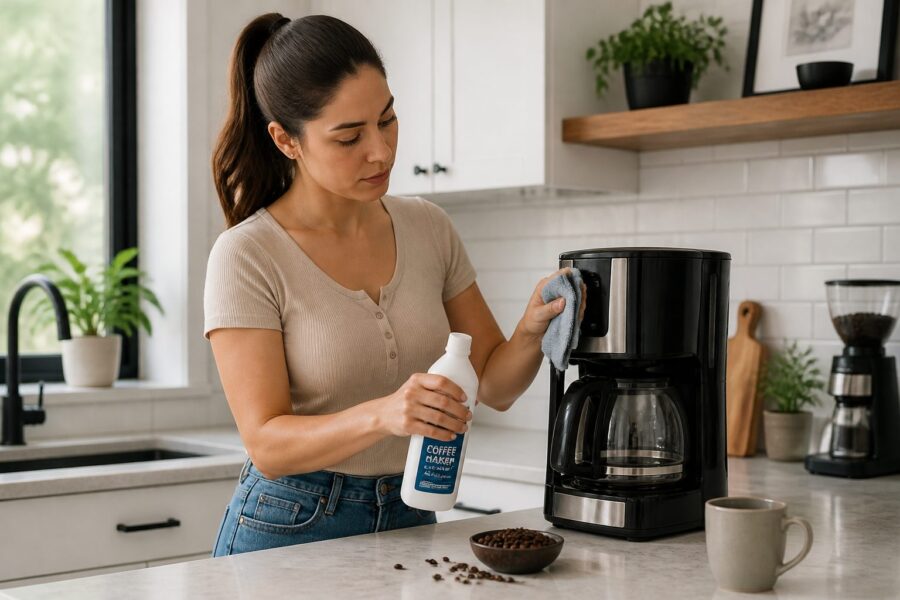
A useful coffee equipment cleaning routine separates quick cleanup after brewing from deeper care that depends on the tool.
A French press, grinder, drip machine, and espresso machine do not collect the same residue, so one calendar cannot sensibly prescribe identical work for all of them.
Use daily habits to remove fresh grounds, coffee oils, and milk residue, then check each appliance’s manual before using a cleaner, taking a component apart, or setting a descaling interval.
The schedule below is a starting framework, not a substitute for model-specific instructions.
Why a single cleaning schedule does not fit every coffee tool
Coffee residue changes with the way a tool is used.
A carafe can hold brewed coffee and oils, a grinder retains dry particles around its burrs or chute, and a milk wand needs attention as soon as milk has been steamed.
Water hardness, brew frequency, and design also matter.
A household making one pot a day has a different cleaning load from one pulling repeated espresso shots, while a removable part may be easier to wash than an enclosed assembly.
Treat the manual as the authority for materials, approved cleaning products, removable parts, and maintenance intervals.
If it conflicts with a generic schedule, follow the manufacturer’s direction.
A practical coffee equipment cleaning routine
| When | Common task | Tools it may apply to |
|---|---|---|
| After each use | Discard grounds, rinse or wash removable brewing parts, and wipe visible spills. | French press, pour-over dripper, carafe, coffee scale |
| After steaming milk | Purge and wipe the steam wand as the machine manual describes. | Espresso machine with a steam wand |
| Regularly, based on use | Brush loose grounds from accessible grinder areas and inspect for buildup. | Coffee grinder |
| At the interval in the manual | Clean internal coffee paths or descale only with an approved method. | Drip brewer, espresso machine, kettle |
The schedule is intentionally flexible: the equipment maker may specify a different sequence, product, or interval.
A machine’s cleaning alert, if present, is another cue to check the manual rather than guess at a chemical or cycle.
What to clean after each brew
For a French press or pour-over, remove the used grounds promptly, rinse the brewer and filter, and wash removable pieces according to their material and care instructions.
Let parts dry fully before storing them if the manual recommends air drying.
Empty a carafe rather than leaving brewed coffee in it for long periods, then wash the vessel and lid with a method suitable for their material.
Pay attention to seams and lids where coffee film can collect.
For an espresso machine, clean the portafilter and basket after use and follow the machine’s directions for the group area.
If milk was steamed, clear milk from the wand immediately using the maker’s specified purge and wipe routine.
Wipe splashes from the counter and equipment exterior with a clean, suitable cloth.
Keeping wet grounds and milk off the work area makes the next use easier and prevents residue from being overlooked.
Weekly checks for grinders and reusable parts
A grinder benefits from brief, regular attention because ground coffee can remain around the burr chamber, adjustment ring, or exit chute.
Unplug an electric grinder before any permitted cleaning, and remove only the parts the manufacturer identifies as user-serviceable.
Use a dry brush or other cleaning method only if the instructions allow it.
Do not add water, detergent, or cleaning pellets to a grinder unless its manufacturer permits that specific method.
Inspect reusable filters, press screens, and seals for trapped grounds or visible coffee oil.
Rinse and clean them using the care instructions for the material, since a fine mesh or coated surface may need different handling from a glass carafe.
- Check whether removable parts are dishwasher-safe before putting them in a dishwasher.
- Look for grounds caught in filter seams, screens, or gaskets.
- Reassemble only after parts are clean and dry as directed.
- Stop if a part is damaged, loose, or difficult to remove rather than forcing it.
When a coffee maker needs a deeper clean
A brewer may need more than washing its basket and carafe.
Mineral deposits can build up in water paths, but the interval and approved descaling product vary by appliance and water conditions.
Check the care section for the exact cleaning cycle, product, dilution, and rinse steps.
Some models call for a branded descaler or a particular sequence; others caution against certain household acids.
A slower brew, a maintenance light, or visible scale can be a reason to consult the manual, but these signs do not identify a universal remedy.
Use the procedure specified for the model rather than trying several cleaners in succession.
Vinegar and descaler are not automatically interchangeable
Vinegar appears in many general cleaning suggestions, but that does not make it suitable for every coffee machine.
A manufacturer may warn that vinegar can affect materials, leave an odor, or fail to match the machine’s required maintenance process.
A descaler is intended for mineral deposits, yet products differ and an appliance may specify one formulation.
The relevant question is which method the manufacturer approves for that model.
Do not combine cleaning products, and do not improvise a stronger mixture.
Follow the stated amount and rinse procedure, especially for parts that contact drinking water.
Common mistakes that make upkeep harder
- Using a universal monthly schedule without checking how often the appliance is used or what its manual says.
- Putting a removable part in a dishwasher before confirming that it is dishwasher-safe.
- Pouring liquid into a grinder or machine opening that the manufacturer does not identify for cleaning.
- Descaling with vinegar or another household cleaner despite a model-specific warning.
- Reassembling equipment while a screen, seal, or removable component is still wet when the instructions call for drying.
- Using abrasive tools on a surface that may scratch or lose a coating.
When in doubt, pause and identify the model before cleaning its internals.
A careful check is quicker than replacing a damaged part or troubleshooting a machine after an unsuitable cleaner has been used.
If coffee spills into a grinder tray or onto a machine base, unplug electrical equipment when its instructions call for it before wiping an accessible surface.
Use a dry or lightly damp cloth only where the manual permits, and keep liquid away from openings, controls, and electrical connections.
For a press or dripper, remove wet grounds before they dry onto a screen or filter seam, where residue can take more effort to clear later.
Small cleanup immediately after brewing is easier to repeat than an occasional aggressive scrub that risks damaging a part.
Questions about equipment cleaning are best answered by combining the tool’s design, the residue involved, and its maker’s care directions.
Questions about cleaning coffee equipment
Wash removable brewing parts and deal with fresh grounds after use, then follow the machine manual for internal cleaning and descaling intervals. Frequency varies with the appliance, water, and how often it is used.
Use only the cleaner and cycle approved in that model’s manual. Some machines specify a descaler or built-in cleaning cycle, and others give different directions, so a universal mixture is not reliable.
Vinegar and descaler are not interchangeable for every machine. Check the manual for the approved cleaner before running any solution through the appliance.