
Predicting crop yields with accuracy is a constant challenge for farmers, agronomists, and market analysts alike. Traditional methods often rely on historical averages or simple visual assessments, which offer limited foresight into the complexities of crop development. We need better tools to understand what influences our harvests.
Precision agriculture demands more sophisticated approaches, moving beyond guesswork to data-driven insights. This article explores how combining advanced soil analysis techniques with atmospheric information can revolutionize our ability to predict future yields. The goal is to create a robust soil spectroscopy climate data yield forecasting system that truly benefits growers.
Integrating diverse datasets provides a clearer picture of crop potential, allowing for more informed decisions on everything from planting to harvest. This powerful synergy between ground-level detail and sky-high trends offers a path toward significantly improved soil data crop yield prediction.
Why Soil Data Alone Is Insufficient for Reliable Yield Estimates
Soil is undoubtedly the foundation of agriculture, providing nutrients, water, and physical support for plants. Detailed soil data offers a snapshot of these conditions, informing decisions about fertilization and irrigation. However, a static understanding of the soil cannot fully capture the dynamic environment where crops grow.
A field might have optimal nutrient levels at planting, but if a severe drought hits mid-season, those nutrients become inaccessible. Conversely, poor initial soil conditions could be mitigated by timely rainfall and careful management, leading to unexpected success. These external factors introduce significant variability.
Yield is heavily influenced by atmospheric conditions like temperature, precipitation, and sunlight hours, not just what’s in the ground. Ignoring these atmospheric elements leaves a huge gap in any yield forecast.
Low organic matter in soil tests might suggest amendments, but its immediate yield impact can be overshadowed by unseasonably cold springs or prolonged dry spells. The interaction is far more complex than a single variable can explain.
Relying solely on soil information provides an incomplete model of plant physiology and environmental stress. Plants respond to a multitude of atmospheric stimuli. Accurate soil data crop yield predictions require considering the weather.
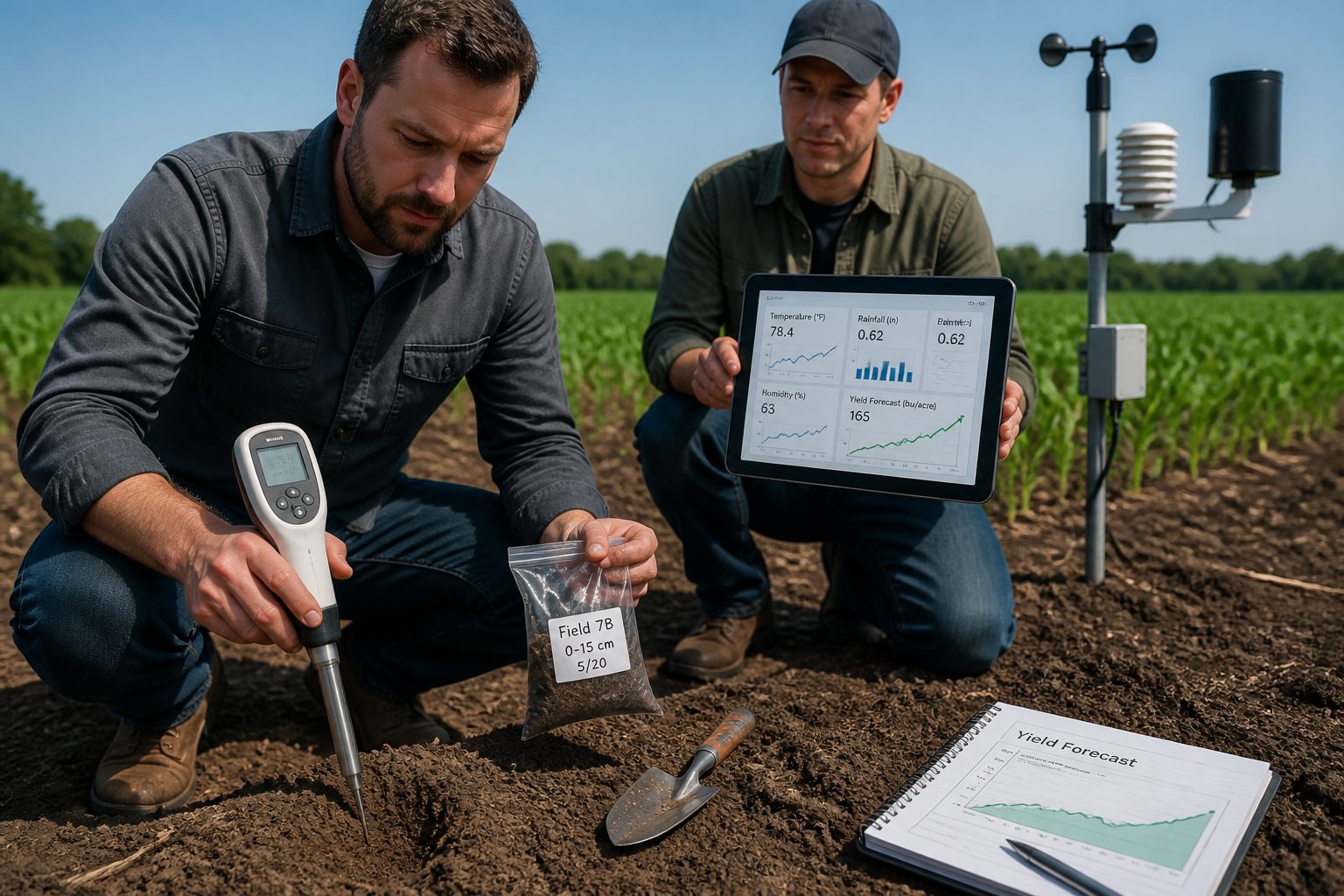
Farmers know this instinctively from years of experience watching their fields. They know that good soil can only do so much if the rain does not come or if temperatures soar too high. Our predictive models must reflect this real-world understanding.
Even advanced soil spectroscopy, while providing rapid and comprehensive soil property assessments, only tells part of the story. It characterizes soil’s physical and chemical makeup but cannot predict future rainfall. Climate data integration is essential here.
Without incorporating climate trends and short-term forecasts, any yield projection remains vulnerable to major inaccuracies. It’s like predicting a football game by only analyzing one team, ignoring the opponent and game-day weather. The result is often wrong.
The temporal aspect of plant growth further complicates things when using only soil data. Soil conditions can change slowly over seasons, but crop development happens on a daily or even hourly basis, reacting to immediate environmental cues. These rapid changes are driven primarily by climate.
Therefore, a comprehensive approach to yield forecasting must marry foundational soil insights with the dynamic influence of the atmosphere. This combined perspective offers a much more robust and reliable prediction. We need both enduring soil characteristics and fleeting weather patterns to truly understand crop potential.
How Spectroscopy-Derived Soil Properties Feed Crop Models
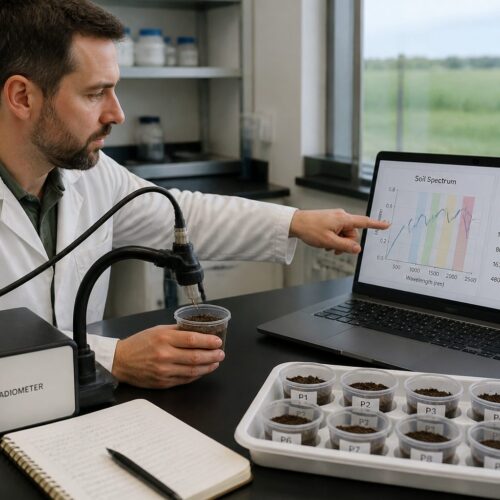
Soil spectroscopy rapidly and non-destructively characterizes soil properties. It measures light interaction with soil samples, providing a spectral signature correlating with chemical and physical attributes. This offers a swift alternative to time-consuming, expensive wet chemistry methods.
Spectroscopy-derived soil properties feed directly into advanced crop models as critical input parameters. For instance, soil organic carbon, easily determined spectrally, influences nutrient cycling and water retention, helping models simulate nutrient availability.
Other vital properties like clay content, pH, and cation exchange capacity (CEC) are also precisely measured through spectral analysis. Crop models use these parameters to simulate soil texture, nutrient holding potential, and overall soil health. This provides a detailed, spatially explicit understanding of the growing environment.
Integrating this rich soil data allows crop models to simulate plant growth more realistically. For example, a model can estimate how varying soil moisture, influenced by texture and organic matter, affects crop water uptake, informing better irrigation management.
Soil spectroscopy’s speed enables high-resolution mapping, creating detailed soil property maps. These maps facilitate precision agriculture forecasting by accounting for within-field variability, allowing farmers to apply inputs precisely where needed.
Models can also use spectral data to predict nutrient availability for specific crops, like nitrogen, phosphorus, and potassium. This helps optimize fertilizer application rates, minimizing waste and environmental impact. Accurate nutrient information is a cornerstone for any reliable yield projection.
Soil spectroscopy climate data yield forecasting benefits from monitoring soil health changes over time. Repeated spectral scans track improvements in organic matter or compaction, feeding dynamic updates into crop models. This continuous feedback refines predictions as soil conditions evolve.
Crop models often include sub-models for root growth, nutrient uptake, and biomass accumulation, all sensitive to soil conditions. Spectroscopy provides the detailed inputs these sub-models require, preventing models from operating with too many assumptions.
This integration enhances the system’s predictive power, moving beyond generic soil type assumptions. Each field, and even zones within it, receives a tailored soil profile within the model. This personalization is key to true precision agriculture forecasting.
Rapid, accurate soil property characterization makes soil spectroscopy indispensable for modern crop modeling. It bridges general agricultural science with specific field conditions. This detailed soil understanding sets the stage for accurate yield forecasts when combined with other data.
Key Climate Variables That Interact With Soil Mineralogy
Climate variables significantly interact with soil’s fundamental mineralogy and properties, not just influencing crops in isolation. Understanding these interactions is essential for accurate soil spectroscopy climate data yield forecasting, as mineral composition dictates soil response to atmospheric conditions.
For example, clay minerals, a major soil component, greatly influence water retention and nutrient exchange. Precipitation patterns directly affect how much water clays absorb and release, impacting plant moisture access. Extreme rainfall can also lead to nutrient leaching, especially in sandy soils with low CEC.
| Climate Variable | Soil Mineralogy Interaction | Impact on Yield |
|---|---|---|
| Precipitation | Water absorption by clays, nutrient leaching | Water availability, nutrient stress |
| Temperature | Organic matter decomposition, mineral weathering | Nutrient release rates, microbial activity |
| Solar Radiation | Soil temperature, evaporation rates | Photosynthesis potential, water loss |
| Wind Speed | Erosion risk, surface drying | Topsoil loss, moisture stress |
| Humidity | Evapotranspiration rates, disease pressure | Water use efficiency, pathogen spread |
Platforms That Combine Spectral Soil Data With Weather Forecasts
The convergence of soil spectroscopy and climate data is now implemented by advanced precision agriculture platforms. These systems integrate diverse data streams, providing farmers with comprehensive, actionable insights for better decision-making.
Many ag-tech companies offer solutions ingesting high-resolution soil data (from spectral analysis) alongside real-time weather and future forecasts. These platforms use sophisticated algorithms to merge datasets, creating a powerful engine for soil data crop yield prediction.
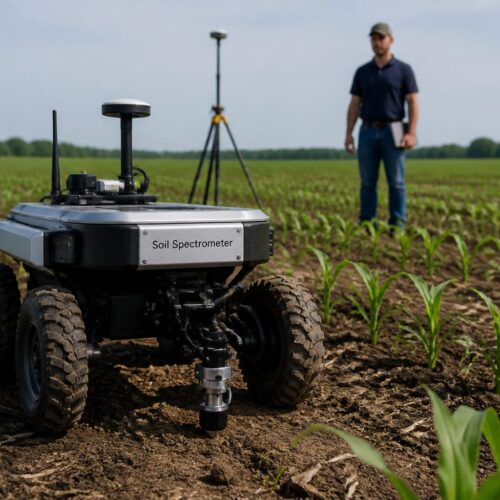
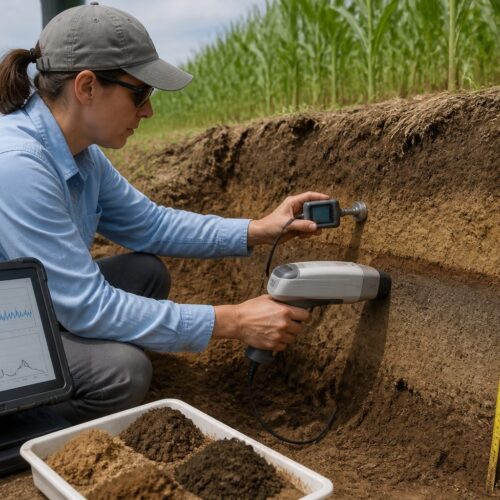
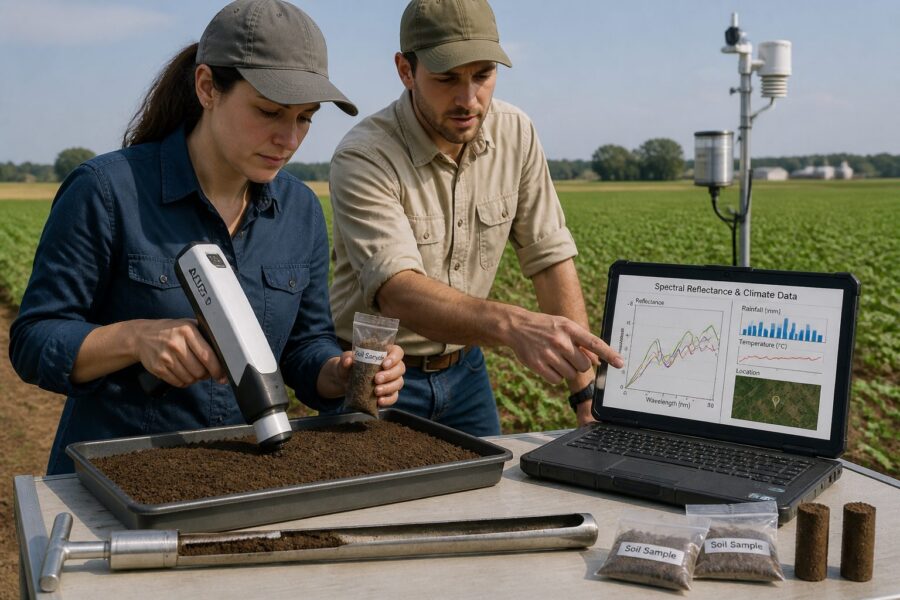
For example, some platforms integrate data from handheld or drone-mounted spectrometers that capture soil properties across a field. This spectral information, detailing organic matter, pH, and nutrient levels, is then combined with hyper-local weather station data. Farmers receive customized recommendations based on this combined analysis.
These systems typically feature user-friendly dashboards visualizing soil conditions alongside predicted rainfall, temperature, and growing degree days. This allows farmers to see how current and future weather might impact their soil, making complex data accessible and understandable.
Leading agricultural software providers are also building modules that specifically address spectroscopy climate integration. They often partner with meteorological services to access highly accurate weather models, which are then downscaled to field-level resolution. This ensures that the climate inputs are as precise as the soil data.
Some platforms incorporate satellite imagery and remote sensing to monitor crop health and growth, adding validation and real-time feedback to yield forecasting models. This combination of ground-truth soil data, atmospheric conditions, and crop canopy observations creates a truly holistic picture.
Platform outputs often include predicted yield maps, suggesting areas of higher or lower potential. They might also offer irrigation scheduling, nutrient application adjustments, or disease risk assessments based on combined data, empowering farmers to react proactively.
Companies like Taranis, Farmers Edge, and various university extension programs are at the forefront of developing and deploying these integrated solutions. They understand that the future of precision agriculture forecasting lies in synthesizing disparate data sources. Their work demonstrates the practical application of this advanced science.
These platforms often leverage cloud computing and machine learning to process vast amounts of data efficiently. They continuously learn from new inputs and outcomes, refining their predictive models over time. This iterative improvement means that soil spectroscopy climate data yield forecasting becomes more accurate with each passing season.
Choosing the right platform depends on a farm’s specific needs, existing infrastructure, and budget. However, the trend is clear: integrated solutions are becoming the standard for serious precision agriculture operations. They represent a significant leap forward in understanding and managing complex farming systems effectively.
These tools are not just about predicting the future; they are about providing the knowledge to shape it. By understanding the intricate connections between soil and sky, farmers gain unprecedented control over their operations. This leads to more sustainable and profitable outcomes.
Validation Studies: How Accurate Are Combined-Model Predictions?
The promise of combining soil spectroscopy with climate data for yield forecasting requires field validation. Numerous studies across diverse agricultural regions and cropping systems assess these combined models’ reliability, generally showing significant improvements over single-input approaches.
Researchers often compare integrated model predictions against actual harvested yields using R-squared values and Root Mean Square Error (RMSE). Studies frequently report R-squared values exceeding 0.70, sometimes 0.80, indicating models explain a large proportion of yield variability and strong correlation between predicted and actual outcomes.
A notable Midwest US study on corn and soybean showed models incorporating soil organic carbon from spectroscopy and seasonal precipitation forecasts achieved up to 15% greater accuracy than single-source models. This improvement was consistent across multiple growing seasons, providing a more robust estimate.
Another Australian validation effort, using spectral soil data and historical climate patterns for wheat, found the integrated system reduced prediction errors by nearly 20% compared to traditional field sampling and generalized weather data. This highlights the power of high-resolution, specific inputs; localized precision makes a real difference.
Accuracy varies depending on crop type, regional climate variability, and input data quality. Crops highly sensitive to water stress, like rice or certain vegetables, often show the most dramatic improvements when detailed soil moisture and rainfall forecasts are integrated. Crop sensitivity plays a large role.
Spatial resolution of soil spectroscopy data and climate forecasts impacts accuracy. Models using finer-scale soil maps and hyper-local weather predictions generally outperform those relying on broader regional data. Precision in data collection directly translates to precision in forecasting.
Validation is an ongoing process, with models continuously refined and re-calibrated as more data becomes available. This iterative approach helps account for new crop varieties, evolving climate patterns, and improved sensor technologies, aiming to make soil spectroscopy climate data yield forecasting systems even more reliable over time.
While perfect prediction remains an elusive goal, these validation studies strongly support the efficacy of spectroscopy climate integration for soil data crop yield prediction. They provide compelling evidence that combining these data sources offers a superior foundation for agricultural decision-making. The science clearly backs up the methodology.
Farmers can feel confident that investments in these advanced systems are supported by rigorous scientific validation. The improvements in accuracy translate directly into better resource management and increased profitability. This is not just a theoretical concept, but a proven method for enhancing agricultural outcomes.
The consistent findings across different geographies and crops underscore the universal applicability of this integrated approach. It represents a significant step forward in our quest for more predictable and sustainable food production. We are building a more resilient agricultural future.
Practical Steps to Connect Your Soil Scans to a Yield Model
Connecting soil spectroscopy data to a robust yield model is a practical, achievable goal for any farmer interested in precision agriculture. The process involves several key steps, each building upon the last to create a comprehensive forecasting system. You do not need to be a data scientist to get started.
First, invest in quality soil spectroscopy equipment and software generating reliable data on your field’s properties. This could be a handheld device for targeted sampling or a larger system for broad-acre mapping. Ensure data output is compatible with common agricultural software.
- Acquire reliable soil spectroscopy equipment
- Collect representative soil samples across your fields
- Process spectral data to derive key soil properties
- Choose a compatible crop modeling platform
- Integrate your soil data into the chosen platform
- Input historical yield data for calibration
- Connect to a reliable climate data source
- Regularly update both soil and climate inputs
- Interpret model outputs for actionable insights
- Adjust farming practices based on predictions
Limitations and Uncertainty in Multi-Input Forecasting Systems
While combining soil spectroscopy with climate data offers unparalleled advantages for yield forecasting, inherent limitations and uncertainties exist within these multi-input systems. No model can perfectly predict the future in complex biological and environmental systems; expectations must be managed realistically.
One major uncertainty stems from climate data itself. Weather forecasts, especially long-range seasonal predictions, always carry error. Extreme or unpredictable events like sudden hailstorms or unseasonal frosts can severely impact yields in ways even the best models struggle to anticipate. Nature still holds surprises.
Soil spectroscopy accuracy depends on calibration models used to translate spectral signatures into physical soil properties. These calibrations are often regionally specific; applying a model from one area to a vastly different soil type can introduce inaccuracies. Regular re-calibration and validation are necessary.
Crop models simplify incredibly complex biological processes, relying on assumptions about plant physiology, nutrient uptake efficiency, and stress responses. While sophisticated, they cannot fully capture every minute interaction within a living plant system. Real plants are more intricate than any algorithm.
Human factors also introduce variability. Farming practices like planting timing, irrigation, or pest control can significantly alter actual yields regardless of ideal soil and climate conditions. A farmer’s skill and responsiveness remain critical components of success.
Pest and disease outbreaks, which spread rapidly and cause extensive damage, are often difficult to predict and integrate into yield models. While some models attempt to incorporate climate-based disease risk, the exact timing and severity of an outbreak can be highly stochastic, posing significant challenges.
Input data quality and resolution significantly impact model reliability. Coarse-resolution soil scans or generalized climate forecasts naturally lead to less precise yield predictions than fine-grained, localized data. Garbage in, garbage out.
Computational demands for highly detailed multi-input models can be substantial, requiring significant processing power and expertise. This might limit accessibility for smaller farms or those with fewer technological resources, as implementation costs can be a barrier.
Despite these limitations, understanding them allows for more judicious use of the forecasting outputs. Farmers should view these predictions as powerful decision-support tools rather than infallible prophecies. They provide valuable guidance, not absolute certainty.
Ongoing research and development constantly strive to reduce these uncertainties through improved sensors, more sophisticated models, and better data integration techniques. We are always learning and refining our approaches; the journey towards perfect soil spectroscopy climate data yield forecasting continues.
Ultimately, while these systems are incredibly powerful, they are best used in conjunction with a farmer’s intuition and on-the-ground observations. The human element remains an irreplaceable part of successful agriculture. Technology should augment, not replace, experienced judgment.
Acknowledging these challenges helps set realistic expectations and encourages continuous improvement in forecasting tool development and application. Honesty about model capabilities builds trust and promotes smarter agricultural practices.
Conclusion
The future of agriculture hinges on smarter, more informed decisions, with precision agriculture forecasting leading the way. Combining detailed, ground-level insights from soil spectroscopy with dynamic climate data offers a powerful approach to predicting crop yields, providing a clearer picture of what a growing season might bring.
While challenges and uncertainties exist in predicting natural systems, the proven accuracy of these integrated models represents a significant leap forward. Farmers can leverage robust, data-driven predictions, optimizing inputs, managing risks, and achieving more sustainable, profitable harvests.
Embracing soil spectroscopy climate data yield forecasting cultivates a more resilient, efficient agricultural system for everyone. The tools are available, the science is strong, and the benefits for food production are undeniable. It is time to look to both the soil and the sky for our answers.