
Cold brew at home does not require a dedicated machine, since a jar, ground coffee, water, and a way to separate the grounds are enough, though the method you choose affects cleanup, sediment, and repeatability.
The main decisions are grind size, coffee-to-water ratio, steeping time, and straining, so keep those variables steady at first to tell whether a later change improved the cup.
What makes cold brew different from iced coffee
Cold brew is made by soaking coffee grounds in cool or room-temperature water for an extended steep before filtering, while iced coffee usually starts as hot-brewed coffee that is cooled or poured over ice.
Because the preparation differs, the drinks do not taste identical even with the same beans: cold brew can taste rounded and less sharp to some drinkers, while iced coffee keeps the character of a hot extraction, though beans and brewing choices still matter.
A home batch can be made at drinking strength or as a concentrate intended for dilution, so decide which you want before measuring because the water amount changes how you serve it later.
Choose a jar, French press, or dedicated brewer
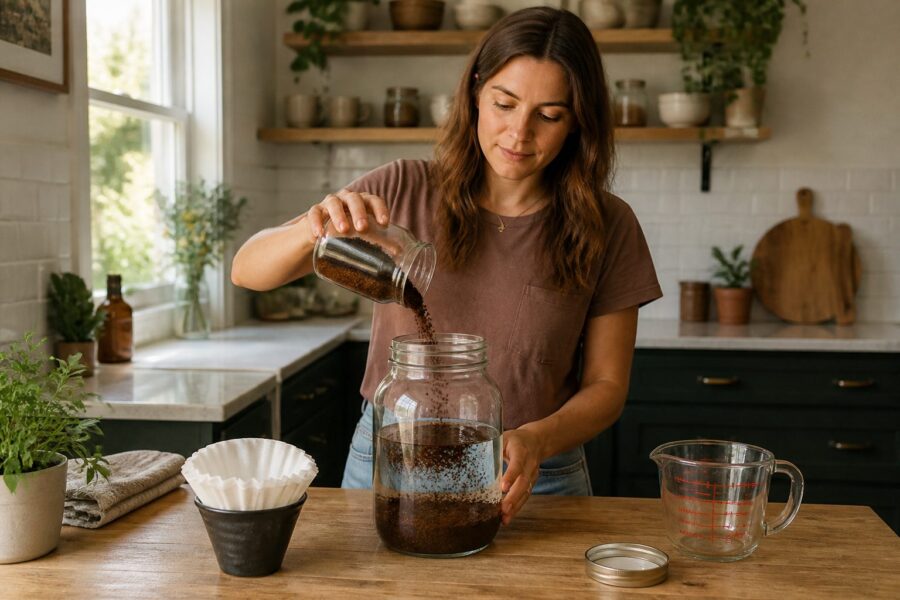
A clean jar or covered container is the simplest starting point because it holds the coffee and water during steeping, after which you pour the mixture through a separate filter.
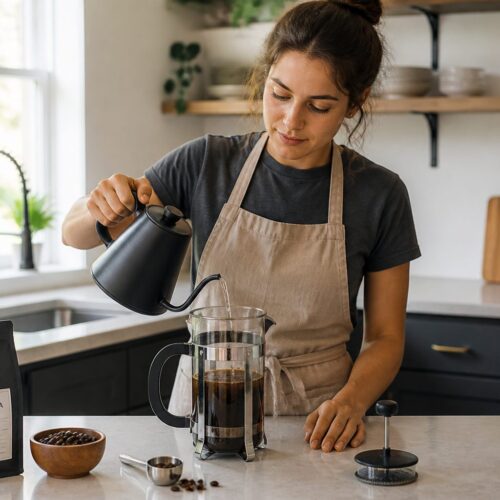
A French press combines steeping and straining in one vessel, and although its mesh plunger catches much of the coffee, very fine particles may pass through, so pour slowly and leave the cloudiest portion behind to limit sediment.
A purpose-built cold-brew brewer may include a removable filter basket that simplifies separation, but it is convenient rather than essential, so check its capacity and cleaning instructions before choosing a batch size.
| Method | Useful when | Tradeoff |
|---|---|---|
| Jar and separate filter | You want a flexible batch size | Requires a second straining step |
| French press | You already own one and want fewer vessels | Mesh may allow some fine sediment through |
| Dedicated brewer | You prefer a fitted filter and repeatable setup | Takes storage space and has a fixed capacity |
Use clean, food-safe equipment and avoid containers that held strongly scented ingredients, since lingering odors can carry into the coffee.
How to make cold brew coffee at home with ground coffee
Regular ground coffee works for cold brew, and a coarse grind is often easier to strain than a fine one because small particles can pass through mesh and slow filtering.
For a first batch, measure both ingredients by weight if you have a kitchen scale, using 1 part coffee to 8 parts water as a practical concentrate-style starting point rather than a universal rule.
- Add the measured coffee to a clean jar, French press, or brewer.
- Pour in cool or room-temperature drinking water, making sure the grounds are wet throughout.
- Stir gently to break up dry pockets without splashing coffee onto the container walls.
- Cover the container and let it steep undisturbed in a cool place or in the refrigerator.
- Strain the coffee through the brewer’s filter or a separate fine filter, then transfer the liquid to a clean container.
Write down the coffee amount, water amount, grind description, and steep location so the first batch becomes a routine you can adjust rather than a memory test.
Set a ratio and adjust the cup
The correct ratio for cold brew coffee depends on whether it will be served as brewed or diluted, and because recipes vary, treat a starting proportion as a reference rather than a universal standard.
For an easy calculation, multiply coffee weight by the water multiplier: a 1:8 ratio uses 400 grams of water for 50 grams of coffee, though the arithmetic does not guarantee a particular strength after filtering.
If the finished batch tastes too intense, dilute a serving gradually with water or milk, while a thin cup may call for less dilution or more coffee relative to water next time; change one thing per batch.
A small tasting test beats chasing a perfect number: pour a modest serving, add a little water, taste, and repeat until the balance suits you.
Steeping time, temperature, and grind
Cold brew is commonly steeped for many hours, but no single duration fits every grind, ratio, and preference, and a longer steep can change intensity and flavor compared with a shorter one.
Choose a repeatable steeping window and record the taste, checking whether the grounds were fully wetted and the ratio measured accurately before extending a weak batch’s steep.
Coarse grounds tend to be easier to filter, while a wide mix of particle sizes may leave more sediment through mesh than paper and make the batch seem harsher or cloudier.
Refrigerator and room-temperature steeping both appear in home recipes, so pick one approach and keep it consistent while adjusting other variables instead of changing temperature and time together.
Strain cleanly and store the finished coffee
With a jar method, pour slowly through a fine sieve or filter into a clean vessel, using paper to catch fine particles if you can wait for its slower drainage, and avoid pressing the grounds hard.
With a French press, lower the plunger gently without forcing it through the grounds, then pour the clearer liquid into a separate container and leave the cloudiest portion behind if sediment bothers you.
Keep finished coffee covered and refrigerated, use clean utensils, make an amount you expect to use promptly, and discard it if its smell or appearance changes because homemade batches vary with preparation and handling.
Store concentrate separately from additions and dilute only what goes into the glass, which keeps the remaining batch consistent and lets you adjust each serving.
Common problems and what to change next time
- Too much sediment: use a coarser grind, strain more slowly, or add a paper-filter step.
- A weak cup: check the measured ratio, confirm all grounds were wetted, or reduce serving dilution.
- A very intense cup: dilute the serving first, then consider a lower coffee proportion for the next batch.
- Slow filtering: use coarser grounds and avoid compacting them during straining.
- Inconsistent results: keep the method, steep location, and measurements steady while changing only one variable.
These adjustments are diagnostic rather than guaranteed fixes. The same coffee can behave differently with another grind, filter, or serving dilution, so make a small change and taste before revising the entire process.
If the grounds float or form a dry raft, stir gently once after adding water and check that no dry clumps remain before covering the vessel, since uneven wetting can leave parts of a batch tasting weaker than others.
For a batch that will be served over ice, taste it after adding ice because melting changes the drink’s strength; a concentrate gives you more room to adjust the serving without changing the stored coffee.
Frequently asked questions
Yes. Use regular ground coffee and water; a coarser grind is generally easier to filter than a fine grind, though the best choice depends on your equipment.
There is no single required ratio. A 1:8 coffee-to-water ratio by weight is one practical concentrate-style starting point, and you can adjust it to your taste and serving dilution.
Combine measured coffee and water in the press, cover it while it steeps, then lower the plunger gently and pour the clearer coffee into a separate container. Coarse grounds can make straining easier.