
Should coffee be stored in the refrigerator?
For most everyday coffee, a cool, dry cupboard is a simpler choice.
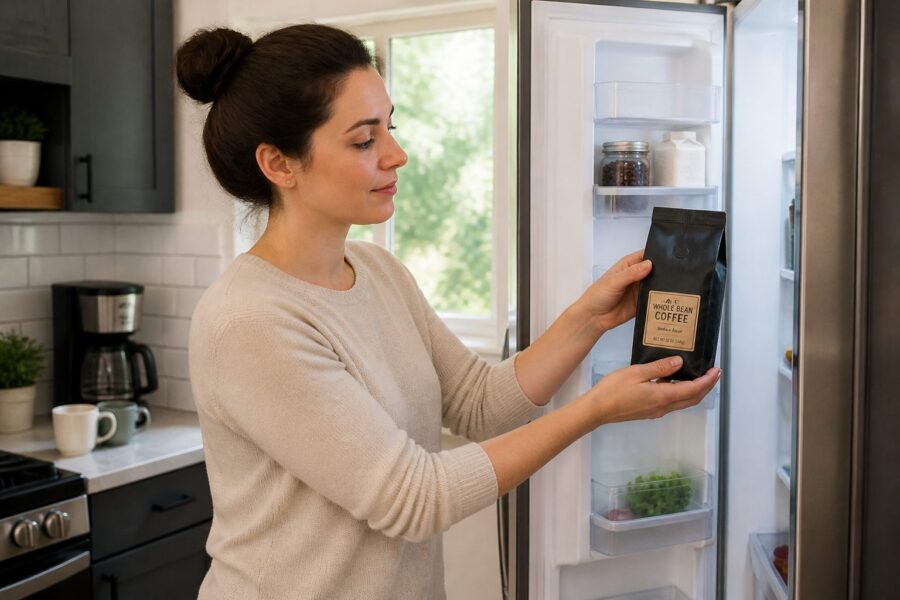
Refrigerators expose packages to changing temperatures and moisture, and coffee can pick up odors from nearby foods.
Freezing is a separate case: it can make sense for coffee you will not use soon, if it is sealed and handled in a way that limits condensation.
The answer depends on whether you mean whole beans, ground coffee, instant coffee, or brewed coffee.
Those are different storage questions.
This guide focuses on preserving the flavor of unopened or opened dry coffee, not on food-safety timing for a prepared drink.
Why refrigerator storage is usually discouraged
A refrigerator is opened throughout the day, so a coffee package may move repeatedly between cold storage and a warmer kitchen.
When cold packaging meets warmer air, moisture can condense on the package or nearby surfaces.
Moisture is unwelcome around dry coffee because it can soften grounds and interfere with flavor and texture.
Coffee can also absorb surrounding aromas.
An open bag or a loosely closed container in a refrigerator shares space with foods that have their own smells.
A tightly sealed package reduces exposure, but it does not make routine in-and-out storage especially convenient.
Light and air matter as well.
Clear containers near a refrigerator light or a bag left unsealed allow more exposure than a closed, opaque container in a cupboard.
The refrigerator does not solve those problems if the coffee is stored casually.
A good everyday place for coffee
Choose a dry cabinet away from the oven, sink, sunny windowsill, and other sources of heat or steam.
Keep coffee in its original package if it closes securely, or transfer it to a clean, dry, airtight container.
A dark cupboard is more useful than a decorative jar left on the counter.
Close the package promptly after taking out the amount you need.
Use a dry scoop, and avoid leaving the bag open while preparing a brew.
These habits limit exposure without requiring special equipment.
Buy a quantity that fits your pace of use when practical.
Ground coffee has more exposed surface than whole beans, so it is especially helpful to keep it sealed and use it promptly after opening.
The exact pace at which flavor changes depends on the coffee and package, so a universal freshness deadline would be misleading.
When freezing coffee may be useful
Freezing can be considered when you have more dry coffee than you expect to use soon.
The key is to protect it from air and moisture and avoid repeatedly warming and chilling the same large container.
Divide it into portions that suit your use, seal them well, and return the unused portions to the freezer.
A sealed package is easier to handle than an open bag.
If you freeze coffee in its original bag, check that the bag closes tightly and that it is protected from freezer odors.
An additional airtight container can provide another barrier if the package is not robust.
When taking out a portion, let the sealed package come to room temperature before opening it.
Opening cold coffee in warm, humid air can invite condensation onto the beans or grounds.
Avoid moving the same container in and out repeatedly; each cycle creates another chance for moisture and aroma exposure.
Freezing is not necessary for every bag.
If you use the coffee regularly and can keep it sealed in a cupboard, room-temperature storage is often more convenient.
Freezing works best as a deliberate way to store a portion for later, not as a daily storage drawer.
Whole beans, ground coffee, and instant coffee
Whole beans are less exposed to air than coffee that has already been ground.
Keep them sealed in a cool, dry, dark place and grind the amount needed for brewing.
If freezing a larger supply, portion it before storage so the main supply stays closed.
Ground coffee needs the same protection from air, moisture, heat, and strong odors, with particular attention to closing the package.
A refrigerator does not reverse the fact that grinding increases exposure.
Use the package’s closure or a clean airtight container rather than leaving grounds in an open bowl.
Instant coffee should be kept dry and closed according to its package instructions.
A damp spoon or steam entering the jar can create clumps.
Refrigeration is generally unnecessary for unopened or opened instant coffee when it can be kept sealed in a dry cupboard.
Brewed coffee is different from dry coffee.
Follow food-safety guidance for prepared beverages and refrigerate leftovers when appropriate; do not apply dry-bean storage advice to a drink that has already been made.
If the coffee contains milk or another perishable ingredient, storage decisions also depend on that ingredient.
How to package coffee for storage
- Check that the coffee and container are dry before packing.
- Press excess air from a resealable bag when the package allows it, then close it firmly.
- Use an opaque airtight container if the original packaging does not seal well.
- Store the container away from heat, steam, sunlight, and strong-smelling foods.
- For a long-term freezer portion, seal it well, label the coffee clearly, and avoid opening it while still cold.
A one-way valve on some coffee bags lets gas escape while limiting air movement into the package.
It can be useful, but it does not mean the bag should be left open.
Fold or seal the package as intended and keep it away from warm or damp spots.
Do not put warm coffee into a sealed storage container and assume it will stay fresh.
Let freshly roasted coffee follow its package guidance, then protect it from unnecessary air and moisture.
Avoid transferring coffee between containers repeatedly, since each transfer creates more exposure and more chances to introduce moisture.
Common storage mistakes
- Keeping an opened bag loosely folded in a humid kitchen or beside the stove.
- Putting a daily-use container in the refrigerator and opening it while cold.
- Freezing one large container, then repeatedly thawing and refreezing it.
- Using a wet scoop or storing coffee in a container with lingering food odors.
- Relying on a clear jar in direct light because it looks tidy on the counter.
- Assuming a best-by date tells the whole story about flavor after opening.
If coffee has absorbed an unpleasant smell or has become damp, storage conditions may have affected it.
Do not use moldy or visibly contaminated coffee.
A stale aroma alone is more often a quality issue than a sign that refrigeration will restore the coffee.
Choosing between the cupboard and freezer
For a bag you expect to finish in a reasonable household routine, use a sealed package or airtight container in a dry cupboard.
For an extra supply you will keep much longer before opening, divide it into sealed portions and consider freezing those portions.
The refrigerator is rarely the most convenient middle ground for dry coffee.
The package directions matter, particularly for specialty packaging or instant products.
Storage practices can preserve quality, but they cannot make old coffee taste newly roasted.
Keeping the container dry, closed, and away from heat is a practical starting point that works without frequent handling.
Think about how you actually use coffee.
A bag beside the brewer may be convenient, but it should still be closed between uses and kept away from steam.
A freezer portion should stay sealed until it has warmed.
The best option is the one that protects the coffee without exposing it to repeated temperature changes.
For dry coffee used regularly, a closed package in a cool, dry cupboard is generally simpler than refrigerator storage. It avoids repeated temperature changes and helps keep coffee away from moisture and food odors.
Frequent temperature changes can encourage condensation, and an open or poorly sealed package can pick up odors. A dry, airtight cupboard is usually a more practical everyday place for coffee.
Freezing can be useful for sealed portions you will not use soon. Keep them protected from air and moisture, and let a sealed portion warm before opening so condensation does not form on cold coffee.