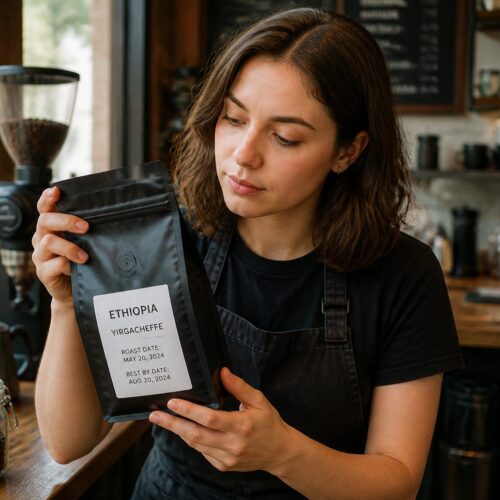

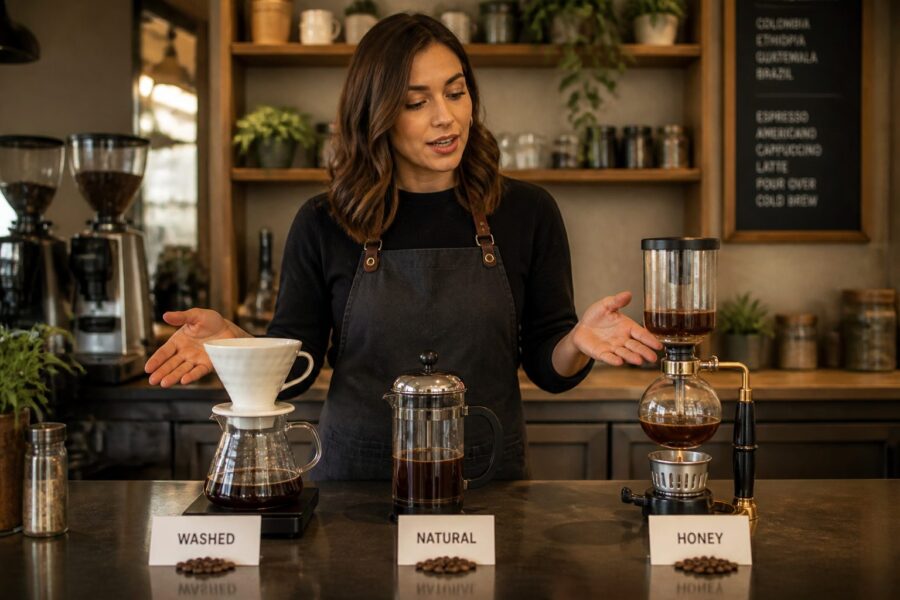
Washed, natural, and honey process are labels for ways coffee fruit is handled after harvest and before the beans are dried and prepared for roasting.
The names describe processing choices, not a guaranteed flavor or a grade of quality.
Coffee beans grow inside cherries, and after picking producers remove the outer fruit in different ways, manage the remaining material during drying, and prepare the seeds for later processing.
Details vary by farm and region, so a label gives a useful outline rather than a complete account of a lot.
What washed coffee means
In a washed process, the outer skin and much of the fruit around the seed are removed before drying.
Producers also use water during steps that separate remaining material from the beans, though the exact method depends on the producer and local setup.
The word “washed” refers to processing, not to a claim that the finished coffee tastes clean in every cup.
People often associate washed coffees with distinct or clear flavor descriptions, but cultivar, growing conditions, harvest, drying, roasting, storage, and brewing all influence what someone tastes.
A bag marked washed does not tell you every detail about fermentation, drying conditions, or sorting.
If a roaster provides a more specific description, read it as information about that particular coffee rather than as a universal rule for all washed lots.
What natural or dry processing means
In natural processing, the coffee cherries are dried with the fruit still around the seeds.
The fruit is removed later, after drying.
This approach is also commonly called dry processing.
Drying whole cherries requires attention to how they are spread, turned, and protected during the process.
The goal is to dry the coffee appropriately, but conditions and methods differ, and the label alone cannot tell a reader exactly how a particular lot was managed.
Natural coffees are often described with fruit-forward or fuller flavor language, but those are tendencies in tasting descriptions, not promises.
A coffee may taste different depending on its origin, roast, age, grind, and brewing method.
What honey processing means
Honey processing usually removes the outer skin of the cherry while leaving some sticky mucilage, the layer around the seed, in place during drying.
The name refers to the tacky feel of that material; it does not mean honey is added.
The amount of mucilage left on the seed and how the coffee is dried can vary.
Terms such as yellow, red, or black honey appear in some coffee descriptions, but the naming conventions are not a universal measurement system that lets a shopper infer an exact process from color alone.
Honey process is sometimes described as a middle path between washed and natural methods because it retains some fruit material during drying while removing the skin.
That comparison is only a broad way to understand the workflow, not a precise prediction of flavor.
| Label | General processing outline | What the label does not guarantee |
|---|---|---|
| Washed | Fruit is removed before drying; water may be used to remove remaining material | A particular flavor or quality level |
| Natural / dry | Cherries dry with fruit around the seed; fruit is removed later | A specific degree of sweetness or fruit character |
| Honey | Skin is removed while some mucilage remains during drying | Added honey, exact mucilage percentage, or a fixed flavor |
How the methods compare
The clearest difference is when fruit is removed in relation to drying.
Washed coffee has most fruit removed earlier, natural coffee dries inside the cherry, and honey coffee dries with some mucilage remaining after the skin is taken off.
The three labels can help explain why two coffees may have different processing histories.
They are not a complete account of origin, variety, harvest selection, fermentation, drying, or roasting, and they do not rank coffees from best to worst.
If a bag lists both a process and a flavor note, keep the two ideas separate.
The processing term describes a post-harvest method, while tasting notes are the roaster’s description of aromas and flavors they associate with the brewed coffee.
How to read a coffee bag
Treat processing as one clue among several.
A bag may also name a country or region, a farm or cooperative, a variety, a roast level, or a flavor description; these labels answer different questions and should not be used interchangeably.
If the bag says “honey,” do not assume the coffee was flavored or sweetened with honey.
If it says “natural,” do not assume the beans are unwashed in the sense of being unsafe or neglected.
These are processing terms in coffee descriptions.
A more detailed producer or roaster note may explain how the cherries were sorted, depulped, fermented, or dried.
When such details are absent, avoid filling the gaps with assumptions based only on the process name.
Why processing can influence taste without deciding it
The seed develops and dries while surrounded by different amounts of fruit material across these methods.
That creates differences in post-harvest handling that can influence the coffee’s character, but it is only one part of a longer chain.
Roasting changes the green coffee, while storage and brewing shape the cup a reader actually drinks.
A light roast brewed with a coarse grind will not necessarily taste like another light roast with the same process label.
When comparing two coffees, keep the brew method as similar as possible and change one coffee at a time.
That will not isolate processing perfectly, because the beans may differ in origin and other ways, but it gives a more useful comparison than changing every part of the recipe at once.
Questions to ask when the label is unclear
A concise processing label can leave reasonable questions unanswered.
Look for a longer description from the roaster or producer if you want specifics, and distinguish confirmed details from marketing shorthand.
- Was the cherry dried whole, or was the fruit removed before drying?
- Does the description explain whether mucilage remained during drying?
- Are colored honey terms defined by this producer or roaster?
- Does the flavor language describe an expected impression rather than a guaranteed result?
The answers may not appear on every bag.
That does not make the coffee impossible to understand; it simply means the label offers a broad category rather than a technical log of every processing step.
Choosing among washed, natural, and honey coffees
Use the process label to decide what you would like to explore, then read the rest of the bag for origin, roast, and tasting descriptions.
If you already enjoy a coffee from a certain process, use it as a starting point, not a rule that every coffee carrying the label will taste alike.
Trying the same brewing method with coffees processed in different ways can make the terminology more concrete.
Note the aromas and mouthfeel you notice, but let your own cup lead rather than expecting a fixed taste from the name.
These terms are most helpful when understood literally: they describe different ways of removing fruit and drying coffee.
They are not ingredients, certifications, or reliable shortcuts for judging every quality in the cup.
Washed coffee has most fruit removed before drying, while natural coffee dries inside the whole cherry and has the fruit removed later. Exact methods vary by producer.
It is a post-harvest method in which the cherry’s outer fruit is removed before the coffee seeds are dried, with water often used to help remove remaining material.
Honey process generally means the skin is removed while some sticky mucilage remains around the seed during drying. The term does not mean honey is added, and “honey washed” may be used inconsistently, so check the producer’s description.