
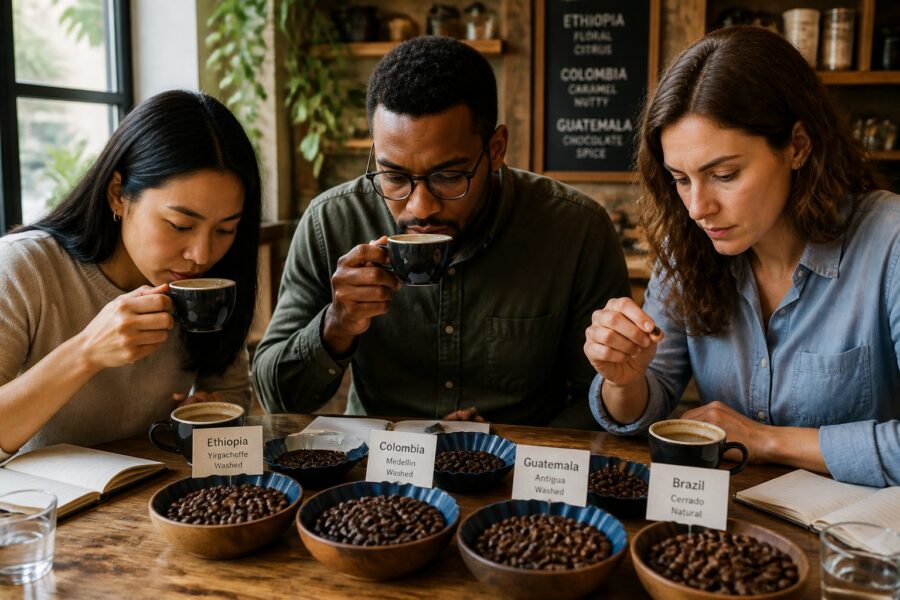
Coffee flavor notes are short descriptions of aromas and tastes that someone may notice in a brewed coffee.
A bag labeled with notes of chocolate, citrus, or berries does not necessarily contain those ingredients.
The words are comparisons that help describe a sensory impression, not a promise that every drinker will taste the same thing.
That can make the label feel mysterious at first.
The most useful way to read it is as a set of clues: one person may notice a familiar fruit-like aroma, while another mainly notices sweetness or roast.
The coffee itself remains coffee unless the package separately identifies added flavoring.
What are coffee flavor notes?
A tasting note is a word or phrase used to communicate an impression of a coffee’s aroma, flavor, or aftertaste.
Descriptions such as cocoa, orange, nuts, flowers, or brown sugar point toward recognizable associations.
They are not a laboratory inventory of ingredients and do not mean that a piece of chocolate or fruit was put into the beans.
People differ in what they notice because tasting involves smell, taste, memory, and attention.
Someone who often eats citrus fruit may connect an aroma to orange peel; another person may use a broader term such as bright or sweet.
Neither description has to be the only correct one.
Tasting notes are also selective.
A roaster may choose a few clear descriptors rather than list every sensation a cup could produce.
A label that says ‘chocolate and cherry’ is a compact reading aid, not a full map of every sip from hot to cool.
Are flavor notes added to coffee?
Usually, tasting notes describe impressions associated with the coffee rather than added ingredients.
Search results from coffee educators and roasters consistently explain this distinction.
If a product has added flavoring, the package should identify it separately; do not infer flavoring from a descriptive tasting note alone.
A flavored coffee and a coffee described as having flavor notes are different product descriptions.
In the first case, a flavoring may be part of the product.
In the second, words such as caramel or berry are comparisons used to describe the brewed cup.
Read the ingredient statement and product description if that distinction matters for a specific bag.
The language can still seem surprisingly vivid compared with the actual drink.
A coffee described as strawberry does not taste like fruit juice, and a cocoa note does not make the cup sweetened.
The descriptor points to a resemblance, often subtle, rather than an exact duplicate of the named food.
Where do coffee notes come from?
Coffee flavor reflects more than one stage of the bean’s path.
Coffee sources describe origin, variety, processing, and roasting as factors that can influence flavor and aroma.
These factors interact, so one word on a label should not be treated as a guaranteed result of a single farm, process, or roast choice.
Growing conditions and the coffee variety can shape the characteristics present in the green bean.
Processing after harvest also affects the coffee, and roasting develops aromas that appear in the cup.
The brew adds another layer: water, grind, proportion, and extraction affect which impressions stand out.
This is why two coffees can receive similar notes yet taste different, and why the same coffee may seem different when brewed another way.
A fruit descriptor may be clear in one preparation and faint in another.
The label offers a starting point, while the brewed cup supplies the evidence.
How to interpret common tasting words
Descriptors often fall into broad families.
Fruit terms might suggest a fresh, dried, or citrus-like association; nut and cocoa terms often describe familiar savory-sweet aromas; floral language may point to a light aromatic impression.
These are ordinary comparisons, not strict categories that every taster applies identically.
Words such as bright, mellow, heavy, or clean describe overall impressions rather than a specific ingredient. ‘Bright’ commonly signals a lively acidic impression, while ‘body’ describes how substantial the liquid feels in the mouth.
A package might use these terms alongside specific notes to give a wider sense of the cup.
Read the whole description instead of isolating one word.
A list such as ‘cocoa, orange, and a rounded finish’ gives a different picture from a list emphasizing florals and a light body.
Still, these descriptors are not standardized guarantees, and the roaster’s language may reflect its own tasting vocabulary.
| Label wording | A useful way to read it | What not to assume |
|---|---|---|
| Chocolate or cocoa | A resemblance to cocoa-like aroma or flavor | That chocolate was added or the coffee is sweetened |
| Citrus or orange | A citrus-like impression in aroma or taste | That the cup will taste like juice |
| Nutty | An association with a familiar nut-like aroma | That the coffee contains nuts |
| Floral | An aromatic impression compared with flowers | That everyone will notice the same flower |
| Sweet | A perceived sweetness or sweet-associated quality | That sugar or syrup is present |
A simple way to taste the notes yourself
Begin with a clean cup and pay attention to aroma before tasting.
Smell the coffee while it is freshly brewed, then take a small sip and notice the first impression, the texture, and what remains after swallowing.
You do not need specialist equipment or a formal tasting session to compare your impressions with the package.
- Read the coffee description once, then set it aside so the words do not dictate every impression.
- Smell the brewed coffee and write down one broad association in your own language.
- Take a sip and notice whether the cup seems light or full, sharp or mellow, and what aroma lingers.
- Compare your notes with the label afterward, treating differences as observations rather than a test you passed or failed.
A useful note can be simple: ‘smells like cocoa, with a citrus-like finish’ or ‘mild aroma, little sweetness.’ Avoid forcing a precise fruit or spice if none comes to mind.
Naming what you actually perceive is more informative than repeating every word on the bag.
Temperature changes perception as a cup cools, so try a second sip later if the initial impression is unclear.
Keep the brewing method steady when comparing coffees.
If one cup uses a different ratio or grind, the brew difference can distract from the bean comparison.
Why the same coffee may taste different at home
A tasting note is not a guarantee of a fixed cup.
A recipe that extracts too little or too much can make some qualities harder to notice, and stale coffee may have a less expressive aroma.
Water and equipment cleanliness can affect the result as well.
When a coffee seems unlike its description, check the basics before concluding that the label is wrong.
Was the coffee stored as directed?
Did the grind suit the brewing method?
Did the brew run unusually quickly or slowly?
These checks can explain why a note is faint without claiming the label predicts an exact flavor.
It is also fine not to identify a listed note.
Tasting is personal, and labels are concise descriptions written by someone else.
You can still decide whether the cup is pleasant, too intense, or not to your taste without matching a specific fruit or dessert.
Use tasting notes as a guide, not a scorecard
Coffee flavor notes help translate a sensory experience into words, especially when comparing unfamiliar beans.
They do not replace the ingredient list, promise an identical cup, or set a correct answer for every drinker.
Treat them as hints about what to look for, then form your own description.
A practical approach is to keep the brewing recipe consistent, smell and taste with attention, and jot down a few plain observations.
Over time, the same words become easier to understand because they connect to aromas and textures you have actually encountered.
The point is not to perform expertise.
It is to make the label useful without taking it literally: a coffee described as cocoa-like may remind you of cocoa, or it may simply taste balanced and pleasant in your cup.
Frequently asked questions
They are short descriptions of aroma or taste impressions associated with a brewed coffee, such as cocoa-like, citrus-like, or floral. They are comparisons, not a guaranteed ingredient list.
They summarize qualities a taster or roaster noticed, using familiar words to help describe the cup. Your own impression may differ because brewing and perception vary.
Not when the words are used as tasting descriptors; they generally describe impressions rather than added ingredients. Check the product’s ingredient statement if you need to know whether flavoring was added.