
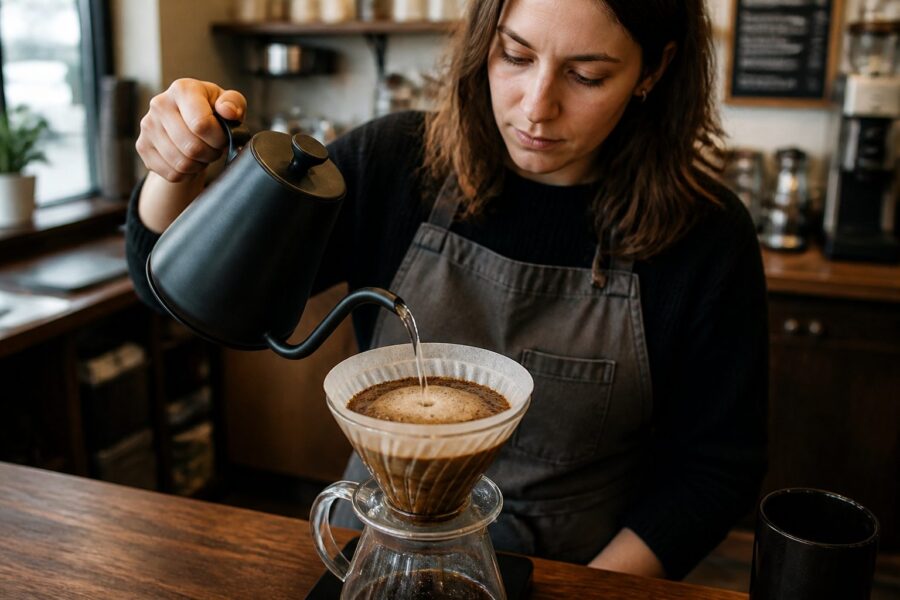
Coffee blooming is the brief bubbling and swelling that can happen when hot water first reaches freshly ground coffee, as gas including carbon dioxide formed during roasting escapes the grounds.
In manual brewing, a small first pour wets the bed before the rest of the water is added.
Blooming is often part of pour-over recipes, but it is not a magic step and does not guarantee a better cup.
It gives the grounds an initial wetting and can make the rest of a manual pour easier to manage.
What happens during a coffee bloom
Roasted coffee retains gas, and grinding exposes more surface to the air.
When water meets the grounds, some of that gas escapes; bubbles rise and the bed may expand or lift.
The strength of the visible bloom varies with the coffee and how it has been stored.
A noticeable bloom can be satisfying to watch, but appearance is not a complete measure of freshness or flavor.
A coffee with little visible bubbling may still brew normally, and a dramatic bloom does not prove that the final cup will suit someone’s taste.
The grounds also begin absorbing water during this first stage.
Wetting them before the main pour can help the brewer cover the bed more evenly, especially when using a cone dripper and a deliberate pouring routine.
Why pour-over recipes include a bloom
A pour-over begins with dry grounds in a filter, and the first water addition starts the brewing process.
A brief pause after wetting gives the coffee time to release some gas before the remaining water passes through.
Gas escaping from dry pockets during the main pour can interfere with water contacting the coffee evenly, so recipes commonly use an initial wetting step.
The effect depends on the grounds, water delivery, and brewer; it is better understood as a useful technique than as a guarantee of extraction quality.
Blooming also gives the brewer a moment to see whether the grounds are wet throughout.
If a dry patch remains, a gentle adjustment to the next pour or the initial water distribution may help, though swirling too forcefully can disturb the bed.
How to bloom coffee in a pour-over
Use the coffee and water amounts in a recipe you trust, then reserve part of the water for the first pour.
Many recipes use an initial amount related to the coffee dose, but no single quantity or pause fits every dripper, coffee, and preference.
- Place the filter and grounds in the dripper as usual.
- Pour enough hot water to wet the grounds across the bed without flooding the brewer.
- Pause briefly while bubbles rise and the grounds settle.
- Continue with the rest of the recipe, keeping the pour steady and avoiding the filter wall where practical.
If the bed looks unevenly wet, direct a little water toward dry areas rather than stirring aggressively.
A gentle swirl may be used in some routines, but it is optional and can change how the bed settles.
The pause should fit the recipe rather than become a ritual with a fixed timer.
A short wait is common, but the research does not establish one universal duration that applies to every coffee and brew method.
Does every brewing method need blooming?
Blooming is most visible and commonly discussed in manual filter brewing, where the brewer controls the first water addition.
Some people also describe an initial wetting stage in immersion methods, but the technique and purpose differ from a pour-over routine.
An automatic drip machine controls the water delivery itself, so whether a separate bloom phase is useful depends on the machine’s design and settings.
Follow the brewer’s directions rather than opening or modifying a hot appliance to create a manual step.
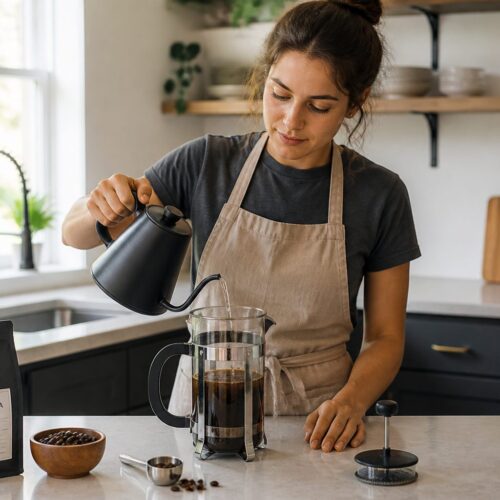
A French press is an immersion brewer: water and grounds remain together before plunging.
Some recipes begin with a small wetting pour, while others add all the water at once.
There is no requirement to force the same pour-over sequence onto every method.
| Method | How the first wetting is handled | What to keep in mind |
|---|---|---|
| Pour-over | Brewer adds a small initial pour, then continues the recipe | Useful for checking wetting and controlling the next pours |
| French press | Water and grounds are immersed together; recipes vary | A separate pause is optional, not a universal rule |
| Automatic drip | Machine manages water delivery | Use its programmed options and manual |
Why a coffee may not visibly bloom
Coffee that has had more time to release gas may show less bubbling than recently roasted or freshly ground coffee.
Storage and packaging also affect how much gas remains by the time the beans are brewed.
The water may simply cover the grounds without producing a dramatic mound, particularly if the pour is gentle or the coffee is not very fresh.
Lack of visible expansion by itself is not a reason to discard the coffee or change the entire recipe.
If the bloom seems uneven, check whether water reached the full bed and whether the grounds are distributed evenly.
A blocked filter, a strongly uneven pour, or an unusually deep bed can affect what you observe, but the cause will depend on the specific brewer.
What to change when the cup is off
Blooming addresses the opening stage of a brew, while taste also depends on dose, grind, water, and total brewing behavior.
If the coffee tastes sour or thin, check the grind and how water passed through the bed before assuming the bloom duration was the only issue.
If a cup tastes harsh, consider whether the grind is too fine for the method or whether the brew ran differently than usual.
Change one variable at a time and compare the next cup; adding a longer bloom without another reason may not solve the cause.
Keep the same coffee dose and total water when testing a change to the bloom.
That makes it easier to notice whether the initial wetting or pause affected your routine, even though it cannot isolate every brewing variable.
A simple way to decide whether to bloom
For pour-over, try the initial wetting step in a recipe and see whether it makes the process easier to repeat.
If the method already works well for you, there is no need to treat a different bloom time as a required upgrade.
For other brewers, follow the machine or recipe instructions and do not assume that a visible bloom must occur.
The term describes a normal interaction between water and roasted grounds, while the brewing step itself is a choice shaped by the method.
The useful takeaway is modest: blooming is a short first wetting that releases gas and sets up the remaining pour.
Its value is practical and recipe-dependent, not a stand-alone promise about the cup.
Blooming wets the grounds before the main pour and allows some trapped gas to escape. In pour-over, it can make the rest of the water addition easier to manage, but it does not guarantee a particular flavor.
It is a common step in pour-over recipes, but it is not necessary in every brewing method or recipe. Follow the method you use and judge the result in your cup.
The coffee will still brew. In a manual pour-over, the main pour begins immediately, and the results depend on the coffee, water delivery, and recipe rather than on the absence of a required step.