
Choosing a coffee grinder gets easier when you begin with the coffee you actually make; someone who brews drip coffee on weekdays has different priorities from a person who switches between espresso and French press, and a grinder that fits one routine may frustrate another.
Focus first on grind adjustment, particle consistency, dose size, cleanup, and how the grinder fits your counter or storage; features matter only when they solve a problem you encounter in your own brewing.
Start with your brewing methods
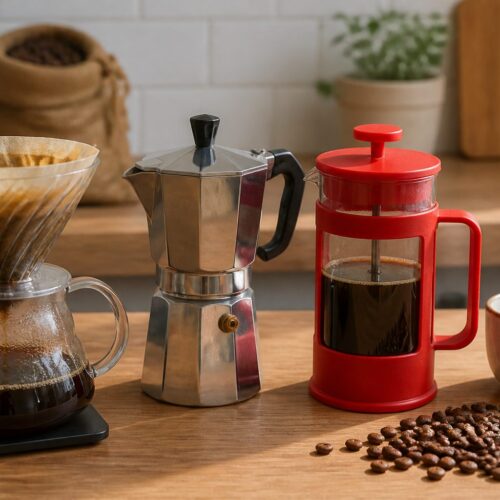
List the methods you use most often, not every method you might try someday; drip, pour-over, and French press all use ground coffee, but the grind settings and repeatability you want can differ from espresso, which usually asks for finer adjustments.
If you use one method, you can prioritize a grinder that handles its grind range well and is simple to set repeatedly; if you alternate between methods, check whether the adjustment mechanism lets you move between settings without losing track of your starting point.
Think about how often you change settings; a dial with clear steps may be easy to return to, while a less constrained adjustment may allow finer tuning but make repeatability harder for some users.
| Brewing routine | What to look for | Question to ask |
|---|---|---|
| One familiar method | Reliable adjustment in the range you use | Can I return to a setting I like? |
| Several brew methods | Useful range and understandable adjustment | Can I switch settings without confusion? |
| Espresso at home | Fine control and repeatable small changes | Can the grinder make the fine adjustments I need? |
| Occasional brewing | Simple operation and manageable cleanup | Will it be easy to use and store? |
Burr or blade: understand the basic difference
Blade grinders use a spinning blade to break beans into particles, while burr grinders crush beans between two grinding surfaces; these mechanisms produce different patterns of particle size, so the choice can affect how consistently water moves through the coffee.
Burr grinders are often selected when users want more control over grind size and repeatability; blade grinders can be simpler and less costly, but they do not adjust particle size in the same way; timing the grind is not the same as selecting a precise setting.
This comparison does not mean every burr grinder suits every brewer or that a blade grinder makes undrinkable coffee; a burr model with awkward adjustment or poor fit for your routine may be less useful than a simpler grinder you will use consistently.
How to choose a coffee grinder for espresso
Espresso calls for a grind fine enough to support a short, pressurized extraction, and small changes can affect how quickly water passes through the coffee bed; a grinder intended only for coarser brewing may not provide the adjustment range or repeatability an espresso routine needs.
Check the product specifications for the grinder’s stated use and available adjustment, then consider whether the controls allow small changes between shots; a label alone cannot show how a particular grinder will perform with your beans and espresso machine, so look for clear documentation rather than assuming one setting suits all.
If you also make drip or French press coffee, ask whether the grinder can move between a fine espresso setting and coarser settings in a usable way; some designs retain grounds or make frequent changes inconvenient, which can matter more in a mixed-method household than in a single-purpose setup.
Consider grind range and adjustment
A grinder’s range describes the sizes it can produce, while its adjustment system determines how you move among them; you need a useful range for your methods and controls that make sense in daily use; an impressive number of settings is not automatically valuable if you cannot identify or repeat them.
Stepped adjustment moves between defined positions, which can make it easier to record a setting; stepless or more continuous adjustment can allow smaller changes, though the absence of marked steps may make returning to a previous position less intuitive.
When comparing models, look for a clear description of which brewing styles the grinder supports and how adjustments are made; if the manufacturer does not explain a capability, do not infer it from photographs or marketing terms.
Burr shape, material, and maintenance
Burrs may differ in shape and material, but those labels do not settle the choice by themselves; the grinder’s whole design, adjustment system, construction, and maintenance requirements also shape how it fits your routine.
Conical and flat burr designs describe the arrangement of the grinding surfaces; neither term alone guarantees a flavor outcome, and broad claims about one shape always being better ignore differences among grinders and brewing preferences.
Steel and ceramic are common burr materials described in grinder specifications; rather than choosing by material alone, check the care instructions, whether the burr set is replaceable if relevant, and whether the maker explains how to clean the grinder.
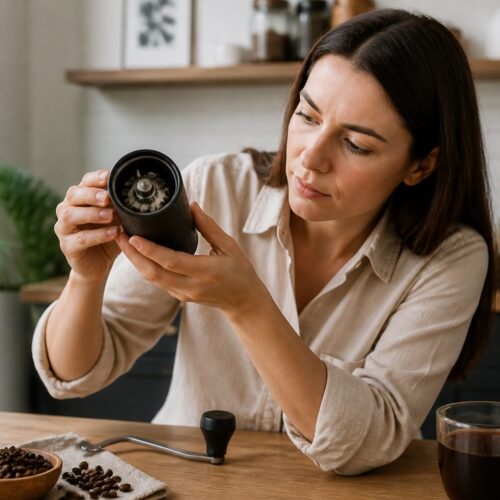
Coffee leaves particles and oils inside equipment, so maintenance should be part of the decision; check how the hopper and grounds path open, what the manual says about cleaning, and whether routine care requires tools you are comfortable using.
Match capacity, workflow, and available space
A grinder that fits the counter but cannot handle your normal dose can interrupt the routine, while a large model may be inconvenient in a small kitchen; compare the stated capacity with the amount you usually brew and measure the space where you plan to keep the equipment.
Consider how you prefer to load and collect grounds; some people value a container that transfers neatly to a brewer; others want to grind directly into a portafilter or dose one serving at a time, so inspect the grinder’s intended workflow before buying.
Noise, speed, and cleanup are household considerations rather than universal quality scores; if you brew early, share a kitchen, or make several cups in a row, decide which of those practical details will affect you most.
- Measure counter height and storage depth before comparing bulky models.
- Check whether the grinder holds enough beans or grounds for your usual batch.
- Look at how grounds are collected and transferred to your brewer.
- Read the care instructions to see how the manufacturer expects routine cleaning to work.
- If you switch brew methods, confirm how to return to a familiar setting.
Do you need an expensive coffee grinder?
No fixed price guarantees that a grinder is right for you; a higher price may reflect construction or controls that matter to a particular routine, but it does not replace checking grind range, adjustment, usability, and care requirements.
Set a practical budget by ranking your needs; if you brew one method and value a repeatable grind, prioritize those qualities before paying for features aimed at espresso or frequent switching that you do not use.
If budget is limited, compare the grinder you can maintain and use regularly with alternatives that may be cheaper upfront but less suited to your method; avoid relying on unverified performance claims or assuming a familiar brand name guarantees a particular cup.
A quick decision checklist
- Name the brewing methods you use most often.
- Choose the required grind range, including fine adjustment if you make espresso.
- Decide whether stepped or continuous adjustment better fits how you work.
- Compare burr or blade designs in the context of control, routine, and budget.
- Check size, capacity, grounds handling, and cleaning instructions.
- Choose the model whose documented features address your actual needs rather than the longest feature list.
Once you have a grinder, write down settings that work for each brewer and change one variable at a time; a grinder supports repeatability, but beans, dose, water, and brewing technique still affect the cup.
Frequently asked questions
Start with the brewing methods you use, then compare grind range, adjustment, consistency, capacity, cleanup, and fit for your kitchen. Choose features that address your routine rather than buying by a single specification.
No. Price alone does not establish whether a grinder is suitable; compare its documented capabilities and usability with the methods you make and the budget you have set.
Look for a grinder intended to handle espresso and check whether its adjustment permits fine, repeatable changes. Also consider dose workflow, cleaning, and whether it can serve any other methods you use.