

Arabica vs robusta coffee is often presented as a simple taste contest, but the names refer to different coffee species, not grades on a single quality scale.
A cup’s flavor also reflects the growing conditions, processing, roast, storage, and brewing choices behind it.
Arabica is generally associated with a softer, more varied range of flavor descriptions, while Robusta is often described as more forceful and bitter.
Those are broad tendencies: an individual coffee can differ, and the label alone cannot tell you exactly how a particular bag will taste.
What Arabica and Robusta names mean
Arabica refers to Coffea arabica, and Robusta is the common name used for coffee from Coffea canephora.
Both species produce coffee beans used in commercial and home brewing, although they are not interchangeable labels for roast level or brewing method.
The species name is only one part of a coffee’s identity.
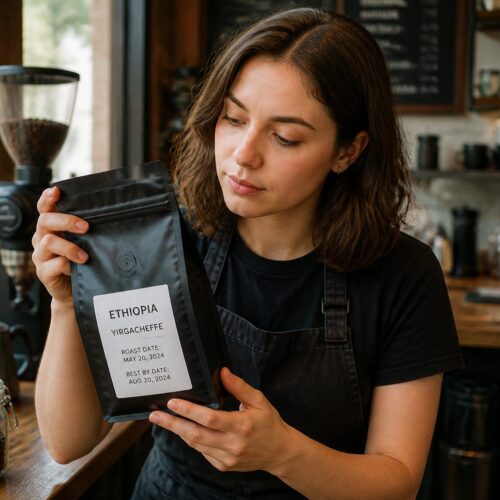
A bag may also identify a country or region, a farm or cooperative, a processing method, a roast description, or a blend; each detail points to a different part of how the coffee was produced.
A product labeled Arabica is not automatically light roasted, mild, or high quality, and Robusta is not automatically dark or harsh.
Roast and preparation can change the character of either coffee.
Flavor and cup character
Arabica coffees are commonly described with terms such as fruit, floral, sweet, or bright.
These are tasting descriptions, not a promise that every Arabica brew will resemble a specific fruit or taste sweet like a dessert.
Robusta often has a stronger, more bitter or earthy reputation, and some coffees have a dense, assertive character.
Growing, processing, roast, and freshness still matter, so it is more useful to taste a specific coffee than to assume the species settles the question.
A blend can combine Arabica and Robusta to create a particular profile.
The percentage and purpose of each species vary by product, so a blend name alone does not indicate how much of either is present.
Brewing adds another layer.
A fine grind, a long extraction, or an unsuitable coffee-to-water balance can make a cup taste harsh regardless of species; a different recipe may change the result without changing the beans.
Caffeine and common assumptions
Robusta is generally known for having more caffeine in the bean than Arabica, but the amount in a served drink depends on the coffee, dose, brewing method, and serving size.
A species label cannot tell you the exact caffeine content of a cup.
Be cautious with precise comparisons repeated online.
Numbers may describe green beans, roasted coffee, or a particular sample, and those are not the same measurement as caffeine in a prepared drink.
Questions about whether one species is healthier cannot be answered just from the species name.
The information here describes coffee types and taste, not medical effects or individualized health guidance.
Growing and sourcing differences
Arabica and canephora have different growing characteristics and are cultivated in different conditions.
However, a general species comparison does not explain the quality or farming practices of one specific coffee; origin and producer details are needed for that.
Labels may use Robusta even when botanical references call the species Coffea canephora.
That common-name usage is widespread in coffee conversations, but it does not mean every product labeled Robusta comes from the same farm, cultivar, or process.
Origin is not a shortcut to flavor either.
Country names can help locate a coffee, but coffees from the same region can vary by elevation, cultivar, harvest, processing, roasting, and freshness.
How to choose between them
Start with the way you brew and the flavor you enjoy.
If you like a lighter cup with more delicate aroma, an Arabica coffee might be a useful starting point; if you prefer a bold profile, consider a Robusta or a blend that lists it.
Read the full bag rather than treating species as a verdict.
Roast level, origin, processing, and tasting notes provide more clues, while a roaster’s description is still a guide rather than a guarantee.
| Label clue | What it can tell you | What it cannot guarantee |
|---|---|---|
| Arabica | The coffee is identified with Coffea arabica | A particular flavor, roast, or quality level |
| Robusta | The coffee is identified with Coffea canephora | Exact caffeine in your brewed serving |
| Blend | More than one coffee component is combined | A fixed species ratio unless stated |
| Origin | A stated place associated with the coffee | One uniform taste for all coffees from that place |
When possible, compare small portions brewed with the same method and recipe.
Keep the grind and water amount steady, taste each without additions first, and then decide whether you prefer aroma, bitterness, body, or aftertaste in one cup over the other.
For someone comparing Arabica and Robusta for the first time, brewing the same recipe is more revealing than ordering one cup in a café and another at home.
Different serving sizes and milk additions can hide whether the difference came from the beans or the preparation.
Try tasting a small black portion before adding milk or sweetener, then taste it again the way you usually drink coffee.
The unadorned sip makes aroma and finish easier to notice, while your normal preparation tells you whether the coffee works in your actual routine.
Roast can blur simple expectations.
A dark-roasted Arabica may taste more roasted and bitter than a lightly roasted canephora coffee, and brewing choices can push either one in different directions.
Species is a helpful label, but it does not replace tasting notes or a sample.
The name on a package may also be part of a blend description rather than the full story.
If the ingredients or proportions are not listed, avoid inferring an exact percentage from a generic term such as espresso blend; ask the roaster or rely on the product’s stated information.
A side-by-side tasting is easiest to interpret when you use the same grinder, brewer, water, and serving size.
If one coffee is prepared as espresso and the other as drip, the method can dominate the comparison, so keep the preparation as similar as practical.
Look at the full tasting experience rather than asking which bean wins on one trait.
You might prefer one coffee’s aroma but the other one’s finish, and that is useful information when choosing a bag for a particular recipe.
The word Robusta can carry a quality stereotype, but broad labels do not describe the care taken with a specific harvest or roast.
A well-described bag with clear origin and roast information is more informative than a species name used as a shortcut for quality.
If you drink coffee with milk, compare both coffees in that drink as well as black.
Milk changes the perception of bitterness and body, so your favorite coffee for a straight cup may not be the one you prefer in a latte or other milk-based drink.
Questions readers often ask
Neither species is best for everyone. Arabica and Robusta have different typical cup profiles, and your preference, the roast, and how the coffee is brewed all affect the result.
It depends on what you enjoy. Arabica is often associated with more varied and delicate flavor descriptions, while Robusta is often bolder; those are general tendencies, not guarantees for every bag.
Choose by the specific coffee’s label and taste rather than the species name alone. Consider origin, roast, processing, and how it performs in your brewing method.