
The Americano and long black start with espresso and hot water, but the order of assembly gives each drink its familiar look and serving convention.
The difference is useful to know when reading a café menu, although neither name guarantees one fixed recipe across every shop.
What an Americano usually means
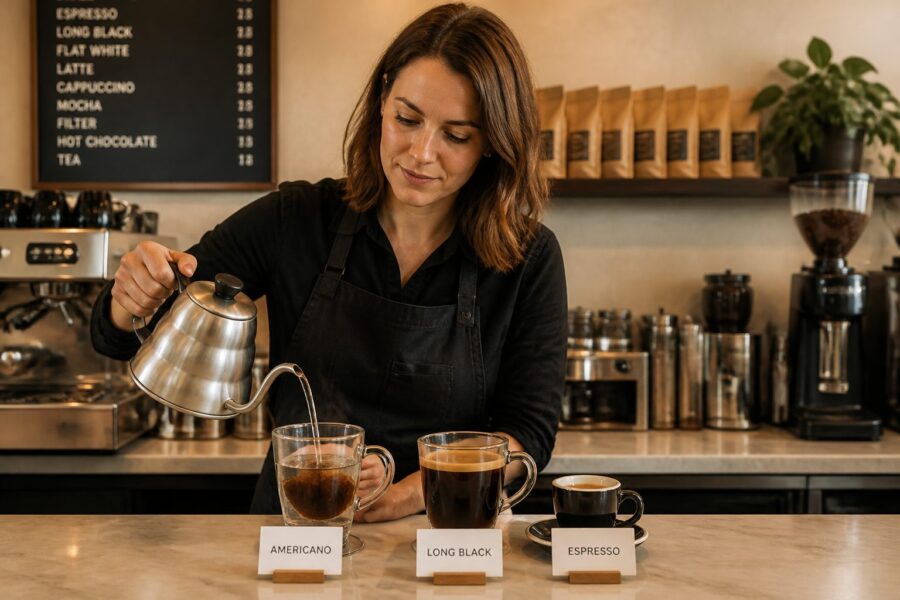
An Americano is espresso diluted with hot water, with the water commonly added to the espresso in the cup.
The added water makes a longer drink than a straight espresso while retaining the flavor character of the espresso used to make it.
Cafés vary the number of shots, water volume, cup size, and whether the water is added before or after the espresso, so the name alone does not specify strength or exact size.
Some menus offer iced Americanos as well, using cold water and ice instead of a hot-water preparation.
What a long black usually means
A long black is commonly prepared by pouring espresso over hot water already in the cup.
That order can leave more of the espresso crema visible on top, though the appearance depends on the coffee, extraction, and how carefully the drink is poured.
Long black is associated with Australian and New Zealand café traditions, while the Americano is more familiar on many North American menus.
Serving conventions vary, so a café may use different ratios or present a long black and Americano in ways that overlap.
Americano vs long black at a glance
| Feature | Americano | Long black |
|---|---|---|
| Base | Espresso and hot water | Espresso and hot water |
| Common assembly | Water added to espresso | Espresso poured over water |
| Typical visual cue | Crema may mix into the drink | Crema may remain more visible on top |
| What the name tells you | A diluted espresso drink | A water-and-espresso drink with a conventionally different pour order |
The table describes common conventions rather than rules every barista follows.
Does the order of water and espresso change the taste
Pouring espresso into water can preserve a more distinct crema layer, while adding water over espresso tends to mix the crema into the cup.
The difference in flavor may be subtle because both drinks contain the same basic ingredients and the final balance depends on the coffee and proportions.
Crema changes texture and aroma at the surface, but it is not a complete measure of espresso quality or a reliable guarantee that one drink will taste better.
Temperature, shot composition, water volume, and how long the drink sits also affect what reaches the palate.
Which drink is stronger
There is no universal winner in strength because cafés can use different amounts of espresso and water.
If two cups contain the same espresso and similar water volumes, the extraction order alone does not make one contain more coffee.
A smaller long black may taste more concentrated than a larger Americano, but a shop could serve them at similar sizes or use different shot counts.
When strength matters to your preference, ask how many shots are in the drink or request the cup size rather than relying on the name.
Why order an Americano
An Americano lets someone enjoy espresso flavor in a larger, less concentrated serving than a straight shot.
It is also an easy menu choice for a person who wants a black coffee made from espresso rather than batch-brewed filter coffee.
A long black can suit someone who prefers a smaller espresso-based drink or likes the crema to remain visible, though local recipes differ.
Neither drink requires a particular roast, and the beans and espresso recipe can shift the flavor more than the label suggests.
Ordering or making either drink at home
At a café, ask whether the shop has a standard cup size or a preferred pour order if the distinction matters to you.
At home, start with the espresso recipe you already enjoy, then add hot water gradually until the cup tastes balanced to you.
For a long black-style pour, put hot water in the cup first and add the espresso gently; for an Americano-style preparation, add hot water to the espresso.
Keep the variables simple while comparing: use the same coffee, shot, and water amount, then change the pour order on a second cup.
A practical comparison should note cup size, shot count, water amount, crema appearance, and perceived intensity rather than treating one variable as the whole explanation.
A shot of espresso is a concentrated starting point, and adding water changes its concentration without changing the amount of coffee grounds used for that shot.
This distinction explains why a larger Americano can taste less concentrated without necessarily using less espresso than a smaller long black.
If a shop uses two shots in both drinks but pours different amounts of water, the cups will share the same espresso base while feeling different in intensity.
The word strong can refer to perceived flavor, concentration, or caffeine, and those are not interchangeable descriptions.
A short, espresso-forward drink may taste more intense while containing an espresso serving similar to a longer drink made with the same shots.
Water also changes how aromas and flavors are experienced as the cup cools, which is one reason a drink can seem different over the time it takes to finish it.
- Assuming every Americano is larger than every long black, even though cafés set their own cup sizes.
- Treating visible crema as proof that a long black is stronger or made with better espresso.
- Assuming pour order alone determines caffeine or total espresso in the cup.
- Expecting the same flavor balance from different beans, shot recipes, or water amounts.
- Confusing espresso-based black coffee with drip coffee because both may be served without milk.
The menu name is a useful starting point, but the recipe behind it provides the better explanation of what the cup will taste like.
A café’s water source and espresso recipe are part of the final cup too, so a comparison across two shops changes more than the label.
For a home tasting, pour both styles into similar cups and taste them at the same temperature, since a cooling drink can shift in perceived balance.
Keep tasting notes simple: describe aroma, body, and intensity in your own terms rather than expecting the crema or pour order to decide preference.
If the cup is too intense, add water in small amounts and taste again rather than changing both espresso and dilution at once.
If it seems weak, consider whether the recipe used enough espresso before concluding that the long-black or Americano label explains the result.
Questions about Americanos and long blacks
They share espresso and hot water, and their common distinction is the order in which they are combined. Café recipes overlap, so the name does not guarantee a universal ratio or flavor.
Neither is always stronger because shot count, water volume, and cup size vary. Compare the actual espresso and water amounts rather than assuming the label determines intensity.
An Americano provides a larger serving of espresso diluted with water, which some people prefer to a straight shot. The coffee remains espresso-based, but its strength and flavor depend on the recipe.