
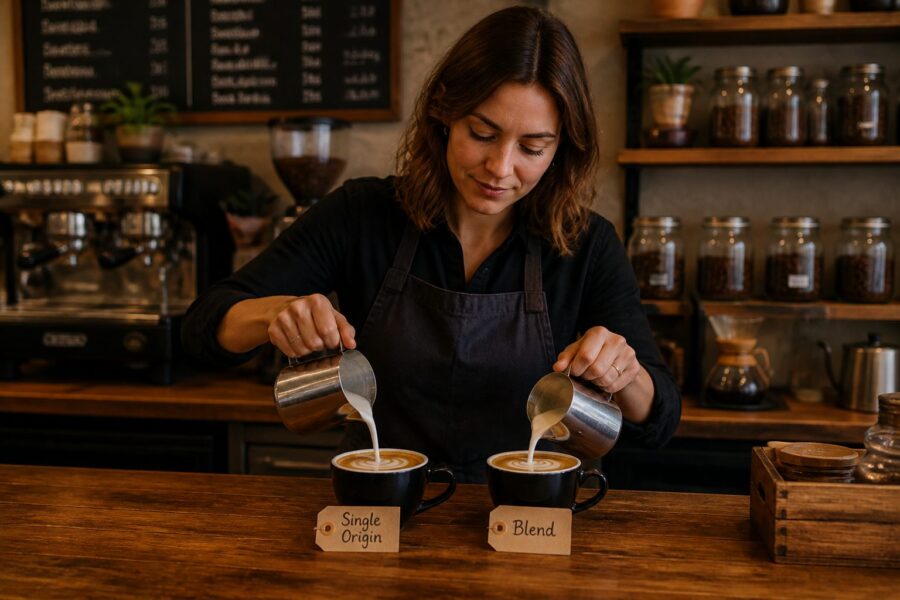
Coffee blend or single origin: the terms describe different ways coffee is sourced and combined, not a ranking of quality.
Knowing the distinction helps you read a bag without expecting one label to guarantee a particular flavor.
A single-origin coffee is associated with one stated source, while a blend combines coffees from more than one source.
The exact scope of “origin” can vary by roaster and label, so read the details provided.
What single origin usually means
A single-origin label signals that the coffee comes from one defined source rather than a mixture assembled from multiple origins.
The stated source might be a country, region, farm, cooperative, or another area, depending on the producer’s description.
More specific sourcing can help a reader connect a coffee to a place or harvest.
A country-level label tells less about the exact farm than a named producer or region, so the degree of traceability depends on the information supplied.
Single origin does not mean that every bean in the bag is identical.
Coffee is a crop, and its profile can shift with variety, growing conditions, harvest, processing, roasting, and storage.
The label also does not automatically mean the coffee is rare, more carefully produced, or better than a blend.
Those claims require information beyond the words “single origin.”
What a coffee blend is
A blend combines coffees from multiple sources to create a particular profile or to maintain a style across changing harvests.
Roasters can select components for how they taste together in a given recipe.
A blend may include coffees from different regions or several lots from a broader sourcing area.
The label may name its components, or it may use a general name such as a house blend without listing every source.
Blending can help a roaster build a repeatable flavor, but consistency is a goal rather than a guarantee that every bag or crop tastes exactly alike.
Agricultural coffee still varies, and recipes can change.
A blend is not inherently a lower grade or a way to hide poor beans.
Its quality depends on the coffees selected, how they are roasted, and whether the finished cup meets the roaster’s intended profile.
How the two labels differ
| Label | Typical sourcing idea | Useful question to ask |
|---|---|---|
| Single origin | One stated source or defined area | How specifically is the source named? |
| Blend | Coffee combined from multiple sources | What flavor or style is the blend intended to create? |
| Either term | A sourcing description | What do the roast and tasting notes say? |
| Neither term | A quality grade by itself | What evidence describes the coffee’s quality? |
The terms mainly describe sourcing, while roast, processing, and brew method describe other parts of the cup.
Comparing a single origin with a blend is most useful when you know what feature you want to compare.
If both coffees are roasted similarly and brewed with the same recipe, their differences may be easier to notice.
Different roast levels or preparation methods can obscure the effect of sourcing alone.
Is single origin better than a blend
Neither is universally better.
A coffee that tastes balanced and pleasant to one person may seem too bright, too chocolatey, or too heavy to another, so preference matters.
A single origin may interest someone who wants to explore how a particular source tastes.
A blend may suit someone who prefers a familiar house profile, but either can be expressive or straightforward.
Price does not settle the comparison.
Cost can reflect sourcing, availability, processing, packaging, and other business choices, and the label alone does not establish why one bag costs more.
For espresso, a blend may be designed to produce a particular balance or to work well with milk, while a single origin can offer a distinctive flavor.
These are common aims, not strict rules for every coffee.
For filter brewing, a single origin can make origin notes easier to explore, while a blend can offer a profile assembled from several coffees.
The brewing method does not require either label.
How to read the label beyond the headline
Look for the named country, region, farm, cooperative, or lot if traceability matters to you.
A more specific description gives more context, although it still does not predict exactly how your brew will taste.
Processing terms describe what happens to coffee after harvest, and roast descriptions tell you how the beans were roasted.
Those details can be as useful as the blend or single-origin label when choosing a cup style.
Tasting notes are a roaster’s descriptions of perceived flavors, not ingredients or guarantees.
A note such as citrus or cocoa points to an impression, and the brewed result can differ with water, grind, and extraction.
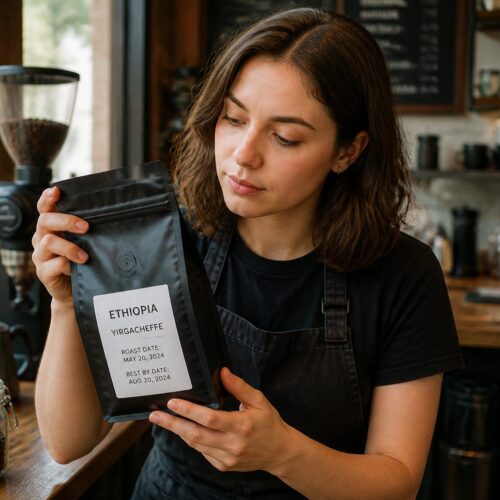
Check whether the bag includes a roast date and storage guidance.
The age and condition of a coffee can affect aroma, so a sourcing label should not be read apart from freshness and packaging.
If a blend lists components, the list can help explain how it was assembled, but it may not state exact proportions.
Do not infer a precise recipe unless the roaster provides one.
A simple side-by-side tasting
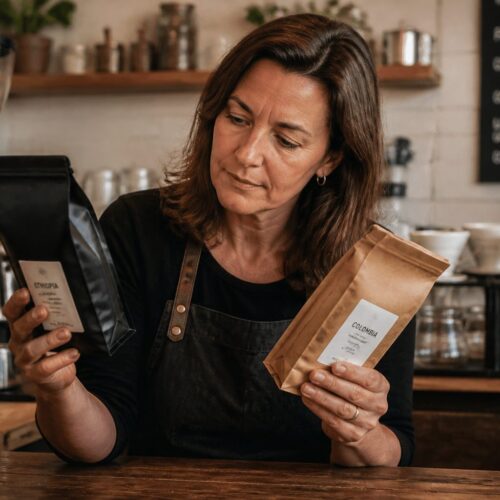
- Choose a blend and a single-origin coffee with similar roast descriptions if you want to focus on sourcing.
- Use the same brewer, water, dose by weight, grind approach, and serving size for both.
- Taste each cup at a similar temperature and write down aroma, sweetness, acidity, bitterness, and body separately.
- Repeat a brew if one cup was clearly prepared differently or had an obvious extraction problem.
- Decide which profile you prefer for that method instead of treating the tasting as a universal quality score.
This comparison cannot prove that single origins or blends are always better.
It can show which of the two particular coffees suits your taste under the recipe you used.
If the coffees differ in roast or processing, include those details in your notes.
Otherwise, it is easy to credit the sourcing label for a difference that came from another variable.
Choosing by what you want in the cup
Choose single origin when the source description itself interests you or you want to compare coffees from different places.
The label can guide exploration, while the cup remains the final test of personal preference.
Choose a blend when its stated flavor profile sounds appealing or you want to return to a style the roaster aims to maintain.
A blend’s name does not promise identical results across every crop.
You can also keep both kinds on hand for different brewing routines.
The category does not dictate a preparation method, and a coffee’s roast and flavor notes may guide the recipe more directly.
A clear label helps you understand what the roaster is telling you, but the wording is only a starting point.
Origin detail, processing, roast, storage, and brewing all help explain what you taste.
The practical distinction is simple: single origin points to one defined source, while a blend combines coffees.
Neither label is a shortcut for judging quality, and neither one has to win every comparison.
Neither category is automatically better. A single origin emphasizes one stated source, while a blend combines coffees, and personal taste determines which cup you prefer.
It is coffee described as coming from one defined source, whose scope may be a country, region, farm, or lot depending on the roaster’s label.
It is not always better; some people prefer its source-specific character, while others prefer a blend’s intended profile. Sourcing terms alone do not establish quality.