
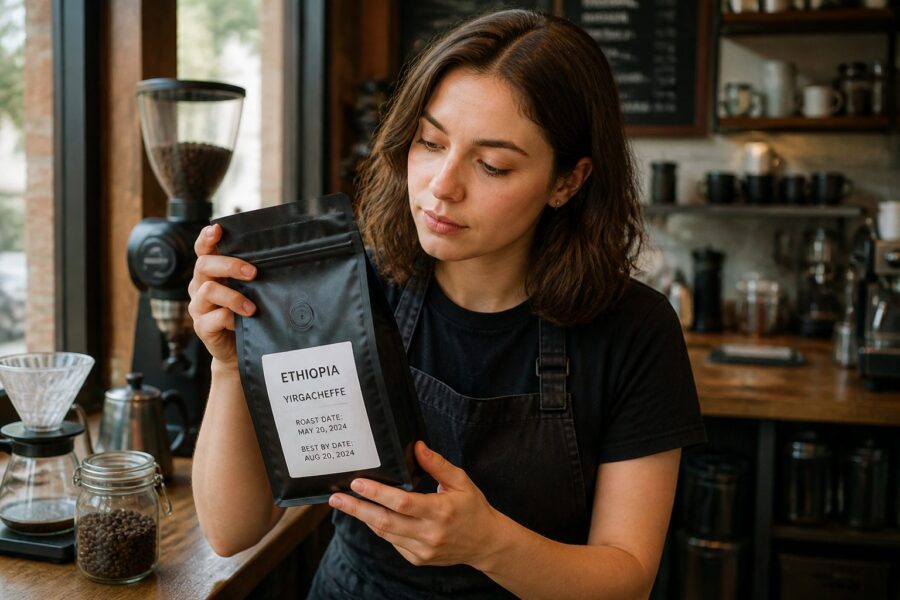
Coffee roast date vs best-by date: the two labels answer different questions.
One marks when roasting took place; the other gives a package’s guidance about quality by a stated date.
Neither date is a complete freshness test.
Coffee changes gradually after roasting, and storage, packaging, grind, and personal taste all affect what a cup is like.
What a roast date tells you
A roast date identifies when the roaster roasted the beans.
It gives a reference point for thinking about age, unlike a best-by date that does not directly say when roasting occurred.
Freshly roasted coffee releases carbon dioxide after roasting, a process commonly called degassing.
The change can influence brewing, especially for espresso, but there is no single waiting period that suits every bean and recipe.
Roast date can help compare two bags if the roast style and packaging are similar.
It cannot tell you how the coffee was stored before purchase or precisely how long its aromas will remain appealing.
Coffee does not switch from fresh to unusable at a universal number of days.
Some people enjoy a coffee after its most expressive aromas have softened, while others prefer a brighter, more aromatic cup.
What a best-by date means
A best-by date is generally a quality date chosen for the packaged food, not a roast date and not automatically a safety deadline.
The exact meaning depends on the product label and applicable rules.
For a bag without a roast date, a best-by date alone cannot reveal how long ago the coffee was roasted.
Different companies may use different dating and packaging practices, so avoid assuming a fixed interval.
The package directions matter, particularly after opening.
Follow any storage instructions printed by the producer, and do not treat a date as proof that the coffee will taste fresh or stale on a particular day.
A best-by date may be useful when comparing packages from the same producer, but it is only one clue.
Look for intact packaging and consider how the bag was stored in the shop and at home.
How coffee changes after roasting
Roasted coffee gradually loses volatile aromatic compounds, especially when exposed to oxygen.
Ground coffee has more exposed surface than whole beans, which is why people often grind beans close to brewing time.
Heat, light, moisture, and air can affect stored coffee.
An airtight container in a cool, dry cupboard limits some exposure, while frequent opening gives new air access to the beans.
A one-way valve on some bags lets gas escape while limiting outside air entry.
It can help with packaging, but it does not stop every change or establish a precise freshness window for all coffees.
Older coffee may taste less aromatic or more muted, though the effect varies.
A flat cup does not prove the beans are unsafe, and a strong smell does not guarantee the brew will match your preference.
Keep coffee away from strong odors and damp places.
Do not move it into a container that smells of detergent or spices, because coffee can pick up unwanted odors during storage.
Can you drink coffee months after roasting
A roast date several months in the past does not, by itself, establish that dry roasted coffee is unsafe to drink.
It does suggest the beans may have lost more of their original aroma, depending on packaging and storage.
The research dossier does not provide a verified universal shelf-life or safety threshold for every coffee product.
Check the producer’s package guidance, and discard coffee if the packaging is damaged or the contents show signs of moisture or contamination.
Brew a small amount if the package is intact and you want to assess its flavor.
A muted cup is a quality issue rather than a reason to make unsupported claims about safety.
Do not confuse dry coffee with a prepared drink left unrefrigerated.
Once brewed and combined with other ingredients, different food-handling considerations apply, so follow relevant storage guidance for the prepared beverage.
How to use both dates when choosing a bag
When both dates appear, use the roast date to understand when the beans were roasted and the best-by date as the package’s quality guidance.
The dates complement each other but do not measure taste directly.
Compare bags from the same roaster when possible because labeling practices can differ.
A recently roasted bag in a compromised package may not retain aroma as well as an older bag with protective packaging.
If you brew espresso, you may notice that beans behave differently as gas escapes after roasting.
Adjusting a recipe can help with flow and taste, but a calendar date alone cannot prescribe a precise espresso setting.
For drip or pour-over, the coffee may be pleasant even when it is not at its most aromatic.
Taste your usual recipe first, then adjust grind or dose only if the cup needs it.
| Label or clue | What it tells you | What it does not establish |
|---|---|---|
| Roast date | When roasting took place | Exact peak flavor or safety |
| Best-by date | Package quality guidance | Roast date or guaranteed taste |
| Intact packaging | Bag appears unopened and undamaged | How it was stored before sale |
| Aroma and brewed taste | Your sensory impression now | A universal shelf-life rule |
Storage habits that preserve flavor
Keep beans sealed between uses and return the bag or container to a cool, dry cupboard.
Avoid leaving an open bag beside an oven, sunny window, sink, or other source of heat or moisture.
Buy a quantity that suits your routine so the open bag does not sit unused for longer than you prefer.
This is a practical choice, not a claim that coffee becomes unusable after a fixed number of days.
If you transfer beans, use a clean, dry, odor-free container with a lid.
Avoid repeatedly moving coffee between containers, since each transfer can expose it to air and create more handling.
Follow the package’s instructions if they differ from general storage habits.
Coffee products vary, and the producer may give directions specific to the packaging or form of coffee.
A sensible way to judge freshness
Use the roast date to compare age, the best-by date to understand the package’s quality guidance, and the brewed cup to decide whether the flavor suits you.
No single label answers all three questions.
If coffee is older but dry and properly sealed, age alone is not a reason to make a safety claim.
If the package is damaged, damp, or smells unusual, do not rely on dates to dismiss that concern.
A coffee can be beyond its most aromatic period and still make a drink someone enjoys.
Freshness is a gradual quality change, not a universal switch that flips at a precise date.
The most useful label is one you interpret alongside packaging and storage.
Roast dates provide context; best-by dates provide the producer’s quality guidance; your own brew tells you what you think of the cup.
A roast date alone does not establish that dry coffee is unsafe after three months. Check the package, storage, and coffee for signs of moisture or damage, then judge the brewed flavor.
There is no single best interval for every coffee and method. Degassing, packaging, roast, and personal taste affect when a coffee is most appealing.
A best-by date is quality guidance, not a direct roast date. Coffee may have muted flavor after that date, but packaging, storage, and product-specific directions matter.