

Conclusion
Spectroscopic soil libraries are a powerful tool for precision agriculture, enabling rapid and non-destructive soil characterization. These libraries provide a wealth of information about soil properties, supporting a range of applications that can improve crop yields, reduce input costs, and minimize environmental impacts.
Building and maintaining comprehensive spectroscopic soil libraries requires standardized data collection protocols, collaborative data sharing, and ongoing validation. By addressing the challenges and embracing the opportunities associated with these libraries, we can unlock their full potential for sustainable agriculture and environmental management.
The future of spectroscopic soil analysis is bright, with new technologies and innovations emerging all the time. By investing in research, development, and capacity building, we can ensure that spectroscopic soil libraries continue to play a vital role in shaping the future of agriculture.
Spectroscopic soil libraries are revolutionizing how we understand and manage our soils. These libraries, collections of soil spectra paired with corresponding soil property data, provide a powerful resource for rapid and non-destructive soil assessment.
By analyzing the way soil reflects light, we can infer a wealth of information about its composition and health. This knowledge is the bedrock for precision agriculture, enabling targeted interventions that optimize crop yields and minimize environmental impact.
Building and utilizing spectroscopic soil libraries agriculture requires careful planning, standardized procedures, and collaborative data sharing. In this article, we will explore the fundamentals of spectroscopic soil libraries, their applications in precision agriculture, and the challenges and opportunities associated with their development and use.
What are Spectroscopic Soil Libraries?
Spectroscopic soil libraries are essentially reference databases that link the spectral signature of a soil sample to its physical, chemical, and biological properties. The spectral signature is a measure of how the soil reflects or emits light across a range of wavelengths, typically in the visible, near-infrared (NIR), and mid-infrared (MIR) regions of the electromagnetic spectrum.
Each soil component, such as minerals, organic matter, and moisture, interacts with light in a unique way, creating a distinctive spectral fingerprint. By analyzing these fingerprints, we can estimate the concentration of various soil constituents and assess soil health indicators.
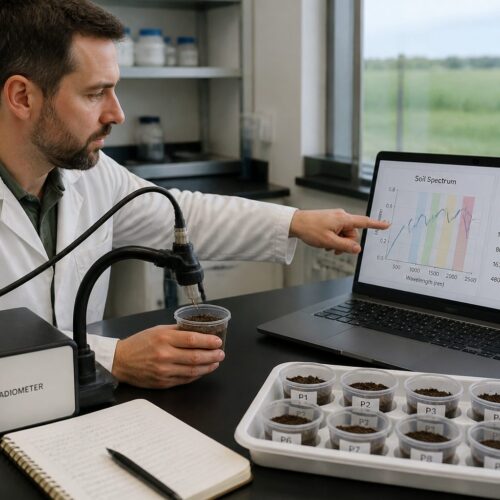
These spectral reference libraries are built by collecting spectra from a large number of soil samples, each of which has been independently analyzed in a laboratory for various properties. The resulting dataset, consisting of spectral data and corresponding soil property measurements, forms the basis of the library.
The power of a spectroscopic soil library lies in its ability to predict soil properties from spectral data alone, without the need for extensive laboratory analysis. This allows for rapid and cost-effective soil characterization over large areas, making it an invaluable tool for precision agriculture.
The Importance of Standardized Data Collection
The accuracy and reliability of spectroscopic soil libraries agriculture depend heavily on the quality and consistency of the data used to build them. Standardized data collection protocols are essential to ensure that spectral measurements are comparable across different instruments, laboratories, and geographical locations.

Without standardization, variations in measurement techniques, sample preparation methods, and environmental conditions can introduce significant errors and biases, reducing the predictive power of the library. This is particularly important when combining data from multiple sources to create a comprehensive spectral reference library.
Key aspects of standardized data collection include using calibrated instruments, following consistent sample preparation procedures, and controlling environmental factors such as temperature and humidity. It also involves documenting all metadata associated with the samples and measurements, including location, soil type, and sampling date.
Efforts are underway to develop and promote international standards for spectroscopic soil analysis, but widespread adoption is still needed. By adhering to these standards, we can ensure that spectroscopic soil libraries are robust, reliable, and applicable across a wide range of agricultural settings.
Creating and Maintaining a Soil Spectral Library
Building a spectroscopic soil library is a multifaceted process that involves careful planning, execution, and ongoing maintenance. The first step is to define the scope and objectives of the library, including the geographical area of interest, the target soil properties, and the intended applications.
Next, a representative set of soil samples must be collected from the area of interest, ensuring that the samples capture the full range of soil types and conditions. The samples should then be analyzed in the laboratory for the target soil properties, using standardized methods and quality control procedures.
| Stage | Description | Considerations |
|---|---|---|
| Planning | Define scope, objectives, and target area. | Data needs, resources, and desired outcomes. |
| Sampling | Collect representative soil samples. | Soil type variability, sampling strategy, sample size. |
| Analysis | Analyze samples for target soil properties. | Standardized methods, quality control, laboratory accreditation. |
| Spectroscopy | Measure soil spectra using calibrated instruments. | Instrument calibration, sample preparation, spectral range. |
Simultaneously, the spectral signatures of the soil samples are measured using a spectrometer, following standardized protocols for sample preparation and instrument calibration. The resulting spectral data and soil property measurements are then combined and stored in a database, along with relevant metadata.
Maintaining a soil spectral database is an ongoing process that involves updating the library with new data, validating existing data, and developing predictive models. Regular quality control checks are essential to ensure the accuracy and reliability of the library over time.
Using Libraries for Soil Characterization
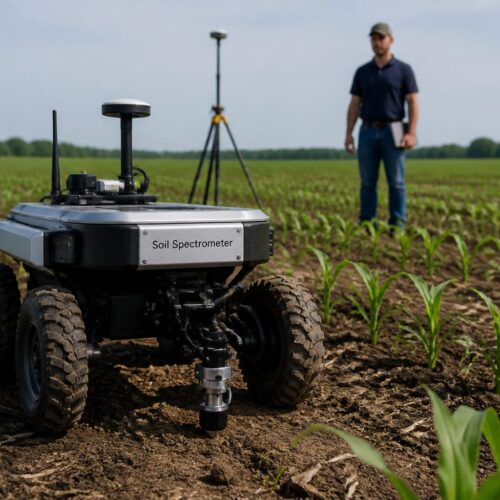
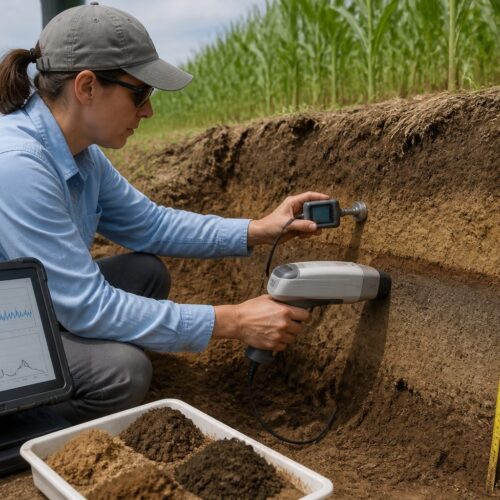
Once a spectroscopic soil library is established, it can be used to rapidly and cost-effectively characterize soils in the field. The basic principle is to measure the spectral signature of a soil sample in situ or ex situ and then use the library to predict its properties.
This can be done using a variety of instruments, ranging from handheld spectrometers to airborne and satellite-based sensors. The choice of instrument depends on the scale of the analysis, the required accuracy, and the available resources.
The spectral data is then compared to the spectra in the library, and the best matches are used to predict the soil properties. This is typically done using statistical models that have been trained on the library data.
The predicted soil properties can then be used to create soil maps, assess soil health, and guide management decisions. For example, soil maps derived from spectroscopic data can be used to optimize fertilizer application, irrigation, and tillage practices.
In addition, spectroscopic soil libraries can be used to monitor changes in soil properties over time, providing valuable information for assessing the impact of different management practices and climate change. This allows for adaptive management strategies that can improve soil health and sustainability.
Applications in Precision Agriculture
Spectroscopic soil libraries are a cornerstone of precision agriculture, enabling farmers to tailor their management practices to the specific needs of their fields. By providing rapid and detailed information about soil properties, these libraries support a range of applications that can improve crop yields, reduce input costs, and minimize environmental impacts.
One key application is variable rate fertilization, where fertilizer is applied at different rates across the field based on the spatial variability of soil nutrient levels. Spectroscopic soil libraries agriculture can be used to map soil nutrient levels and guide the application of fertilizer, ensuring that crops receive the right amount of nutrients in the right places.
Another application is irrigation management, where water is applied at different rates based on the spatial variability of soil moisture content. Spectroscopic soil libraries can be used to map soil moisture content and guide the application of irrigation, optimizing water use and preventing water stress in crops.
Spectroscopic data can also inform tillage practices, allowing farmers to reduce tillage intensity in areas with healthy soil structure and focus tillage efforts on areas with compaction or other problems. This can improve soil health, reduce erosion, and save fuel.
Beyond nutrient and water management, spectral reference libraries can support the identification and management of soil constraints, such as salinity, acidity, and sodicity. By mapping these constraints, farmers can implement targeted remediation strategies to improve soil health and productivity.
Open-Source Soil Spectral Libraries
The development and widespread adoption of spectroscopic soil libraries agriculture are greatly facilitated by open-source initiatives. Open-source soil spectral libraries provide a valuable resource for researchers, practitioners, and policymakers, promoting collaboration, innovation, and data sharing.
These data sharing platforms typically consist of spectral data, soil property measurements, metadata, and associated software tools, all of which are freely available to the public. Open-source libraries encourage transparency, reproducibility, and the development of standardized methods.
- Global Soil Map
- AfSIS project
- LandPKS
- Soil Spectroscopy for Digital Soil Mapping
- ISRIC World Soil Information
Several open-source soil spectral libraries are currently available, each with its own strengths and limitations. These libraries vary in terms of geographical coverage, soil properties included, data quality, and accessibility.
By leveraging these open-source resources, researchers can develop and validate new spectroscopic methods, practitioners can apply these methods to improve soil management, and policymakers can make informed decisions about land use and environmental protection. The key is to promote these data sharing platforms.
Challenges in Building Comprehensive Libraries
Despite the immense potential of spectroscopic soil libraries, several challenges remain in building comprehensive and globally applicable libraries. One major challenge is the high cost of collecting and analyzing soil samples, particularly for large geographical areas.
Another challenge is the lack of standardized data collection protocols, which can lead to inconsistencies and biases in the data. This makes it difficult to combine data from different sources and to develop robust predictive models.
The complexity of soil itself also poses a challenge, as soil properties are influenced by a wide range of factors, including climate, geology, and land use. Capturing this variability in a spectroscopic soil library requires a large and diverse set of samples.
Data management and accessibility are also critical challenges, as large spectroscopic soil libraries can be difficult to store, process, and share. Developing user-friendly data platforms and tools is essential to make these libraries accessible to a wide range of users.
Addressing these challenges requires a collaborative effort involving researchers, practitioners, policymakers, and funding agencies. By investing in standardized data collection, open-source data platforms, and capacity building, we can unlock the full potential of spectroscopic soil libraries for sustainable agriculture and environmental management.
The Role of Data Quality and Validation
Data quality is paramount in ensuring the reliability and accuracy of spectroscopic soil libraries agriculture. Rigorous quality control measures must be implemented at every stage of the library development process, from sample collection to spectral measurement to data analysis.
This includes using calibrated instruments, following standardized protocols, and implementing quality assurance procedures in the laboratory. It also involves validating the library data using independent datasets and comparing the predicted soil properties with actual measurements.
Data validation is particularly important when using spectroscopic soil libraries for decision-making, as inaccurate predictions can lead to suboptimal management practices. Regular validation exercises should be conducted to assess the performance of the library and to identify areas for improvement.
Furthermore, data provenance and uncertainty should be documented and communicated to users, allowing them to assess the reliability of the data and to make informed decisions. This includes providing information about the sampling methods, analytical techniques, and error estimates associated with the data.
By prioritizing data quality and validation, we can ensure that spectroscopic soil libraries are a trusted source of information for precision agriculture and environmental management. This will foster confidence in the technology and encourage its widespread adoption.
Future Trends and Innovations
The field of spectroscopic soil analysis is rapidly evolving, with new technologies and innovations emerging all the time. One promising trend is the development of portable and handheld spectrometers, which allow for rapid soil characterization in the field.
These instruments are becoming more affordable and user-friendly, making them accessible to a wider range of users. Another trend is the integration of spectroscopic data with other data sources, such as remote sensing imagery and soil maps.
This allows for a more comprehensive assessment of soil properties and their spatial distribution. Machine learning and artificial intelligence are also playing an increasingly important role in spectroscopic soil analysis, enabling the development of more accurate and robust predictive models.
These techniques can be used to identify complex relationships between spectral data and soil properties, and to improve the accuracy of soil property predictions. Furthermore, cloud computing and data analytics platforms are making it easier to store, process, and share large spectroscopic datasets.
These platforms provide a collaborative environment for researchers and practitioners to develop and apply spectroscopic methods. By embracing these future trends and innovations, we can further enhance the power and utility of spectroscopic soil libraries for precision agriculture and environmental management.
Conclusion
Spectroscopic soil libraries are a powerful tool for precision agriculture, enabling rapid and non-destructive soil characterization. These libraries provide a wealth of information about soil properties, supporting a range of applications that can improve crop yields, reduce input costs, and minimize environmental impacts.
Building and maintaining comprehensive spectroscopic soil libraries requires standardized data collection protocols, collaborative data sharing, and ongoing validation. By addressing the challenges and embracing the opportunities associated with these libraries, we can unlock their full potential for sustainable agriculture and environmental management.
The future of spectroscopic soil analysis is bright, with new technologies and innovations emerging all the time. By investing in research, development, and capacity building, we can ensure that spectroscopic soil libraries continue to play a vital role in shaping the future of agriculture.