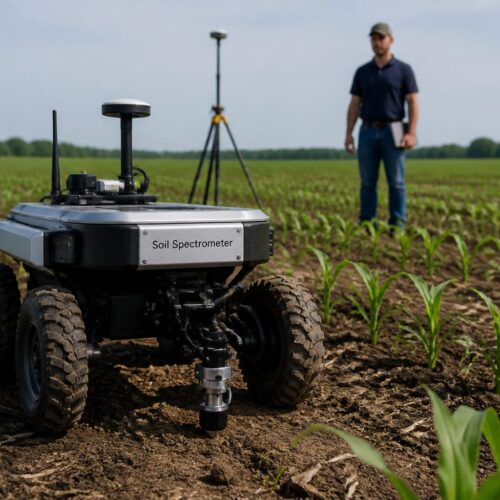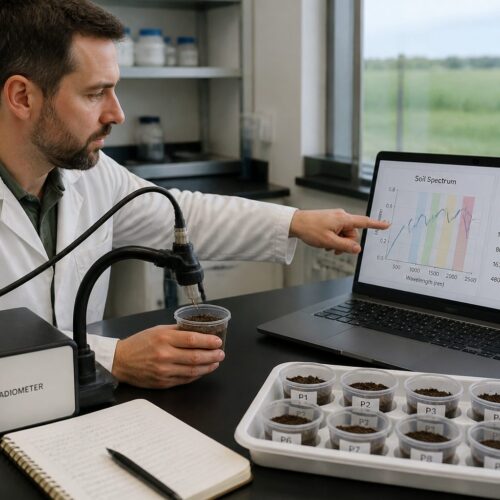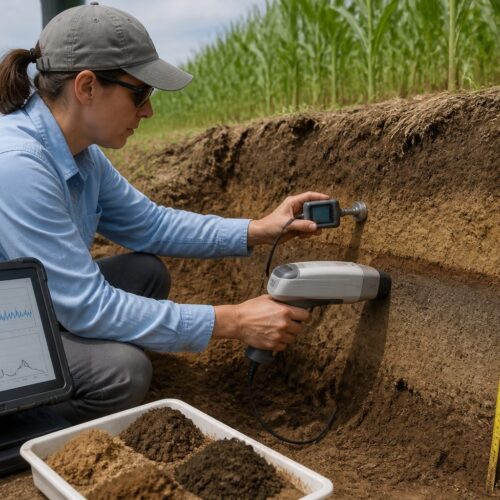


Soil spectroscopy is transforming how we understand and manage our soils. By analyzing the light reflected from soil samples, we can gather a wealth of information about its composition and health. This information is crucial for precision agriculture, enabling farmers to make informed decisions about irrigation, fertilization, and crop selection.
The ability to rapidly and non-destructively assess soil properties is a game-changer for sustainable agriculture. As technology evolves, the potential applications of soil spectroscopy are expanding, promising a more efficient and environmentally friendly approach to farming. The soil spectroscopy future is here and it is revolutionizing agriculture.
This article examines the latest innovations in soil spectroscopy, its integration with remote sensing technologies, and its role in real-time soil analysis. We will also explore how spectral data can predict crop yields, discuss the challenges and opportunities in the field, and present case studies of successful implementations of soil spectroscopy in precision agriculture.
Advancements in Spectroscopic Technologies
Spectroscopic technologies have advanced significantly in recent years, offering improved accuracy, speed, and portability. Near-infrared spectroscopy (NIRS) remains a cornerstone of soil analysis, but new techniques are emerging to complement and enhance its capabilities. These advancements are allowing for more detailed and comprehensive soil assessments.
One notable development is the use of visible near infrared spectroscopy (Vis-NIRS) combined with machine learning algorithms. This combination enables the prediction of various soil properties with greater precision. The integration of advanced sensors and data processing methods has also led to the development of handheld and field-portable spectrometers, allowing for on-site analysis and immediate feedback.
Another area of advancement is in the development of more robust and sensitive sensors. These sensors are designed to withstand harsh field conditions and provide reliable data even in challenging environments. Improvements in sensor technology have also enabled the detection of a wider range of soil constituents, including micronutrients and contaminants.
The use of laser-induced breakdown spectroscopy (LIBS) is also gaining traction in soil analysis. LIBS offers the advantage of minimal sample preparation and the ability to analyze a wide range of elements. This technique involves focusing a high-energy laser pulse onto the soil sample, creating a plasma, and analyzing the emitted light to determine the elemental composition of the soil.
Integrating Spectroscopy with Remote Sensing
The integration of soil spectroscopy with remote sensing technologies offers a powerful approach to mapping and monitoring soil properties over large areas. Remote sensing data, acquired from satellites, aircraft, and drones, provides valuable information about the spatial variability of soil characteristics. Combining this data with soil spectroscopy measurements allows for the creation of detailed and accurate predictive soil mapping.

One common approach involves using remote sensing data to identify areas with similar spectral signatures. These areas can then be targeted for soil sampling and spectroscopic analysis. The resulting data is used to calibrate and validate models that predict soil properties based on remote sensing data, enabling the creation of high-resolution soil maps.
The use of drones equipped with hyperspectral cameras is also becoming increasingly popular. Hyperspectral imaging captures a wide range of wavelengths, providing detailed spectral information about the soil surface. This data can be used to assess soil moisture content, organic matter levels, and nutrient concentrations, among other properties.
Integrating remote sensing with soil spectroscopy also enables the monitoring of soil changes over time. By comparing spectral data acquired at different time points, it is possible to track the effects of land management practices, climate change, and other factors on soil health. This information is crucial for developing sustainable land management strategies and mitigating soil degradation.
Real-time Soil Analysis for Precision Irrigation
Real-time soil analysis is essential for precision irrigation, allowing farmers to optimize water use and improve crop yields. Soil spectroscopy can play a key role in providing the data needed for real-time irrigation management. By continuously monitoring soil moisture levels and nutrient availability, farmers can tailor irrigation schedules to meet the specific needs of their crops.
One approach involves using soil moisture sensors in conjunction with spectroscopic measurements. The sensors provide continuous data on soil moisture content, while spectroscopy is used to assess nutrient levels and other soil properties. This data is then used to create irrigation maps that guide the application of water in a targeted and efficient manner.
| Sensor Type | Measured Property | Application |
|---|---|---|
| Soil Moisture Sensor | Soil Water Content | Irrigation Scheduling |
| Near-Infrared Spectroscopy | Organic Matter, Nutrients | Fertilizer Management |
| Electrochemical Sensor | Soil pH, Salinity | Soil Amendment |
| Remote Sensing | Vegetation Index | Crop Health Monitoring |
Predicting Crop Yields with Spectral Data
Soil spectroscopy offers a promising approach to predicting crop yields, enabling farmers to make informed decisions about planting, fertilization, and harvesting. By analyzing the spectral signatures of soil samples, it is possible to estimate the nutrient content, organic matter levels, and other properties that influence crop growth. This information can be used to develop models that predict crop yields with reasonable accuracy.
One common approach involves correlating spectral data with crop yield data collected from field trials. The resulting models can then be used to predict yields in other fields based on their spectral signatures. The integration of machine learning algorithms has further improved the accuracy of these models, allowing for more precise yield predictions.
The use of spectral data to predict crop yields can also help farmers optimize their fertilizer applications. By identifying areas with nutrient deficiencies, farmers can apply fertilizers in a targeted manner, reducing waste and minimizing environmental impacts. This approach is particularly valuable in regions with variable soil conditions, where traditional fertilizer application methods may not be effective.
In addition to predicting yields, soil spectroscopy can also be used to assess crop quality. By analyzing the spectral signatures of plant tissues, it is possible to estimate the nutrient content, protein levels, and other quality parameters of crops. This information can be used to make informed decisions about harvesting and processing, ensuring that crops meet the desired quality standards.
Challenges and Opportunities in Soil Spectroscopy
While soil spectroscopy offers numerous benefits, there are also several challenges that need to be addressed to fully realize its potential. One major challenge is the need for robust calibration models that can accurately predict soil properties across different regions and soil types. The development of these models requires extensive data collection and validation, which can be time-consuming and expensive.
Another challenge is the complexity of soil spectral data. Soil spectra are influenced by a wide range of factors, including mineral composition, organic matter content, moisture levels, and surface roughness. Separating the effects of these different factors can be difficult, requiring advanced data processing techniques and a thorough understanding of soil science.
- Standardizing spectral data collection protocols
- Developing open-source spectral libraries
- Improving the accessibility of spectroscopic equipment
- Training soil scientists and agricultural professionals in the use of spectroscopy
- Promoting collaboration between researchers, industry, and policymakers
Case Studies: Successful Implementations of Soil Spectroscopy
Several case studies demonstrate the successful implementation of soil spectroscopy in precision agriculture. These examples highlight the potential of this technology to improve crop yields, reduce fertilizer use, and enhance soil health. By examining these case studies, we can gain valuable insights into the practical applications of soil spectroscopy.
One example is a study conducted in the Midwestern United States, where soil spectroscopy was used to optimize nitrogen fertilizer applications in cornfields. The study found that by using spectral data to guide fertilizer applications, farmers were able to reduce nitrogen use by 20% without sacrificing yield. This resulted in significant cost savings and reduced environmental impacts.
Another case study involved the use of soil spectroscopy to assess soil health in vineyards in California. The study found that spectral data could accurately predict soil organic matter levels, which are a key indicator of soil health. By monitoring soil organic matter levels over time, vineyard managers were able to track the effects of different management practices and identify areas where soil health was declining.
In Australia, soil spectroscopy has been used to map soil salinity in agricultural areas. The study found that spectral data could accurately predict soil salinity levels, allowing farmers to target remediation efforts to the most affected areas. This approach has helped to reduce soil degradation and improve crop productivity in saline soils.
The Role of Predictive Soil Mapping
Predictive soil mapping plays a crucial role in leveraging the data obtained from soil spectroscopy. It allows for the creation of detailed maps that illustrate the spatial distribution of various soil properties. These maps are invaluable for precision agriculture, enabling farmers to make informed decisions about resource allocation and management practices across their fields.
By integrating spectroscopic data with geographic information systems (GIS) and remote sensing data, predictive soil mapping can provide a comprehensive view of soil variability. This integration enables the identification of areas with specific nutrient deficiencies, moisture imbalances, or other soil-related issues that may impact crop performance. Farmers can then use this information to tailor their management strategies to address these specific needs.
Predictive soil mapping also facilitates the monitoring of soil changes over time. By comparing soil maps generated at different time points, it is possible to track the effects of various management practices on soil properties. This information can be used to evaluate the effectiveness of different strategies and make adjustments as needed to ensure long-term soil health and productivity. Predictive soil mapping is a cornerstone of modern precision agriculture.
Moreover, predictive soil mapping supports sustainable land management by providing a basis for targeted interventions. By identifying areas that are particularly vulnerable to degradation, such as erosion or salinization, farmers can implement specific conservation practices to protect these areas. This targeted approach is more efficient and effective than applying uniform management practices across the entire field.
The Economic Benefits of Soil Spectroscopy
Implementing soil spectroscopy in precision agriculture can lead to significant economic benefits for farmers. These benefits stem from increased crop yields, reduced input costs, and improved resource efficiency. By optimizing fertilizer and irrigation applications based on soil spectroscopic data, farmers can minimize waste and maximize the return on their investments.
One of the primary economic benefits of soil spectroscopy is the potential for increased crop yields. By identifying and addressing nutrient deficiencies or other soil-related issues that may be limiting crop growth, farmers can improve overall productivity. This can translate into higher revenues and greater profitability for their operations. The improved yields are a direct result of targeted interventions.
Reduced input costs are another significant economic advantage of soil spectroscopy. By precisely tailoring fertilizer and irrigation applications to the specific needs of their crops, farmers can minimize the use of these resources. This not only saves money but also reduces the environmental impact of agricultural practices. The savings can be substantial over time.
In addition to increased yields and reduced input costs, soil spectroscopy can also lead to improved resource efficiency. By optimizing the use of water and nutrients, farmers can conserve these resources and reduce their reliance on external inputs. This can enhance the sustainability of their operations and contribute to long-term environmental stewardship. The efficiency gains are a key factor in sustainable agriculture.
Future Trends in Soil Spectroscopy Research
The field of soil spectroscopy is constantly evolving, with new research and innovations emerging all the time. Several key trends are expected to shape the future of soil spectroscopy research in the coming years. These trends include the development of more advanced sensors, the integration of artificial intelligence (AI) and machine learning (ML) techniques, and the expansion of spectroscopic applications to new areas of agriculture.
One important trend is the development of more advanced sensors with improved sensitivity and spectral resolution. These sensors will enable the detection of a wider range of soil properties and provide more accurate and detailed information about soil conditions. The advancements in sensor technology will drive further progress in soil spectroscopy. Smaller, more robust sensors are on the horizon.
The integration of AI and ML techniques is another key trend in soil spectroscopy research. AI and ML algorithms can be used to analyze complex spectral data and develop more accurate predictive models for soil properties and crop yields. These techniques can also help to automate the process of soil analysis and make it more accessible to farmers and agricultural professionals. AI integration will improve accuracy and efficiency.
Finally, the expansion of spectroscopic applications to new areas of agriculture is expected to drive further research in the field. Soil spectroscopy is already being used to assess soil health, optimize fertilizer applications, and predict crop yields. However, there is potential to expand its applications to areas such as disease detection, pest management, and irrigation scheduling. Expanded applications will broaden the impact of soil spectroscopy.
Conclusion
Soil spectroscopy is poised to play a transformative role in the future of agriculture. Its ability to provide rapid, non-destructive, and cost-effective soil analysis makes it an invaluable tool for precision agriculture. As technology advances and new applications emerge, soil spectroscopy will become increasingly integral to sustainable and efficient farming practices.
The integration of soil spectroscopy with remote sensing, real-time soil analysis, and predictive modeling offers unprecedented opportunities to optimize crop yields, reduce input costs, and enhance soil health. By embracing these innovations, farmers can create a more sustainable and prosperous future for agriculture. The soil spectroscopy future is promising and full of opportunity.