
In the realm of precision agriculture, the analysis of soil spectra plays a crucial role in mineral identification and understanding the complex dynamics of soil health. Continuum removal, a powerful technique, enhances the clarity of spectral features, leading to more accurate assessments of soil composition and providing essential data for agricultural decision-making.
This blog will delve into the intricacies of continuum removal and its applications in soil mineralogy, emphasizing the importance of accurate mineral identification in agricultural practices. By understanding the mathematical basis and practical workflows associated with continuum removal, we can significantly improve our approach to soil spectral feature extraction and ultimately enhance crop yield and sustainability.
Furthermore, we will explore how continuum removal techniques can be employed to analyze clay mineralogy and detect iron oxide features within soil samples. This holistic view will highlight the strengths and limitations of continuum removal in the context of mixed-mineral soils, ensuring a comprehensive understanding of its applications in precision agriculture.
What Continuum Removal Does to a Raw Reflectance Spectrum
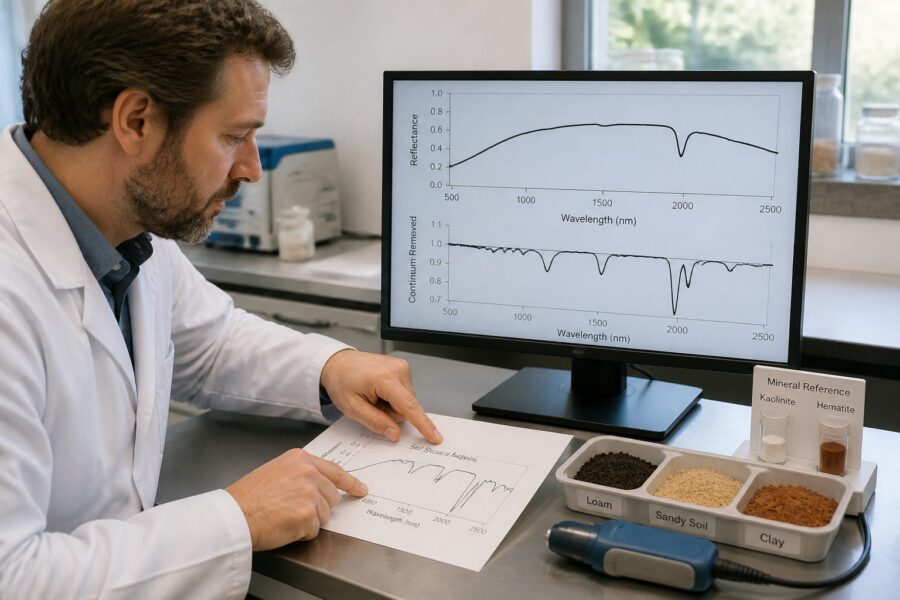
Continuum removal is a preprocessing step that modifies a raw reflectance spectrum to enhance the visibility of absorption features that are critical for mineral identification. By adjusting the baseline of the spectrum, it allows for a clearer distinction between the spectral features of different minerals, which is vital for accurate soil analysis.
This technique effectively normalizes the spectral data, making it easier to identify specific mineralogical features that may otherwise be obscured by noise. As a result, continuum removal facilitates more accurate mineral identification in soils, ultimately benefiting agricultural practices that rely on precise mineral assessments.
Moreover, continuum removal minimizes the interference caused by overlapping spectral features that can complicate the analysis of soil composition. This leads to improved absorption feature analysis and ultimately better decision-making in precision agriculture, where understanding soil health is paramount.
In practice, the continuum removal process involves creating a smooth curve that represents the continuum of the spectrum, effectively serving as a baseline for comparison. The difference between the raw spectrum and this smooth curve highlights the specific absorption features of interest, allowing researchers to focus on critical data points.
By focusing on these absorption features, researchers can gain valuable insights into the composition and health of the soil, facilitating more informed agricultural management decisions. This makes continuum removal a vital tool in the field of soil mineralogy, bridging the gap between spectral data and practical applications.
Mathematical Basis of Convex Hull Continuum Removal
The mathematical basis of convex hull continuum removal involves constructing the convex hull of the spectral data points, which is a geometric representation that encompasses all available data. This approach ensures that the continuum curve lies above all the absorption features present in the spectrum, thereby providing a reliable framework for analysis.
Using algorithms, we can efficiently compute the convex hull and derive the continuum line for the raw reflectance spectrum, allowing for precise adjustments to the data. This method is particularly effective in isolating mineralogical features that are critical for accurate soil analysis, ensuring that researchers can draw meaningful conclusions from their findings.
In convex hull continuum removal, the goal is to minimize the distance between the spectral data and the continuum line, creating a robust representation of the spectral features. This optimization process enhances the sensitivity of the analysis, allowing for better mineral identification and a clearer understanding of soil composition.
By removing the continuum, we can focus on the specific absorption features that correspond to various minerals within the soil, which is essential for effective soil management. This targeted approach leads to improved results in mineralogical assessments and contributes to more sustainable agricultural practices.
Overall, the mathematical foundation of convex hull continuum removal is pivotal for effective soil spectral analysis, providing a systematic method for data interpretation. It empowers researchers to glean valuable insights from complex spectral data, ultimately enhancing our understanding of soil health and fertility.
Why Normalized Absorption Depth Improves Mineral Discrimination
Normalized absorption depth is a crucial metric that enhances mineral discrimination in soil spectra, allowing for more accurate comparisons across different samples. By standardizing the depth of absorption features, this metric helps mitigate variability that may arise from differences in sample concentration or path length, leading to more reliable data.
This normalization process reduces variability, which can significantly impact the assessment of mineral presence and concentration. As a result, researchers can more accurately assess the presence and concentration of specific minerals, providing a clearer picture of soil mineralogy.
| Mineral Type | Normalized Depth | Absorption Feature |
|---|---|---|
| Kaolinite | 0.75 | 2200 nm |
| Smectite | 0.65 | 2300 nm |
| Illite | 0.80 | 2400 nm |
| Chlorite | 0.70 | 2500 nm |
In addition, normalized absorption depth improves the reliability of mineral identification, particularly in mixed-mineral soils where spectral overlaps can complicate analysis. By providing a clear and standardized metric for comparison, it enhances the overall accuracy of soil spectral feature extraction, reinforcing the importance of precise analytical techniques in agriculture.
Researchers often employ this metric to differentiate between minerals with similar spectral characteristics, which is vital for effective precision agriculture practices. This nuanced approach allows for better-informed decisions regarding soil management, ultimately leading to improved crop health and yield.
Step-by-Step Continuum Removal Workflow in Python and R
Implementing continuum removal in Python or R involves a systematic workflow that can be easily followed by researchers and practitioners alike. The first step is to import the necessary libraries for data manipulation and spectral analysis, ensuring that the tools required for continuum removal are readily available.
Next, load the raw reflectance spectrum data into your chosen programming environment, which serves as the foundation for applying continuum removal techniques. This initial step is critical, as it sets the stage for further analysis and allows researchers to work with real spectral data.
After this, use built-in functions or custom algorithms to compute the convex hull of the spectrum, which will help define the continuum line. This step creates the continuum line that will be used to adjust the raw reflectance data, ensuring that the baseline is accurately represented.
Once the continuum line is established, subtract it from the raw spectrum to highlight the absorption features that are of interest. This is where the magic of continuum removal truly begins to show its benefits, as the absorption features become more pronounced and easier to analyze.
Finally, visualize the continuum-removed spectrum to assess the clarity of the absorption features that have been isolated. This step is crucial for verifying the effectiveness of the continuum removal process and allows researchers to ensure that their analysis is both accurate and comprehensive.
Applying Continuum Removal to Identify Clay Mineralogy Peaks
Continuum removal plays a significant role in identifying clay mineralogy peaks in soil spectra, which is essential for understanding soil composition and fertility. By enhancing spectral clarity, researchers can pinpoint specific absorption features associated with various clay minerals that are critical for informed agricultural practices.
In particular, the technique allows for the differentiation of minerals such as kaolinite, smectite, and illite, each of which has distinct properties and implications for soil behavior. This differentiation is crucial for understanding soil properties and behavior in agricultural settings, ensuring that agronomists can tailor their practices accordingly.
Moreover, the improved visibility of clay mineral peaks aids in the assessment of soil health and fertility, allowing for more targeted soil management strategies. By identifying these minerals, agronomists can make informed decisions about soil management practices, contributing to sustainable agriculture.
As a result, continuum removal is not just a technical tool but a valuable asset in precision agriculture, where the stakes of soil health are high. Its application in mineral identification directly influences crop yield and sustainability, making it an indispensable part of modern agricultural practices.
- Kaolinite identification
- Smectite identification
- Illite identification
- Clay mineral health assessment
- Soil management recommendations
Iron Oxide Feature Detection Using Continuum-Removed Spectra
Continuum removal is also effective in detecting iron oxide features within soil spectra, which is crucial for understanding soil mineralogy and its implications for plant growth. By isolating these features, researchers can assess the presence and concentration of iron oxides in soils, providing valuable information about soil fertility.
This detection is not only important for mineral identification but also for understanding the role of iron oxides in soil health and ecosystem dynamics. Iron oxides play a significant role in soil fertility and overall ecosystem health, influencing the availability of nutrients to plants.
In practice, continuum-removed spectra enhance the ability to visualize iron oxide absorption features that may otherwise be obscured in raw data. This clarity aids in making accurate assessments of soil composition, which is essential for effective land management practices.
Furthermore, the detection of iron oxide features can inform land management practices by providing insights into soil nutrient dynamics. By understanding the iron content, farmers can optimize nutrient applications for their crops, leading to improved growth and yield.
Overall, the application of continuum removal in iron oxide feature detection underscores its importance in precision agriculture, where data-driven decisions are crucial. This technique provides critical insights that can lead to better agricultural outcomes and more sustainable farming practices.
Limitations of Continuum Removal in Mixed-Mineral Soils
While continuum removal is a powerful tool, it does have limitations, especially in mixed-mineral soils where the complexity of spectral data can pose challenges. The presence of overlapping spectral features can complicate the continuum removal process and lead to misinterpretations that may affect mineral identification.
Additionally, the convex hull method may struggle to accurately depict the baseline in highly heterogeneous samples, which can result in inaccurate mineral identification and absorption feature analysis. These challenges underscore the need for careful consideration when applying continuum removal techniques in variable soil conditions.
Moreover, continuum removal may not fully account for variations in mineral concentrations, which can impact the reliability of the results. This limitation can particularly affect soils with complex mineral assemblages, where subtle differences in concentration may carry significant implications for soil health and management.
As such, researchers must be cautious when applying continuum removal techniques in these contexts, recognizing that additional methods may be necessary for comprehensive analysis. Complementary methods may be required to enhance the accuracy of mineral identification, ensuring that all relevant data is considered.
Recognizing these limitations is essential for optimizing soil spectral analysis and ensuring that researchers can make informed decisions based on the data at hand. By being aware of the potential pitfalls, practitioners can better navigate the complexities of soil mineral assessment.
Comparing Continuum Removal to Derivative Spectroscopy for Feature Isolation
Comparing continuum removal to derivative spectroscopy reveals the strengths and weaknesses of each technique, offering insights into their respective applications. While continuum removal excels at enhancing absorption features, derivative spectroscopy focuses on the rate of change in the spectrum, providing a different perspective on the data.
Derivative spectroscopy can offer additional insights into subtle spectral features that may be overlooked by continuum removal, making it a complementary technique for soil spectral feature extraction. This combination of methods can enhance the overall understanding of soil mineralogy and improve analytical outcomes.
However, continuum removal often provides clearer visual representations of absorption features, which can be particularly beneficial for mineral identification in complex soil samples. This clarity is essential for researchers seeking to draw accurate conclusions from their spectral data.
Ultimately, the choice between these techniques depends on the specific goals of the analysis and the characteristics of the soil samples being studied. Each method has its unique advantages, making them valuable tools in the field of soil mineralogy and agricultural research.
In practice, combining both methods could yield the most comprehensive results, offering a multifaceted approach to data analysis. This synergistic approach allows for a more thorough understanding of soil composition and behavior, leading to better-informed management practices in agriculture.
Case Study: Identifying Kaolinite vs. Smectite Using Normalized Absorption Depth
A case study involving kaolinite and smectite demonstrates the effectiveness of normalized absorption depth in mineral identification, showcasing its practical applications in soil science. By analyzing soil spectra with this metric, researchers successfully differentiated between these two clay minerals, highlighting the importance of precise measurement techniques.
The study highlighted how normalized absorption depth improved the reliability of mineral identification, emphasizing its value in agricultural research. This outcome underlines the importance of precise techniques in soil spectral analysis for effective precision agriculture, where accurate data is crucial.
Furthermore, the ability to distinguish between kaolinite and smectite has significant implications for soil management practices, influencing decisions regarding fertilization and crop selection. It allows agronomists to tailor their approaches based on the specific mineralogy present, leading to better outcomes for crop health and yield.
In conclusion, continuum removal and normalized absorption depth serve as critical tools for enhancing mineral identification in soils, providing the necessary insights for effective agricultural management. Their application can lead to better soil management strategies and improved agricultural productivity, ultimately contributing to the sustainability of farming practices.