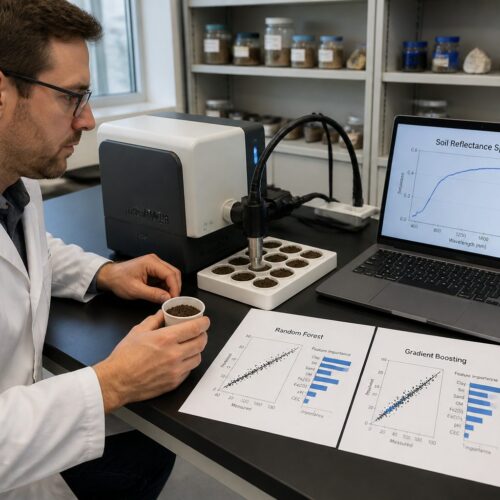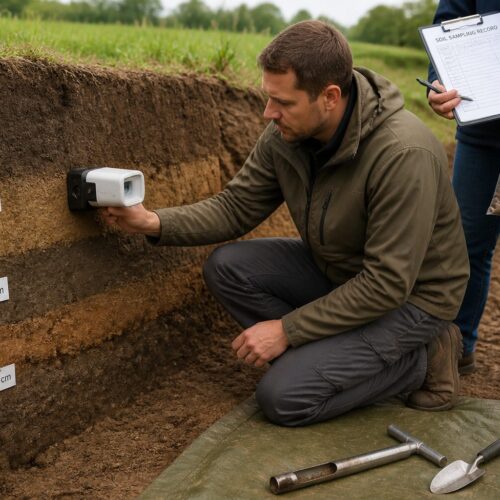


Soil spectroscopy is a powerful technique for rapidly assessing soil properties, offering valuable insights for precision agriculture. However, the accuracy of soil spectroscopy can be significantly affected by varying levels of soil moisture. It’s essential to understand and correct for these moisture effects to obtain reliable and meaningful data, which can then be used to optimize agricultural practices.
This article will discuss the impact of soil moisture on spectroscopy, explore methods for measuring soil moisture content, and delve into various soil moisture correction spectroscopy techniques. These techniques include drying methods, spectral normalization, and calibration models, providing a comprehensive guide for achieving accurate soil analysis.
By implementing appropriate soil moisture correction strategies, researchers and practitioners can unlock the full potential of soil spectroscopy. This enables informed decision-making in precision agriculture, leading to improved crop yields, efficient resource management, and sustainable farming practices.
Why Soil Moisture Affects Spectroscopy
Soil moisture significantly influences the spectral reflectance of soil, primarily because water absorbs electromagnetic radiation at specific wavelengths. This absorption alters the intensity and shape of the spectral curve, leading to inaccuracies in the determination of other soil properties.
The presence of water in soil affects the scattering of light, reducing the overall reflectance. This effect is more pronounced at certain wavelengths, particularly in the near-infrared (NIR) and mid-infrared (MIR) regions, where water absorption bands are located.
Increased soil moisture generally leads to a decrease in spectral reflectance across the entire spectrum. However, the magnitude of this decrease varies depending on the wavelength and the specific water content of the soil.
The spectral features associated with other soil components, such as organic matter, minerals, and clay content, can be masked or distorted by the presence of water. This makes it challenging to accurately quantify these properties using spectroscopy without addressing the moisture effects.
Specifically, water molecules strongly absorb light at wavelengths around 1450 nm and 1940 nm. These absorptions create distinct dips in the spectral reflectance curve, which can interfere with the identification of other soil constituents.

The amount of water present in the soil directly influences the strength of these absorption features. Higher moisture content leads to deeper and broader absorption bands, further obscuring the spectral signatures of other soil components.
Furthermore, the surface roughness of the soil can be affected by moisture. Wet soil tends to be smoother, leading to more specular reflection and less diffuse reflection, which can also alter the spectral characteristics.
The interaction between water and other soil particles can also change the refractive index of the soil matrix. This change affects the way light is scattered and absorbed, further complicating the interpretation of spectral data.
Therefore, it is crucial to carefully control or correct for soil moisture effects when using spectroscopy to analyze soil properties. Ignoring these effects can lead to inaccurate and misleading results, hindering the effectiveness of precision agriculture practices.
Understanding the specific mechanisms by which moisture influences spectral reflectance is the first step towards implementing effective correction strategies. This understanding allows researchers and practitioners to choose the most appropriate methods for minimizing the impact of moisture on their analyses.
Methods for Measuring Soil Moisture Content
Accurate measurement of soil moisture content is crucial for effective soil moisture correction spectroscopy. Several methods are available for determining soil moisture, each with its own advantages and limitations.
The choice of method depends on factors such as the required accuracy, the scale of the measurement, and the available resources. Common methods include gravimetric analysis, time-domain reflectometry (TDR), capacitance sensors, and neutron scattering.
Gravimetric analysis, considered the gold standard, involves weighing a soil sample, drying it in an oven until all moisture is removed, and then reweighing it. The difference in weight represents the water content, which is expressed as a percentage of the dry soil weight.
Time-domain reflectometry (TDR) measures the travel time of an electromagnetic pulse through the soil. The dielectric constant of the soil, which is strongly influenced by water content, affects the pulse’s travel time, allowing for an indirect measurement of moisture.
Capacitance sensors measure the soil’s dielectric permittivity, which is also related to water content. These sensors are often buried in the soil and provide continuous, real-time monitoring of moisture levels.
Neutron scattering involves emitting neutrons into the soil and measuring the number of neutrons that are slowed down by collisions with hydrogen atoms in water molecules. This method is highly accurate but requires specialized equipment and training.
Another method, frequency domain reflectometry (FDR), is similar to TDR but uses a continuous wave signal instead of a pulse. FDR sensors are often less expensive than TDR sensors and are suitable for field monitoring applications.
Remote sensing techniques, such as using satellites or drones equipped with sensors that measure microwave or thermal radiation, can also be used to estimate soil moisture over large areas. These methods are less accurate than direct measurements but provide valuable information for regional-scale monitoring.
The accuracy of each method can be affected by factors such as soil texture, salinity, and temperature. It is important to calibrate the sensors and account for these factors to ensure reliable measurements.
Ultimately, the choice of soil moisture measurement method depends on the specific requirements of the study or application. Consider the trade-offs between accuracy, cost, ease of use, and spatial resolution when selecting the most appropriate technique.
Comparing Soil Moisture Measurement Techniques
Understanding the strengths and weaknesses of different soil moisture measurement techniques is essential for selecting the most appropriate method. Each technique offers a unique balance of accuracy, cost, and ease of use.
Here’s a comparison of several common methods, highlighting their key characteristics and applications, so you can choose the best one for your specific needs.
| Method | Accuracy | Cost | Ease of Use | Applications |
|---|---|---|---|---|
| Gravimetric Analysis | High | Low | Labor-intensive | Laboratory calibration, reference method |
| Time-Domain Reflectometry (TDR) | Medium to High | Medium | Moderate | Field monitoring, research |
| Capacitance Sensors | Medium | Low to Medium | Easy | Automated monitoring, irrigation control |
| Neutron Scattering | High | High | Specialized training required | Research, deep soil moisture profiling |
| Frequency Domain Reflectometry (FDR) | Medium | Low to Medium | Easy | Field monitoring, irrigation scheduling |
Gravimetric analysis provides the most accurate direct measurement of soil moisture. However, it is destructive, time-consuming, and only provides a snapshot of moisture content at the time of sampling.
TDR offers a good balance of accuracy and convenience, allowing for repeated measurements at the same location. However, TDR probes can be expensive, and the accuracy can be affected by soil salinity and texture.
Capacitance sensors are relatively inexpensive and easy to install, making them suitable for large-scale monitoring networks. However, their accuracy is generally lower than that of gravimetric analysis and TDR.
Neutron scattering provides highly accurate measurements of soil moisture, even at great depths. However, the equipment is expensive and requires specialized training to operate safely.
FDR sensors offer a cost-effective alternative to TDR for field monitoring applications. They are easy to use and can be integrated into automated irrigation systems.
When selecting a soil moisture measurement technique, consider the specific requirements of your application, including the desired accuracy, the scale of the measurement, and the available budget. It is also important to calibrate the sensors properly to ensure reliable results.
For research purposes, gravimetric analysis is often used as a reference method to calibrate other sensors. In agricultural settings, capacitance sensors and FDR sensors are commonly used for irrigation management.
For large-scale monitoring of soil moisture, remote sensing techniques can provide valuable information, although the accuracy may be lower than that of direct measurements. Combining different measurement techniques can provide a more comprehensive understanding of soil moisture dynamics.
Drying Soil Samples for Spectroscopic Analysis
One of the most straightforward approaches to address soil moisture effects is to dry the soil samples before spectroscopic analysis. Drying removes the water, eliminating its influence on the spectral reflectance.
However, the drying process can also alter the soil’s physical and chemical properties, potentially affecting the accuracy of the analysis. Therefore, it’s crucial to implement controlled drying methods to minimize these alterations.
Oven drying is a common technique, typically performed at temperatures between 60°C and 105°C. The specific temperature and duration depend on the soil type and the target analytes, with careful consideration needed to avoid volatilization of organic compounds or alteration of mineral structures.
Air drying is another option, involving spreading the soil samples in a thin layer and allowing them to dry at room temperature. This method is gentler but slower and may not remove all the moisture, requiring a longer drying time to achieve consistent results.
Microwave drying can also be used, offering a faster drying time compared to oven drying. However, it is important to carefully control the microwave power to prevent overheating and potential damage to the soil sample.
Freeze-drying, or lyophilization, is a more specialized technique that involves freezing the soil sample and then removing the water by sublimation under vacuum. This method minimizes the alteration of soil properties but requires specialized equipment and is more expensive.
The choice of drying method should be based on the specific soil properties being analyzed and the potential impact of the drying process on those properties. For example, if volatile organic compounds are of interest, air drying or freeze-drying may be preferred over oven drying.
Regardless of the drying method used, it is important to ensure that the soil samples are completely dry before spectroscopic analysis. Incomplete drying can lead to inaccurate results and inconsistent data.
After drying, the soil samples should be stored in a dry, airtight container to prevent reabsorption of moisture from the atmosphere. This is particularly important if the samples are not analyzed immediately after drying.
It is also important to note that drying soil samples can alter their particle size distribution. This can affect the spectral reflectance, so it is important to consider this effect when interpreting the data.
Spectral Normalization Techniques for Moisture Correction
Spectral normalization techniques aim to minimize the effects of soil moisture by scaling the spectral reflectance data. These methods adjust the overall intensity of the spectrum without physically altering the soil sample.
Several normalization methods exist, each with its own mathematical approach. Common techniques include standard normal variate (SNV), multiplicative scatter correction (MSC), and continuum removal.
SNV centers and scales each spectrum by subtracting the mean reflectance and dividing by the standard deviation. This reduces the impact of multiplicative effects, such as variations in particle size and moisture content, by normalizing the data to a common scale.
MSC corrects for additive and multiplicative scatter effects by fitting a linear regression model to each spectrum. The corrected spectrum is then obtained by subtracting the intercept and dividing by the slope of the regression line, effectively removing the scatter-induced variations.
Continuum removal normalizes the spectrum by dividing it by a convex hull fitted to the spectral curve. This enhances the absorption features and reduces the influence of baseline shifts caused by moisture or other factors, making it easier to compare spectra from different samples.
Another normalization technique is vector normalization, which divides each reflectance value by the Euclidean norm of the spectrum. This method scales the spectrum to unit length, reducing the influence of variations in overall reflectance intensity.
De-trending is another approach that involves fitting a polynomial function to the spectrum and then subtracting this function from the original data. This removes baseline shifts and trends, which can be caused by moisture or other factors.
The choice of normalization technique depends on the specific characteristics of the data and the nature of the moisture effects. Some methods may be more effective than others in certain situations.
It is important to evaluate the effectiveness of each normalization technique by comparing the results with and without normalization. This can be done by assessing the accuracy of soil property predictions using calibration models.
Spectral normalization techniques can be used in combination with other moisture correction methods, such as drying or calibration modeling, to further improve the accuracy of spectroscopic analysis.
These techniques are particularly useful when it is not possible or practical to dry the soil samples before analysis. They provide a relatively simple and effective way to reduce the impact of moisture on spectral data.
Using Calibration Models to Account for Moisture
Calibration models can be developed to directly account for the influence of soil moisture on spectral data. These models use statistical techniques to relate spectral reflectance to soil properties, incorporating moisture content as a predictor variable.
By including moisture as a variable, the model can compensate for its effects, improving the accuracy of soil property predictions. This approach requires a dataset with both spectral measurements and corresponding moisture content data.
- Partial Least Squares Regression (PLSR)
- Multiple Linear Regression (MLR)
- Support Vector Regression (SVR)
- Artificial Neural Networks (ANN)
- Gaussian Process Regression (GPR)
Partial Least Squares Regression (PLSR) is a widely used technique for developing calibration models. It reduces the dimensionality of the spectral data by identifying latent variables that are correlated with both the spectral reflectance and the soil properties of interest.
Multiple Linear Regression (MLR) is a simpler technique that relates soil properties to a linear combination of spectral reflectance values at specific wavelengths. However, MLR can be less effective than PLSR when dealing with highly correlated spectral data.
Support Vector Regression (SVR) is a machine learning technique that uses kernel functions to map the spectral data into a higher-dimensional space, where a linear regression model is then fitted. SVR can be more robust than PLSR and MLR when dealing with non-linear relationships between spectral data and soil properties.
Artificial Neural Networks (ANN) are another machine learning technique that can learn complex relationships between spectral data and soil properties. ANNs consist of interconnected nodes that process and transmit information, allowing them to model non-linear relationships and interactions between variables.
Gaussian Process Regression (GPR) is a non-parametric technique that provides a probabilistic prediction of soil properties based on the spectral data. GPR can also provide uncertainty estimates, which can be useful for assessing the reliability of the predictions.
When developing calibration models, it is important to use a representative dataset that covers the range of soil types and moisture conditions present in the study area. The dataset should also be large enough to ensure that the model is robust and accurate.
The performance of the calibration model should be evaluated using independent validation data. Common metrics for evaluating model performance include the coefficient of determination (R²), root mean square error (RMSE), and ratio of performance to deviation (RPD).
Calibration models can be used to predict soil properties from spectral data even when the soil moisture content is unknown. However, the accuracy of the predictions will be higher if the moisture content is measured and included as a predictor variable in the model.
These models offer a powerful approach to account for moisture effects in soil spectroscopy, enabling more accurate and reliable predictions of soil properties. They are particularly useful when it is not possible or practical to dry the soil samples before analysis.
Evaluating the Effectiveness of Moisture Correction
Evaluating the effectiveness of soil moisture correction techniques is essential to ensure the accuracy and reliability of spectroscopic analysis. Several statistical metrics can be used to assess the performance of different correction methods.
Common metrics include the coefficient of determination (R²), root mean square error (RMSE), and ratio of performance to deviation (RPD). These metrics provide a quantitative measure of how well the corrected spectral data predict soil properties compared to the original, uncorrected data.
The coefficient of determination (R²) indicates the proportion of variance in the measured soil properties that is explained by the spectral data. A higher R² value suggests a better fit between the predicted and measured values, indicating a more effective moisture correction.
The root mean square error (RMSE) quantifies the average difference between the predicted and measured soil properties. A lower RMSE value indicates a smaller prediction error and, therefore, a more accurate moisture correction.
The ratio of performance to deviation (RPD) is calculated as the ratio of the standard deviation of the measured soil properties to the RMSE. An RPD value greater than 2.0 is generally considered acceptable for quantitative predictions, while values between 1.4 and 2.0 indicate reasonable predictions that can be used for screening purposes.
In addition to these metrics, visual inspection of the spectral data can also provide valuable insights into the effectiveness of moisture correction. Comparing the corrected and uncorrected spectra can reveal whether the correction method has successfully removed the moisture-related features.
Another approach is to compare the performance of calibration models developed using corrected and uncorrected spectral data. If the model developed using corrected data has a higher R² and lower RMSE than the model developed using uncorrected data, this indicates that the moisture correction method is effective.
It is also important to consider the specific soil properties being analyzed when evaluating the effectiveness of moisture correction. Some properties may be more sensitive to moisture effects than others, and the choice of correction method should be tailored to the specific property of interest.
The validation dataset used to evaluate the performance of the moisture correction method should be independent of the calibration dataset used to develop the calibration model. This ensures that the evaluation is unbiased and provides a realistic estimate of the model’s performance on new data.
It is also important to consider the cost and complexity of the moisture correction method when evaluating its effectiveness. Some methods may provide slightly better accuracy but require significantly more time and resources to implement.
Ultimately, the best way to evaluate the effectiveness of moisture correction is to compare the results with independent measurements of soil properties. This provides a direct assessment of the accuracy of the spectroscopic analysis and the effectiveness of the moisture correction method.
Advanced Techniques for Soil Moisture Correction
Beyond the basic methods, several advanced techniques can further improve the accuracy of soil moisture correction spectroscopy. These techniques often involve more complex mathematical models and require specialized software or programming skills.
One such technique is wavelet transform, which decomposes the spectral data into different frequency components. This allows for the separation of moisture-related signals from other spectral features, enabling more targeted correction.
Another advanced approach is the use of machine learning algorithms, such as support vector machines (SVM) and artificial neural networks (ANN). These algorithms can learn complex relationships between spectral data, moisture content, and soil properties, providing highly accurate predictions.
Furthermore, combining multiple correction techniques can often yield better results than using a single method. For example, drying soil samples followed by spectral normalization or calibration modeling can provide a more robust and accurate correction.
Wavelet transform can be used to identify and remove the specific spectral features that are associated with soil moisture. This can improve the accuracy of soil property predictions, particularly when the moisture content is highly variable.
Support vector machines (SVM) are powerful machine learning algorithms that can handle high-dimensional data and non-linear relationships. SVMs can be trained to predict soil properties from spectral data, even in the presence of significant moisture variations.
Artificial neural networks (ANN) are another type of machine learning algorithm that can learn complex patterns in spectral data. ANNs can be trained to predict soil properties and to correct for the effects of soil moisture.
Deep learning, a subset of machine learning, involves using ANNs with multiple layers to extract even more complex features from the spectral data. Deep learning models can be particularly effective for correcting for soil moisture effects in complex soil systems.
Another advanced technique is the use of radiative transfer models, which simulate the interaction of light with the soil. These models can be used to estimate the soil moisture content and to correct for its effects on the spectral reflectance.
Combining different data sources, such as spectral data, soil moisture measurements, and meteorological data, can also improve the accuracy of soil property predictions. This approach allows for a more comprehensive understanding of the factors that influence soil reflectance.
Case Studies: Soil Moisture Correction in Action
Examining real-world case studies can provide valuable insights into the application and effectiveness of soil moisture correction techniques. These studies demonstrate how different correction methods have been used to address moisture effects in various agricultural settings.
One study conducted in a semi-arid region of Australia investigated the use of spectral normalization to improve the prediction of soil organic carbon. The researchers found that SNV and MSC significantly reduced the impact of soil moisture, leading to more accurate estimates of organic carbon content.
Another case study in the United States focused on using calibration models to predict soil texture in agricultural fields. The researchers incorporated soil moisture content as a predictor variable in their PLSR model, which resulted in a substantial improvement in prediction accuracy compared to models that did not account for moisture.
A third study in Europe explored the use of wavelet transform to correct for moisture effects in soil spectroscopy data. The researchers found that wavelet-based correction effectively removed the moisture-related signals, allowing for more accurate determination of soil nutrient levels.
In a study conducted in Brazil, researchers used artificial neural networks (ANNs) to predict soil properties from spectral data, taking into account the effects of soil moisture. The ANN model was able to accurately predict soil organic matter, clay content, and cation exchange capacity, even in the presence of significant moisture variations.
Another case study in China investigated the use of radiative transfer models to correct for soil moisture effects in remote sensing data. The researchers found that the radiative transfer model was able to accurately estimate soil moisture content and to improve the accuracy of soil property predictions.
In a study conducted in Africa, researchers compared the performance of different soil moisture correction techniques for predicting soil fertility indicators. The results showed that combining spectral normalization with calibration modeling provided the most accurate predictions.
These case studies demonstrate the importance of addressing soil moisture effects in soil spectroscopy. By using appropriate correction techniques, researchers and practitioners can obtain more accurate and reliable information about soil properties, leading to improved agricultural management practices.
The specific choice of moisture correction technique will depend on the specific soil properties being analyzed, the available data, and the resources available. However, the case studies highlight the potential benefits of using a combination of different techniques to achieve the best results.
These real-world examples showcase the versatility and effectiveness of soil moisture correction techniques in various geographical locations and agricultural contexts. They provide valuable guidance for researchers and practitioners seeking to improve the accuracy of soil spectroscopy.
Conclusion
Soil moisture poses a significant challenge to the accuracy of soil spectroscopy, but various correction techniques can mitigate its effects. Drying methods, spectral normalization, and calibration models offer effective strategies for improving the reliability of spectroscopic analysis.
By carefully considering the choice of method, the specific soil properties of interest, and the practical considerations involved, researchers and practitioners can unlock the full potential of soil spectroscopy. This enables informed decision-making in precision agriculture, leading to improved crop yields, efficient resource management, and sustainable farming practices, all thanks to effective soil moisture correction spectroscopy.
The continued development and refinement of soil moisture correction techniques will further enhance the capabilities of soil spectroscopy. This will lead to more accurate and reliable soil assessments, supporting sustainable agriculture and environmental management practices worldwide.
Embracing these advanced techniques and understanding their nuances is crucial for the future of precision agriculture. As technology advances, so too will our ability to analyze and manage our soil resources effectively.
Ultimately, the goal is to harness the power of soil spectroscopy to create a more sustainable and productive agricultural system. By addressing the challenges posed by soil moisture, we can unlock the full potential of this valuable tool and pave the way for a more food-secure future.