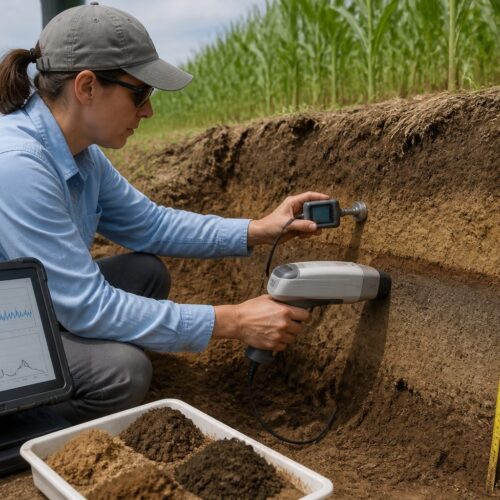


In today’s world, ensuring the safety of our food supply is more critical than ever. One major threat to food safety is the presence of heavy metals in soil, which can be absorbed by plants and ultimately end up in the food we eat.
Traditional methods of detecting these contaminants are often time-consuming and expensive, but fortunately, a cutting-edge technology offers a faster, more efficient solution: soil spectroscopy heavy metal detection. This method is becoming increasingly popular as a way to ensure environmental monitoring and protect human health.
Soil spectroscopy is a powerful tool that can identify and quantify the presence of heavy metals in soil samples. By analyzing the spectral data, we can gain valuable insights into the extent and nature of soil contamination, enabling us to take targeted action to remediate affected areas and prevent further harm.
The Risks of Heavy Metal Contamination in Soil
Heavy metal contamination in soil poses a significant threat to both environmental and human health. These metals, including lead, mercury, cadmium, and arsenic, can persist in the soil for extended periods, accumulating over time and entering the food chain.
This accumulation can have devastating consequences, as plants grown in contaminated soil absorb these metals, which then make their way into the food supply. Consuming food contaminated with heavy metals can lead to a range of health problems, including developmental issues, organ damage, and even cancer.
The risks of soil contamination are particularly high in areas with a history of industrial activity, mining operations, or improper waste disposal. These activities can release large quantities of heavy metals into the environment, leading to widespread soil contamination and posing a threat to nearby communities.
It’s not just about direct consumption of contaminated food, it’s about the broader impact on ecosystems. Heavy metals can also contaminate water sources, harming aquatic life and disrupting ecological balance.
The long-term effects of heavy metal exposure can be subtle but cumulative, impacting future generations. Children are especially vulnerable, as their developing bodies are more susceptible to the toxic effects of these metals. Therefore, proactive measures to prevent and remediate soil contamination are crucial for safeguarding public health.

Furthermore, heavy metal contamination can negatively impact soil fertility and agricultural productivity. The presence of these metals can inhibit plant growth, reduce crop yields, and decrease the nutritional value of food. This can have significant economic consequences for farmers and communities that rely on agriculture.
The complex interactions between heavy metals and soil components make remediation a challenging task. Understanding the specific chemical forms and bioavailability of different heavy metals is essential for developing effective strategies. Soil spectroscopy heavy metal detection offers a valuable tool for characterizing these complex interactions and guiding remediation efforts.
The ecological consequences of heavy metal contamination extend beyond the immediate vicinity of the contaminated site. These metals can be transported through the air and water, affecting ecosystems far downstream. This underscores the need for a holistic approach to environmental management that considers the interconnectedness of different environmental compartments.
Sources of Heavy Metal Pollution
Understanding the sources of soil contamination is the first step in preventing it. Industrial activities are a major culprit, with smelting, electroplating, and chemical manufacturing releasing heavy metals into the environment.
Mining operations, both active and abandoned, can also contribute significantly to soil contamination, as the extraction and processing of ores often involve the release of heavy metals. Agriculture, while essential for food production, can also be a source of heavy metal contamination.
The use of fertilizers, pesticides, and sewage sludge can introduce heavy metals into the soil, especially if these products are derived from contaminated sources. Improper waste disposal practices, such as illegal dumping and inadequate landfill management, can also lead to soil contamination.
Even seemingly innocuous activities can play a role; for example, the use of leaded gasoline in the past has left a legacy of lead contamination in soils near roadways. Identifying and addressing these sources is essential for effective soil remediation and prevention of future contamination.
The legacy of past industrial practices continues to impact soil quality in many regions around the world. Brownfield sites, often located in urban areas, are frequently contaminated with a cocktail of heavy metals and other pollutants. Redeveloping these sites requires careful assessment and remediation to ensure the safety of future residents and workers.
The global trade in electronic waste (e-waste) is another emerging source of heavy metal contamination. Improper recycling of e-waste can release heavy metals into the environment, particularly in developing countries where environmental regulations may be less stringent. Promoting responsible e-waste management practices is essential for preventing further contamination.
Natural sources of heavy metals, such as volcanic activity and weathering of rocks, can also contribute to soil contamination, although these sources are generally less significant than anthropogenic sources. However, in certain regions with naturally high levels of heavy metals in the bedrock, the background concentrations in soil may exceed regulatory limits.
The increasing demand for mineral resources to support technological advancements and economic growth is likely to exacerbate the problem of heavy metal contamination in the future. Sustainable mining practices and responsible resource management are crucial for minimizing the environmental impact of mining operations.
Using Spectroscopy to Identify Heavy Metals
Soil spectroscopy offers a rapid and cost-effective way to identify heavy metals in soil. This technique involves analyzing the interaction of electromagnetic radiation with soil samples to determine their chemical composition.
When light interacts with soil, certain wavelengths are absorbed or reflected depending on the specific elements present. By measuring the reflected or absorbed light, we can create a spectral signature that is unique to each element, including heavy metals.
| Heavy Metal | Spectral Feature | Wavelength (nm) |
|---|---|---|
| Lead (Pb) | Electronic transitions | 200-300 |
| Cadmium (Cd) | Charge transfer | 228.8 |
| Arsenic (As) | Vibrational modes | 193.7 |
| Mercury (Hg) | Atomic absorption | 253.7 |
| Copper (Cu) | Ligand field transitions | 324.8 |
Different heavy metals exhibit distinct spectral features, allowing for their identification and quantification. Soil spectroscopy heavy metal detection is a non-destructive method, meaning that the soil sample remains intact after analysis, allowing for further testing if needed.
The spectral signatures of heavy metals can be influenced by various factors, such as soil moisture content, organic matter content, and mineral composition. Therefore, it is important to carefully calibrate and validate spectroscopic models to ensure accurate results. Sophisticated data analysis techniques are often required to account for these confounding factors.
Soil spectroscopy can also be used to assess the bioavailability of heavy metals in soil. By analyzing the spectral features associated with different chemical forms of heavy metals, we can gain insights into their potential to be absorbed by plants and enter the food chain. This information is crucial for assessing the risks associated with soil contamination.
The speed and efficiency of soil spectroscopy make it a valuable tool for large-scale soil surveys and environmental monitoring programs. Traditional laboratory methods for heavy metal analysis can be time-consuming and expensive, limiting the number of samples that can be analyzed. Soil spectroscopy offers a cost-effective alternative for rapidly assessing soil quality over large areas.
Furthermore, soil spectroscopy can be used to track the effectiveness of remediation efforts over time. By repeatedly analyzing soil samples using spectroscopy, we can monitor the changes in heavy metal concentrations and assess the success of different remediation strategies. This allows for adaptive management and optimization of remediation efforts.
Types of Spectroscopy Used
Several types of spectroscopy can be used for soil analysis, each with its own advantages and limitations. Visible near-infrared (Vis-NIR) spectroscopy is a popular choice due to its ease of use and relatively low cost.
It analyzes the interaction of visible and near-infrared light with soil, providing information about the organic matter content, moisture levels, and mineral composition. X-ray fluorescence (XRF) spectroscopy is another powerful technique that can directly measure the concentration of heavy metals in soil.
XRF works by bombarding the soil sample with X-rays, which cause the elements in the soil to emit secondary X-rays with characteristic energies. By measuring the intensity of these secondary X-rays, we can determine the concentration of each element present.
Other spectroscopic methods, such as atomic absorption spectroscopy (AAS) and inductively coupled plasma mass spectrometry (ICP-MS), can also be used for soil analysis, but these techniques typically require more sample preparation and are more expensive than Vis-NIR and XRF.
Raman spectroscopy is another technique that can provide valuable information about the molecular composition of soil. It measures the vibrational modes of molecules in the soil, which can be used to identify different organic and inorganic compounds, including heavy metal complexes. Raman spectroscopy is particularly useful for studying the speciation of heavy metals in soil.
Laser-induced breakdown spectroscopy (LIBS) is a relatively new technique that involves focusing a high-energy laser pulse onto the soil sample, creating a plasma. The light emitted from the plasma is then analyzed to determine the elemental composition of the soil. LIBS is a rapid and versatile technique that can be used to analyze a wide range of elements, including heavy metals.
Each spectroscopic technique has its own strengths and weaknesses in terms of sensitivity, accuracy, and cost. The choice of which technique to use depends on the specific application and the resources available. Often, a combination of different spectroscopic techniques is used to obtain a more complete picture of soil composition and contamination.
The development of portable and handheld spectrometers has made it possible to perform soil analysis in the field, reducing the need for transporting samples to the laboratory. These portable instruments are becoming increasingly popular for environmental monitoring and site assessment.
Quantifying Heavy Metal Concentrations with Spectral Data
While spectroscopy can identify the presence of heavy metals, it is equally important to quantify their concentrations. This information is crucial for assessing the severity of soil contamination and determining the appropriate remediation strategies.
To quantify heavy metal concentrations, spectral data is typically used to develop calibration models. These models relate the spectral features of soil samples to the known concentrations of heavy metals, which are determined through laboratory analysis of a subset of samples.
Once the calibration model is established, it can be used to predict the concentrations of heavy metals in other soil samples based on their spectral data. The accuracy of these predictions depends on the quality of the calibration model and the representativeness of the calibration samples.
Advanced chemometric techniques, such as partial least squares regression (PLSR) and support vector machines (SVM), are often used to develop robust and accurate calibration models. These techniques can handle complex spectral data and account for the interactions between different soil components.
The selection of appropriate calibration samples is critical for developing accurate and reliable predictive models. The calibration samples should be representative of the range of soil types and heavy metal concentrations found in the study area. Stratified random sampling is often used to ensure that the calibration samples are representative of the population.
Cross-validation techniques are used to assess the performance of the calibration models and to estimate their prediction error. Cross-validation involves dividing the calibration data into multiple subsets and using each subset to validate the model developed using the remaining subsets. This provides a more robust estimate of the model’s performance than simply using the entire dataset for both calibration and validation.
The accuracy of the predicted heavy metal concentrations can be further improved by incorporating ancillary data, such as soil texture, organic matter content, and pH, into the calibration models. These ancillary data can help to account for the influence of soil properties on the spectral signatures of heavy metals.
The quantified heavy metal concentrations can be used to create maps of soil contamination, which can be used to guide remediation efforts and to assess the risks to human health and the environment. These maps can be created using geographic information systems (GIS) software, which allows for the spatial analysis and visualization of soil contamination data.
Developing Remediation Strategies for Contaminated Soils
Once the extent and severity of soil contamination have been assessed, the next step is to develop effective remediation strategies. Several approaches can be used to remediate contaminated soils, depending on the type and concentration of heavy metals present, as well as the specific characteristics of the soil.
One common approach is soil removal and replacement, where the contaminated soil is excavated and replaced with clean soil. This method is effective for removing heavy metals from the soil, but it can be expensive and disruptive.
Another approach is stabilization, which involves adding amendments to the soil to immobilize the heavy metals and prevent them from being absorbed by plants. Amendments such as lime, phosphate, and organic matter can be used to increase the pH of the soil and bind the heavy metals, reducing their bioavailability.
Phytoremediation is a promising technology that uses plants to remove or stabilize heavy metals in soil. Certain plants, known as hyperaccumulators, can absorb high concentrations of heavy metals from the soil and store them in their tissues, which can then be harvested and disposed of.
In situ stabilization techniques are often preferred over soil removal because they are less disruptive and more cost-effective. These techniques involve treating the contaminated soil in place, without the need for excavation. Chemical stabilization, bioremediation, and electrokinetic remediation are examples of in situ techniques.
Bioremediation uses microorganisms to degrade or transform heavy metals into less toxic forms. This approach is particularly effective for remediating soils contaminated with organic pollutants, but it can also be used to remediate soils contaminated with certain heavy metals. The effectiveness of bioremediation depends on the type of microorganisms present in the soil and the environmental conditions.
Electrokinetic remediation uses an electric field to transport heavy metals through the soil to an extraction well. This technique is particularly effective for remediating soils with low permeability, where other remediation methods may be less effective. The effectiveness of electrokinetic remediation depends on the electrical properties of the soil and the type of heavy metals present.
The selection of the most appropriate remediation strategy depends on a variety of factors, including the type and concentration of heavy metals, the soil characteristics, the land use, and the cost. A comprehensive site assessment is essential for developing an effective remediation plan.
Regulatory Standards for Heavy Metal Levels in Soil
To protect human health and the environment, regulatory standards have been established for heavy metal levels in soil. These standards vary depending on the specific heavy metal and the intended land use, with stricter limits for residential and agricultural areas compared to industrial sites.
In the United States, the Environmental Protection Agency (EPA) sets standards for heavy metal levels in soil through various regulations and guidelines. These standards are based on scientific assessments of the potential risks associated with exposure to heavy metals, taking into account factors such as the toxicity of the metal, the exposure pathway, and the sensitivity of the population.
- EPA’s Superfund program
- Resource Conservation and Recovery Act (RCRA)
- Clean Water Act
- Safe Drinking Water Act
- State environmental regulations
It’s not just the federal government; many states also have their own regulations for heavy metal levels in soil, which may be more stringent than the federal standards. Compliance with these regulatory standards is essential for ensuring that contaminated sites are properly remediated and that human health and the environment are protected.
International organizations, such as the World Health Organization (WHO) and the Food and Agriculture Organization (FAO), also provide guidelines for heavy metal levels in soil and food. These guidelines are based on scientific evidence and are intended to protect human health and promote sustainable agriculture. Adopting these guidelines can help to ensure the safety of food produced in contaminated areas.
The regulatory standards for heavy metal levels in soil are constantly evolving as new scientific information becomes available. It is important to stay up-to-date on the latest regulations and guidelines to ensure compliance and to protect human health and the environment. Regular monitoring of soil quality is essential for identifying and addressing potential contamination problems.
The enforcement of regulatory standards for heavy metal levels in soil is crucial for ensuring that contaminated sites are properly remediated and that responsible parties are held accountable. Effective enforcement requires strong regulatory frameworks, adequate funding, and trained personnel. Collaboration between government agencies, industry, and the public is essential for achieving effective environmental protection.
Public awareness of the risks associated with heavy metal contamination is essential for promoting responsible environmental practices. Educating the public about the sources of contamination, the health effects of exposure, and the available remediation options can help to prevent future contamination and to protect human health.
Case Studies: Successful Heavy Metal Remediation Projects
Several successful heavy metal remediation projects have demonstrated the effectiveness of various remediation strategies. One example is the remediation of the Tar Creek Superfund site in Oklahoma, which was contaminated with lead, zinc, and cadmium from decades of mining operations.
The remediation project involved the removal of contaminated soil, the stabilization of mine tailings, and the restoration of wetlands. Another example is the remediation of the Milltown Reservoir Sediments Superfund site in Montana, which was contaminated with arsenic and copper from mining activities.
The project used a combination of capping, soil removal, and phytoremediation to reduce the levels of heavy metals in the soil and sediments. These case studies illustrate the importance of using a comprehensive approach to remediation, combining different strategies to achieve the desired outcome.
They also highlight the need for long-term monitoring to ensure that the remediation efforts are effective and that the site remains safe for human health and the environment. Soil spectroscopy heavy metal detection plays a key role in these monitoring efforts, providing a rapid and cost-effective way to assess the effectiveness of remediation and identify any potential recontamination.
The Iron Mountain Mine in California is another example of a successful heavy metal remediation project. This site was heavily contaminated with acid mine drainage containing high concentrations of copper, zinc, and cadmium. The remediation project involved the construction of a water treatment plant to remove the heavy metals from the acid mine drainage and the implementation of measures to prevent further contamination.
The Palmerton Zinc Pile Superfund site in Pennsylvania is an example of a remediation project that involved the use of phytoremediation. This site was contaminated with zinc and cadmium from zinc smelting operations. The remediation project involved planting trees and other vegetation to stabilize the soil and to absorb the heavy metals. This approach has been successful in reducing the levels of heavy metals in the soil and in improving the ecological health of the site.
The success of these remediation projects depends on a variety of factors, including the selection of appropriate remediation technologies, the effective implementation of the remediation plan, and the long-term monitoring of the site. Collaboration between government agencies, industry, and the public is essential for achieving successful remediation outcomes.
These case studies demonstrate that it is possible to remediate heavy metal contaminated sites and to restore them to productive use. By learning from these successes, we can improve our ability to address heavy metal contamination problems and to protect human health and the environment.
Future Trends in Soil Spectroscopy
The field of soil spectroscopy is constantly evolving, with new technologies and applications emerging all the time. One exciting trend is the development of portable and handheld spectrometers, which allow for rapid on-site analysis of soil samples.
These devices can be used to quickly screen large areas for heavy metal contamination, providing valuable information for targeted sampling and remediation efforts. Another trend is the integration of soil spectroscopy with remote sensing technologies, such as drones and satellites.
This integration allows for the mapping of heavy metal contamination over large areas, providing a comprehensive picture of the extent and distribution of contamination. Machine learning algorithms are also being used to improve the accuracy and efficiency of soil spectroscopy analysis.
These algorithms can be trained to recognize complex spectral patterns and predict heavy metal concentrations with greater precision than traditional methods. As these technologies continue to develop, soil spectroscopy will become an even more powerful tool for environmental monitoring and ensuring food safety.
The development of hyperspectral imaging technology is enabling the acquisition of detailed spectral information over a wide range of wavelengths. This technology can be used to identify and quantify a variety of soil properties, including heavy metal concentrations, with greater accuracy and precision. Hyperspectral imaging is particularly useful for mapping soil contamination over large areas.
The integration of soil spectroscopy with blockchain technology is emerging as a promising approach for ensuring the transparency and traceability of soil data. Blockchain technology can be used to create a secure and immutable record of soil analysis results, which can be used to verify the authenticity of soil data and to track the movement of contaminated soil.
The use of artificial intelligence (AI) is transforming the field of soil spectroscopy. AI algorithms can be used to automate the analysis of spectral data, to identify patterns and relationships that would be difficult to detect manually, and to develop more accurate and robust predictive models. AI is also being used to develop new sensors and instruments for soil spectroscopy.
The future of soil spectroscopy is likely to be characterized by the development of more sophisticated sensors, more powerful data analysis techniques, and more integrated approaches to environmental monitoring. These advancements will enable us to better understand and manage soil contamination problems and to protect human health and the environment.
Conclusion
Heavy metal contamination in soil is a serious issue that poses a threat to both environmental and human health. Soil spectroscopy offers a rapid, cost-effective, and non-destructive way to identify and quantify heavy metals in soil, enabling us to develop targeted remediation strategies and protect our food supply.
By understanding the risks of heavy metal contamination, utilizing advanced spectroscopic techniques, and implementing effective remediation strategies, we can ensure a safer and healthier future for all.
The adoption of sustainable agricultural practices, such as reducing the use of fertilizers and pesticides, can help to prevent future heavy metal contamination. Promoting responsible industrial practices, such as proper waste management and pollution control, is also essential for protecting soil quality. By working together, we can create a more sustainable and healthy environment for future generations.
Continued research and development are needed to improve the accuracy and efficiency of soil spectroscopy techniques and to develop new and innovative remediation strategies. Investing in research and development is essential for addressing the challenges of heavy metal contamination and for ensuring a sustainable future.