
Precision agriculture relies on detailed knowledge of soil properties to optimize crop production. Soil spectroscopy offers a rapid and cost-effective method for assessing various soil parameters. This article focuses on using soil spectroscopy to determine soil organic matter content, a critical indicator of soil health and fertility.
Understanding and managing soil organic matter is essential for sustainable agriculture. Soil spectroscopy provides a valuable tool for achieving this goal, helping farmers make informed decisions and improve soil health.
By leveraging the power of spectral analysis, we can gain deeper insights into soil composition and its impact on agricultural productivity. Let’s examine how soil spectroscopy can enhance our understanding and management of soil organic matter.
The Role of Organic Matter in Soil Health
Organic matter is the fraction of soil composed of decomposed plant and animal residues, along with microbial biomass. It plays a crucial role in maintaining soil structure, water retention, and nutrient availability.
Soils with high organic matter content tend to have better aggregation, which improves aeration and water infiltration. This, in turn, supports healthy root development and reduces soil erosion.
Organic matter serves as a reservoir of essential nutrients, such as nitrogen, phosphorus, and sulfur. These nutrients are gradually released through decomposition, providing a sustained supply for plant growth.
Furthermore, organic matter enhances the soil’s buffering capacity, helping to stabilize pH levels and reduce the impact of pollutants. It also supports a diverse community of soil microorganisms that contribute to nutrient cycling and disease suppression.
In essence, organic matter is the cornerstone of soil health, influencing nearly all physical, chemical, and biological properties. Maintaining adequate levels of organic matter is vital for long-term soil fertility and agricultural sustainability.
Therefore, monitoring and managing organic matter content should be a priority for farmers and land managers. Soil spectroscopy offers a powerful tool for rapidly assessing organic matter levels and guiding soil management decisions.

Traditional Methods for Measuring Organic Matter
Traditional methods for measuring soil organic matter content often involve laboratory analysis. These methods typically include dry combustion, wet oxidation, and loss on ignition (LOI).
Dry combustion involves heating a soil sample to a high temperature in the presence of oxygen. The organic matter is oxidized, and the resulting carbon dioxide is measured to determine the organic carbon content.
Wet oxidation methods, such as the Walkley-Black method, use chemical oxidants to break down organic matter. The amount of oxidant consumed is then measured to estimate the organic carbon content.
Loss on ignition involves heating a soil sample to a high temperature and measuring the weight loss. This weight loss is assumed to be due to the combustion of organic matter, but it can also include the loss of water and other volatile compounds.
While these traditional methods are accurate, they can be time-consuming and expensive. They also require specialized equipment and trained personnel, making them less accessible for routine soil testing.
Moreover, traditional methods often involve destructive sampling, meaning the soil sample cannot be used for other analyses. In contrast, soil spectroscopy offers a non-destructive and rapid alternative for estimating organic matter content.
Using Spectroscopy for Rapid Organic Matter Assessment
Soil spectroscopy utilizes the interaction between electromagnetic radiation and soil components to infer soil properties. When light interacts with soil, certain wavelengths are absorbed or reflected depending on the soil’s composition.
Organic matter has distinct spectral features, particularly in the visible and near-infrared (Vis-NIR) regions. By analyzing the soil’s reflectance or absorbance spectrum, we can estimate the organic matter content.
| Spectral Region | Wavelength Range (nm) | Organic Matter Sensitivity |
|---|---|---|
| Visible (Vis) | 400-700 | Moderate |
| Near-Infrared (NIR) | 700-2500 | High |
| Mid-Infrared (MIR) | 2500-25000 | Very High |
| Short-Wave Infrared (SWIR) | 1000-2500 | High |
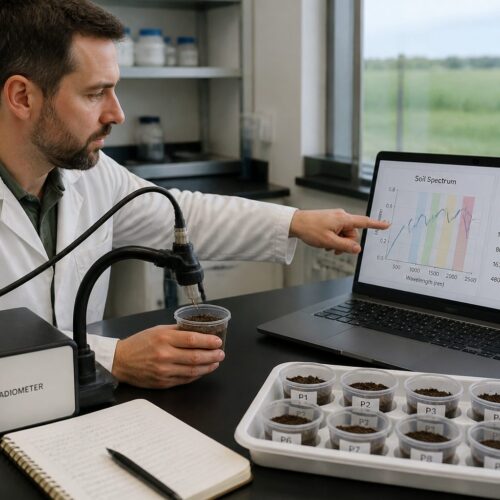
To use soil spectroscopy, a soil sample is exposed to a light source, and the reflected or transmitted light is measured by a spectrometer. The resulting spectrum is then compared to calibration models developed using known organic matter values.
These calibration models are typically built using multivariate statistical techniques, such as partial least squares regression (PLSR). PLSR relates the spectral data to the organic matter content measured by traditional methods.
Benefits of Monitoring Organic Matter Levels
Monitoring soil organic matter levels provides several benefits for farmers and land managers. Regular monitoring allows for tracking changes in soil health over time, which can inform management decisions.
By understanding the trends in organic matter content, farmers can assess the effectiveness of their soil management practices. This includes evaluating the impact of tillage, cover cropping, and organic amendments on soil health.
Monitoring organic matter levels can also help identify areas within a field that are deficient in organic matter. This information can be used to target soil amendments and improve nutrient management.
Furthermore, monitoring organic matter levels can contribute to carbon sequestration efforts. Soils with high organic matter content act as carbon sinks, helping to mitigate climate change.
By implementing practices that increase soil organic matter, farmers can enhance carbon sequestration and potentially participate in carbon credit programs. Regular monitoring is essential for verifying carbon sequestration and quantifying the benefits of sustainable soil management.
In summary, monitoring organic matter levels provides valuable insights into soil health, informs management decisions, and supports carbon sequestration efforts. Soil spectroscopy offers a rapid and cost-effective tool for achieving these goals.
Factors Affecting Soil Spectroscopy Accuracy
Several factors can affect the accuracy of soil spectroscopy for organic matter analysis. Soil moisture content can significantly influence spectral reflectance, leading to inaccurate estimates if not properly accounted for.
Variations in soil texture, mineralogy, and particle size distribution can also affect spectral features. These factors can introduce noise and bias into the calibration models, reducing the accuracy of organic matter predictions.
The quality of the calibration models is also crucial for accurate organic matter assessment. Calibration models should be developed using a representative set of soil samples that capture the variability within the target area.
Additionally, the spectral resolution and range of the spectrometer can impact accuracy. Higher spectral resolution allows for more detailed analysis of spectral features, while a wider spectral range captures more information about soil composition.
Proper sample preparation is also essential for accurate soil spectroscopy. Soil samples should be air-dried, ground, and sieved to ensure uniformity and reduce particle size effects.
By carefully controlling these factors and using appropriate calibration models, the accuracy of soil spectroscopy for organic matter analysis can be maximized. Regular validation of calibration models is also recommended to ensure ongoing accuracy and reliability.
Integrating Organic Matter Data into Soil Management Plans
Integrating organic matter data into soil management plans is essential for optimizing soil health and crop production. Soil spectroscopy provides a valuable tool for collecting the necessary data to inform these plans.
By incorporating organic matter data, farmers can make informed decisions about tillage practices, cover cropping, and nutrient management. This can lead to improved soil structure, water retention, and nutrient availability.
- Reduce tillage intensity
- Implement cover cropping
- Apply organic amendments
- Optimize nutrient management
- Monitor soil health regularly
For example, if soil spectroscopy reveals low organic matter levels, farmers may choose to reduce tillage intensity to minimize soil disturbance. They may also implement cover cropping to increase organic matter inputs and improve soil structure.
Additionally, farmers can apply organic amendments, such as compost or manure, to increase soil organic matter content. They can also optimize nutrient management by tailoring fertilizer applications to meet crop needs and minimize nutrient losses.
Case Studies: Spectroscopy in Action
Several case studies have demonstrated the effectiveness of soil spectroscopy for organic matter assessment and soil management. In a study conducted in the Midwestern United States, soil spectroscopy was used to map organic matter variability across agricultural fields.
The resulting organic matter maps were then used to guide variable-rate fertilizer applications, optimizing nutrient use and reducing environmental impacts. The study found that variable-rate fertilization based on soil spectroscopy data significantly improved crop yields and reduced fertilizer costs.
Another case study in Australia used soil spectroscopy to assess the impact of different tillage practices on soil organic matter. The study found that reduced tillage practices resulted in higher organic matter levels compared to conventional tillage.
This information was used to promote the adoption of reduced tillage practices among farmers, leading to improved soil health and carbon sequestration. In a semi-arid region of Spain, soil spectroscopy was used to monitor the effects of compost amendments on soil organic matter.
The study found that compost amendments significantly increased soil organic matter content and improved soil water retention. This information was used to develop targeted soil management strategies for enhancing agricultural productivity in the region.
These case studies illustrate the practical applications of soil spectroscopy for organic matter assessment and soil management. By leveraging the power of spectral analysis, farmers and land managers can make informed decisions that improve soil health and agricultural sustainability.
Challenges in Spectroscopic Organic Matter Analysis
Despite its advantages, soil spectroscopy for organic matter analysis faces several challenges. One of the main challenges is the development of robust and accurate calibration models.
Calibration models need to be tailored to specific regions and soil types to account for variations in soil composition. This requires collecting a representative set of soil samples and developing calibration models using appropriate statistical techniques.
Another challenge is the influence of soil moisture content on spectral reflectance. Soil moisture can significantly alter spectral features, leading to inaccurate organic matter estimates if not properly accounted for.
Various techniques, such as spectral pretreatments and moisture correction algorithms, can be used to minimize the impact of soil moisture. However, these techniques require careful calibration and validation to ensure accuracy.
The presence of other soil constituents, such as minerals and salts, can also interfere with spectral analysis. These constituents can absorb or reflect light at similar wavelengths as organic matter, making it difficult to isolate the organic matter signal.
Furthermore, the cost of spectrometers and the expertise required to operate them can be a barrier for some users. However, the cost of spectrometers is decreasing, and user-friendly software is becoming more available, making soil spectroscopy more accessible.
Future Trends in Soil Spectroscopy
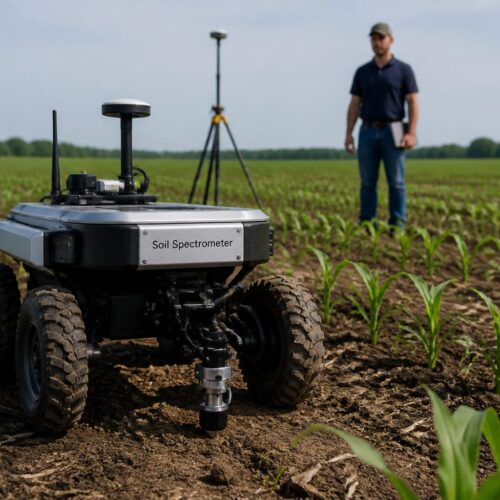
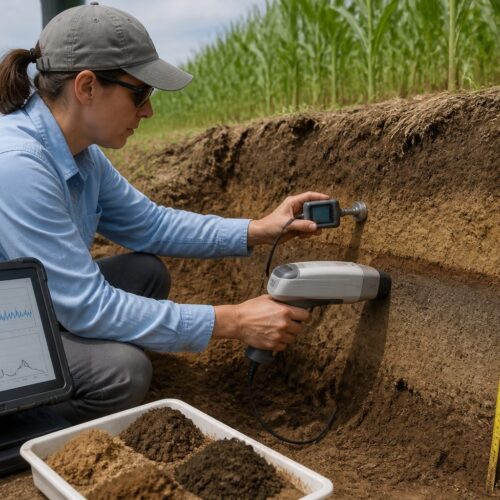
The field of soil spectroscopy is constantly evolving, with new technologies and applications emerging. One of the key trends is the development of portable and handheld spectrometers.
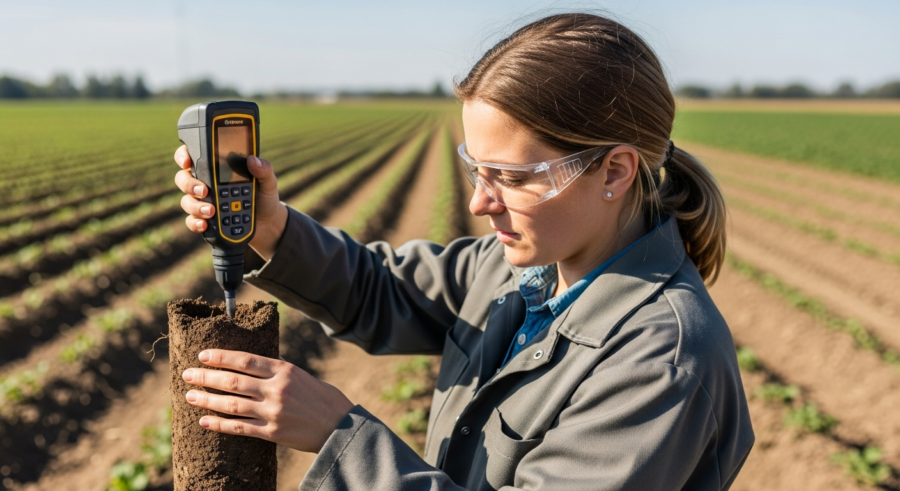
These devices allow for rapid on-site soil analysis, eliminating the need to transport samples to a laboratory. Portable spectrometers are becoming increasingly affordable and user-friendly, making them accessible to a wider range of users.
Another trend is the integration of soil spectroscopy with remote sensing technologies. Combining spectral data from satellites and drones with ground-based measurements can provide a comprehensive view of soil properties across large areas.
This information can be used to monitor soil health, detect soil degradation, and guide precision agriculture practices. The development of advanced data analysis techniques, such as machine learning, is also enhancing the capabilities of soil spectroscopy.
Machine learning algorithms can be used to develop more accurate and robust calibration models, improving the reliability of organic matter estimates. These algorithms can also be used to identify complex relationships between spectral data and soil properties, providing new insights into soil processes.
In the future, soil spectroscopy is likely to play an increasingly important role in sustainable agriculture and environmental monitoring. By providing rapid, cost-effective, and non-destructive soil analysis, soil spectroscopy can help farmers and land managers make informed decisions that improve soil health and agricultural productivity.
Conclusion
Soil spectroscopy offers a powerful tool for rapidly assessing soil organic matter content, a critical indicator of soil health. By leveraging the interaction between light and soil, we can gain valuable insights into soil composition and its impact on agricultural productivity.
Integrating soil spectroscopy data into soil management plans can lead to improved soil structure, water retention, and nutrient availability. While challenges remain, ongoing advancements in technology and data analysis are enhancing the capabilities of soil spectroscopy.
As soil spectroscopy becomes more accessible and affordable, it is likely to play an increasingly important role in sustainable agriculture and environmental monitoring. By embracing this technology, we can work towards improving soil health, enhancing crop production, and mitigating climate change.
Farmers can use soil spectroscopy organic matter content data to make informed decisions about tillage, cover cropping, and nutrient management. Ultimately, the goal is to create healthier soils that support thriving crops and a sustainable future.