
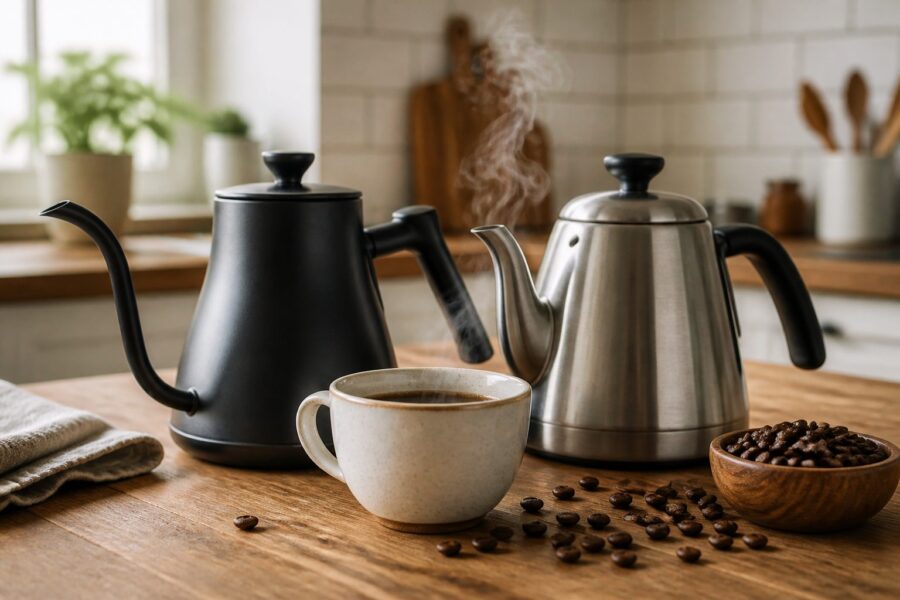
A gooseneck kettle and a regular kettle both heat water, but their spouts differ.
For pour-over coffee, a narrow gooseneck spout makes it easier to direct a controlled stream, while a broad spout releases water more freely; that distinction can matter when pouring slowly over a small bed of grounds without making one kettle necessary for every brewer.
The practical choice depends on how you brew.
If you mostly fill a French press, drip machine, or saucepan for another method, control over a narrow pour may add little to the routine.
If you make pour-over often, the spout can make the pouring motion easier to manage.
What the spout changes
A gooseneck spout is long and narrow, which generally lets the user aim the water and moderate the stream more deliberately.
A regular kettle’s wider opening is built for pouring water quickly, so small adjustments to the tilt can change the flow more abruptly.
This is a difference in handling, not a guarantee of flavor.
Coffee also responds to the grind, dose, water, filter, brewer, and the way the grounds are arranged.
A kettle cannot correct a recipe that is far from the user’s preference or a filter that is clogged.
In pour-over, the water stream passes over a relatively small area of coffee.
A controlled pour can help you wet the grounds where you intend, avoid pouring directly onto the filter wall, and repeat a pattern from brew to brew.
When a gooseneck helps with pour-over
A gooseneck is most useful when the brewer calls for deliberate additions of water, such as a gentle initial wetting followed by one or more pours.
The narrow stream can make these actions easier to repeat, particularly when the filter cone is small.
It can also help someone who wants to practice a pouring pattern.
A low, steady stream is easier to aim at the coffee bed than a fast gush, although skill and comfort still matter; the kettle does not perform the technique by itself.
Some pour-over brewers and recipes are more forgiving than others.
A person who uses a simple continuous pour may not need the same degree of control as someone who is trying to reproduce several separate additions.
- A gooseneck can help when you want a narrow, directed stream.
- A standard kettle can be workable when you pour slowly and carefully.
- A dripper’s shape, size, and recipe affect how much control is useful.
- Neither kettle guarantees a better-tasting cup on its own.
Can you use a regular kettle?
Yes.
A regular kettle can supply water for pour-over, and many people brew without a gooseneck.
The main adjustment is to tilt gently and keep the kettle close enough to direct the flow without splashing or making an uncontrolled stream.
For greater control with a wide spout, use a measured pour from a small container with a suitable lip, or pour from the kettle in short, careful increments.
Keep hot water handling safe and avoid an awkward transfer if it increases spill risk.
A regular kettle may be especially convenient when it already serves several jobs in the kitchen.
Buying a separate tool solely for a technique you rarely use may not make sense; first see whether your existing kettle can produce a steady enough pour for your brewer.
How pour control relates to the cup
Pouring affects where water meets the coffee and how the bed is disturbed.
If water repeatedly hits one area, grounds can shift or the bed can become uneven, which may change the flow.
A directed stream gives the brewer more control over this part of the process.
The cup’s flavor still reflects several variables at once.
If a brew tastes thin, bitter, or uneven, check the coffee amount, grind, water quantity, filter placement, and whether the brew flowed unusually quickly or slowly before blaming the kettle.
A practical test is to keep the coffee, grind, water, and brewer the same and compare pours.
One brew with a narrow controlled stream and another with your usual kettle can reveal whether the extra handling control is noticeable to you.
Other kettle features are separate questions
Spout shape and temperature control are different features.
Some kettles let a user select or monitor water temperature, while others simply heat water; both designs exist with different spout styles.
Do not assume that owning a gooseneck means the kettle has temperature settings.
Capacity, handle shape, weight when full, lid fit, and ease of cleaning also affect daily use.
A kettle that is comfortable to lift and pour may be more practical than one with a specialized spout that feels awkward in the hand.
For a stovetop kettle, use the heat source and handling instructions supplied with that model.
For an electric kettle, follow the manufacturer’s fill and cleaning directions.
The research does not establish one universal maintenance method for every kettle material or design.
Choose by brewing routine, not by label
Consider how often you make pour-over and how precise your current pouring needs to be.
Someone who brews a cone daily may appreciate the consistent flow; someone who uses an automatic brewer may see no meaningful benefit.
Before changing equipment, try a slower pour with the kettle you have.
If the stream is still hard to control, or your recipe uses repeated precise additions, a gooseneck may address that specific annoyance.
If the current process is comfortable, there is no brewing requirement to replace the kettle.
The useful question is not which spout is universally superior.
It is whether the extra control solves a real problem in the method you use, while remaining safe and comfortable for your kitchen.
A quick comparison
For a dripper with a narrow bed, aim the stream near the coffee rather than against the paper, and pause if the flow becomes difficult to control.
This technique can be practiced with either kettle, although the spout changes how easily the stream responds to small adjustments.
A quick kitchen test can clarify the decision: keep the same dripper, coffee, grind, and water amount, then pour one brew with the kettle you own and another with a narrow controlled stream if you can borrow one.
Focus on the motion as well as the cup, since less splashing or easier targeting may matter even when flavor differences are subtle.
If the results seem alike and the regular kettle feels manageable, the specialty spout may not change your routine enough to justify another piece of equipment.
| Consideration | Gooseneck spout | Regular spout |
|---|---|---|
| Water stream | Usually easier to direct narrowly | Often pours more freely |
| Pour-over handling | Useful for controlled, repeated pours | Can work with a careful tilt |
| Other kitchen use | Depends on kettle design and capacity | Often convenient for general pouring |
| Flavor outcome | Does not guarantee a better cup | Can make satisfying coffee when technique fits |
It can make a narrow, controlled pour easier, which is useful for some pour-over routines. It does not guarantee better flavor, and a regular kettle can work with careful pouring.
No. It is optional equipment. Consider one only if controlling the stream with your current kettle is difficult or your pour-over routine benefits from repeated, directed pours.
Yes, a regular kettle can work when you tilt it gently and keep the flow controlled, with the brewer and recipe determining how much precision is helpful.