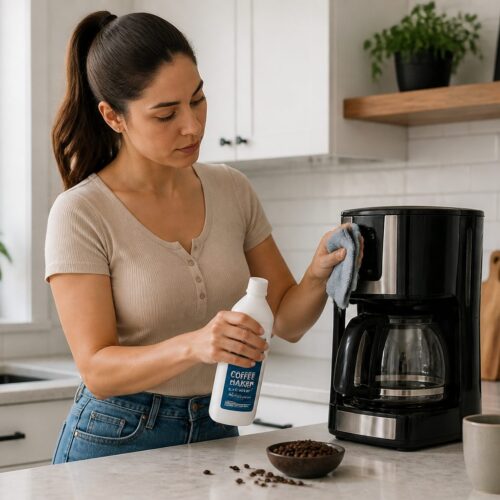

Coffee maker descaling removes mineral deposits that can build up inside water passages and heating components.
It is different from washing the carafe or filter basket, and the right method depends on the machine’s instructions.
If you searched for what coffee maker descaling means, think of it as periodic internal maintenance rather than routine dishwashing.
This guide explains what the process addresses, how to decide when to check your manual, and why a generic cleaning recipe may not suit every brewer.
What descaling does inside a coffee maker
Tap water contains dissolved minerals, and some of them can remain behind as water is heated and evaporates.
Over time, deposits may form inside a machine’s water path, where a user cannot reach them by wiping the outside or washing removable parts.
Descaling uses a product or process intended to loosen mineral scale so it can be flushed from the machine.
It does not replace ordinary cleaning, which removes coffee oils and residue from surfaces that contact brewed coffee.
The distinction matters because a clean-looking carafe does not show the condition of internal passages, while a descale cycle does not necessarily clean the brew basket or carafe.
Treat the two jobs separately and follow the care instructions for each part.
Scale buildup may be associated with changes in flow or heating, but a slow brew or warning light does not prove scale is the cause.
A clogged filter, an incorrectly seated reservoir, or another issue can produce similar symptoms, so avoid assuming that repeated descaling will fix every problem.
When to check the manufacturer’s instructions
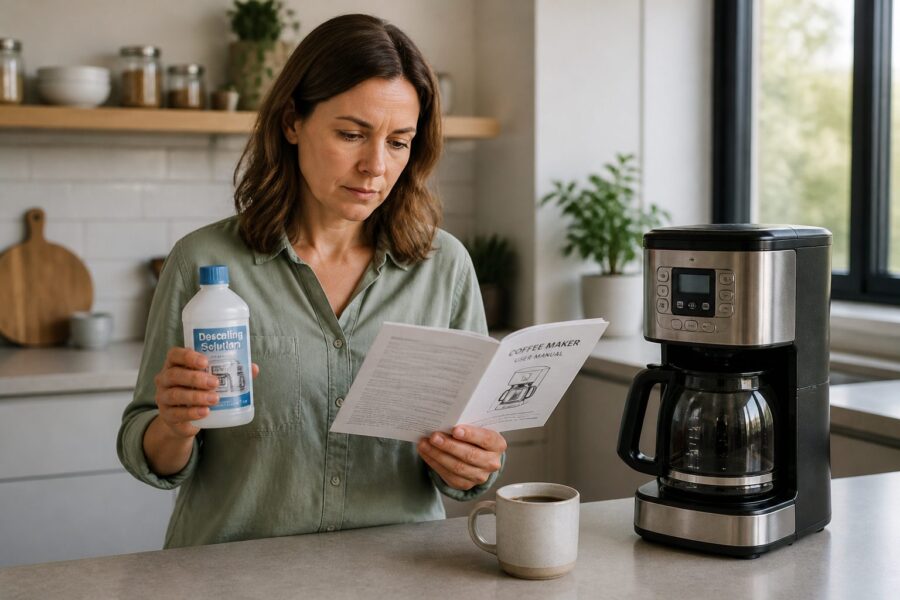
Start with the manual for the exact model, even if a general article or cleaning video recommends a familiar solution.
Instructions can specify a compatible descaler, a built-in cycle, the amount of liquid, how to start the cycle, and how to rinse afterward.
A machine may signal when maintenance is due, while another model may leave timing to the owner.
Harder water can leave more mineral residue than softer water, but the device maker’s schedule is the dependable reference for that product.
Check the manual before using vinegar, citric acid, or a household mixture.
A method suitable for one simple drip brewer might be discouraged for a machine with a different pump, internal materials, sensors, or cleaning program.
- Find the model number on the appliance or its documentation.
- Look for a maintenance or descaling section rather than relying only on a general cleaning page.
- Confirm which product or solution the maker permits.
- Follow the listed sequence for starting the cycle, emptying the carafe, and rinsing.
- If the manual is unavailable, look for guidance from the manufacturer’s support site for that model.
Descaling is not the same as daily cleaning
After brewing, used grounds and coffee oils remain in accessible areas such as the basket, lid, carafe, and reusable filter.
Those parts usually need regular washing according to their material and the manufacturer’s care directions.
Descaling targets deposits formed from water inside the machine.
Running a descale cycle does not make it sensible to leave wet grounds in the basket, and washing the basket does not flush scale from internal water channels.
A practical routine keeps the jobs distinct: remove and wash the parts the manual identifies after use, then descale only when the model’s schedule or indicator calls for it.
This reduces the temptation to use a harsh or unnecessary treatment for everyday residue.
Choosing a descaling solution safely
There is no single solution that can be recommended for every coffee maker.
Some manufacturers provide a branded descaling product, while others identify a broader compatible option; what matters is the exact model’s stated guidance.
Vinegar is often mentioned in general cleaning advice, but that does not establish that it is appropriate for every machine.
A manufacturer may warn against it, specify a particular solution, or require a particular dilution and rinse cycle.
Do not mix cleaning products or combine a descaler with another household chemical.
If a product label says to dilute it or keep it away from certain surfaces, follow that label as well as the coffee maker’s instructions.
Measure only as directed.
More concentrated solution is not a shortcut to better maintenance, and an overly strong mixture may leave odor or residue or conflict with the appliance’s guidance.
What the descale cycle generally involves
The exact steps differ by machine, so use this sequence only as a way to understand the process rather than a substitute for the manual.
A model with an automatic maintenance program may require a specific button sequence or a particular reservoir level.
- Empty the machine and remove used grounds or a disposable filter as directed.
- Prepare the approved descaling solution in the stated amount and add it to the reservoir only if the manual instructs you to do so.
- Place the carafe or collection vessel as directed and start the model’s descale program or listed brew cycle.
- Discard the collected liquid safely and complete the rinse cycles the manual specifies with fresh water.
- Wash removable parts that require cleaning, then check the instructions for resetting any maintenance indicator.
Do not leave the machine unattended if its instructions call for supervision, and do not try to force a cycle that has stopped or produced an error.
A repeated warning may call for troubleshooting or service rather than another round of the same solution.
How to tell whether the rinse is complete
Use the number or type of rinse cycles specified by the manufacturer.
There is no universal count that applies to every model, so a rule copied from another brewer may either be insufficient or needlessly excessive.
If the manual tells you to run fresh water through the system, follow its sequence before brewing coffee again.
A remaining cleaning odor or unusual taste is a reason to consult the product directions, not to add a second chemical in an attempt to mask it.
After the prescribed rinse, wash the carafe and any removable parts that the manual says should be cleaned.
Let components dry as directed before putting the machine back into regular use.
Common mistakes to avoid
Using a familiar household recipe without checking compatibility is the most avoidable mistake.
The solution may be unsuitable for a specific model, and advice for one machine should not be transferred automatically to another.
Another mistake is confusing a descale alert with a diagnosis.
The indicator can signal that scheduled maintenance is due, but persistent poor flow may also have another cause that requires model-specific troubleshooting.
Avoid skipping the rinse because the carafe looks clear.
The required rinse is part of the maintenance procedure, and the machine’s own instructions determine how to complete it.
Finally, do not scrape internal passages or open the machine to remove deposits.
Use the approved maintenance process, and contact the manufacturer or a qualified service provider if the device behaves abnormally.
Questions about coffee maker descaling
Use the solution approved in the manual for your exact model. Recommendations vary, so a product or household method that suits one brewer may not suit another.
Follow the rinse sequence specified by the manufacturer. There is no reliable universal number of rinse runs for all coffee makers.
Not necessarily. Check the appliance instructions because some models specify a particular descaler or do not recommend vinegar.