
A coffee grind size guide can point you toward a useful starting texture, but grind labels are not precise measurements shared by every grinder maker.
Coarse, medium, and fine describe relative particle sizes; the right setting depends on how your brewer moves water through or around the coffee, and on how the cup tastes.
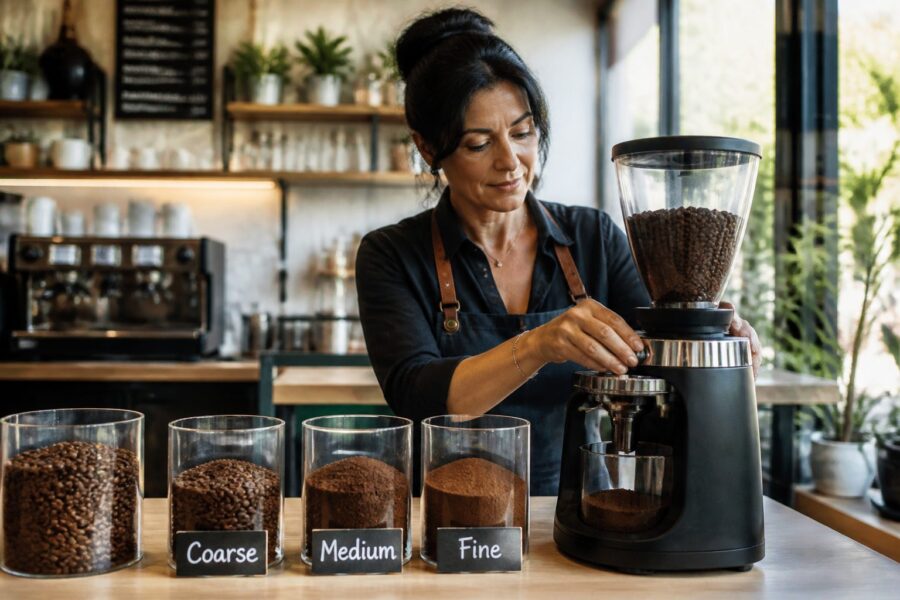
A coarse grind has visibly larger particles, while a fine grind feels closer to powder.
Between those ends are many useful steps, and a grinder’s numbered dial may move in the opposite direction from another model.
Learn the texture and the brewing response rather than memorizing someone else’s setting number.
Why grind size changes a brew
Grinding breaks whole beans into smaller pieces and exposes more surface area to water.
With other variables held steady, water can interact with smaller particles more quickly than with larger ones, which is why grind size affects the pace of extraction.
A finer grind can make a brew more intense, but it does not automatically make it better or simply stronger.
If water extracts too much from the grounds, the cup may taste harsh or drying; if the grind is too coarse for a short brew, the result can taste thin or sour.
Flavor is a clue, not a perfect diagnosis.
Grind consistency matters alongside average size.
A grinder that produces a broad mix of fine dust and large fragments can create uneven extraction: small particles respond quickly while larger pieces take longer.
The same nominal setting on two grinders can therefore produce quite different brews.
Common grind descriptions by method
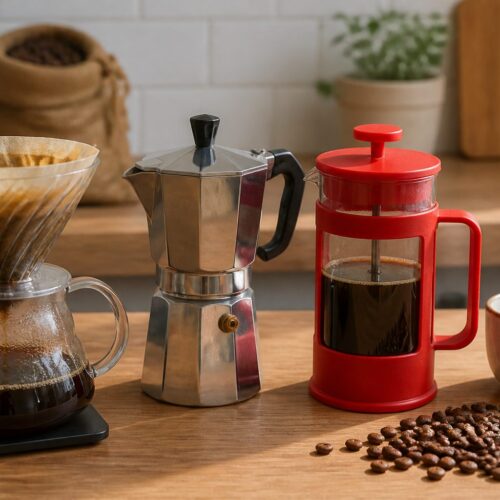
| Brewing approach | Useful starting description | What to watch |
|---|---|---|
| Espresso | Fine, with setting adjusted for the machine and recipe | Flow and taste can change quickly with small adjustments |
| Pour-over | Medium to medium-fine is a common starting range | Filter shape, pouring, and drawdown affect the result |
| Automatic drip | Medium is a familiar starting description | Machine flow and batch size vary |
| French press | Coarse to medium-coarse is often used | A very coarse grind may need a longer steep |
| Cold brew | Coarse is a common practical starting point | Steep style and straining method differ |
This table is a vocabulary map, not a universal setting chart.
Some brewers work well outside the typical description, and recipes differ.
The grinder instructions or a brewer’s recipe may give a better first setting for a specific model than a generic chart can.
Espresso deserves special care because pressure, dose, basket, and machine behavior interact with grind.
A coarse change may cause a shot to run quickly, while a finer setting may slow it, but no single dial number translates across brands or even across individual grinders.
Why grinder numbers do not match
A dial number is a position on one device, not a standardized measurement of particle size.
One grinder may call a setting 10, another may use clicks, and another may label only broad regions; their burr geometry and calibration differ too.
Even two units of the same model can vary slightly because of calibration, wear, assembly, or user technique.
Published charts can help you find a starting point when they name your exact grinder and brewing method, but they should not replace checking the actual result in your cup.
Turn the adjustment mechanism according to the manufacturer’s instructions.
Some grinders should not be adjusted while stopped at certain settings, and burr contact can damage equipment; do not force a dial past its normal range to match an online chart.
How to dial in a grind at home
Begin with a stable recipe: keep the coffee dose, water amount, temperature approach, and method consistent while you test grind.
Change one adjustment at a time, because changing dose and grind together makes it difficult to know which change affected flow or taste.
- Choose a reasonable starting grind description for your brewer or follow the equipment instructions.
- Brew with the same coffee and measured recipe you plan to repeat.
- Note whether the brew ran unusually quickly or slowly and describe the flavor in plain terms.
- Move the grinder one modest step finer or coarser, then repeat the same brew.
- Keep the setting that gives you a pleasant result, and record the recipe with the grinder model.
For pour-over and drip coffee, a brew that drains unusually fast can be one sign to inspect grind size, but filter clogging, pouring, and dose can also change drawdown.
A long drawdown can reflect a fine grind, a clogged filter, or a pouring pattern that disturbed the bed, so interpret the timing with the taste.
For French press, sediment is not automatically proof that the grind is wrong.
The screen, pouring motion, and how carefully the press is served all affect what reaches the cup.
If the coffee tastes dusty or gritty, use a coarser setting as one controlled test and avoid stirring up settled grounds when pouring.
Use taste as feedback, not a verdict
Sourness, bitterness, and thinness can suggest different directions, but coffee flavor has several causes.
A sour cup might involve under-extraction, a naturally bright bean, water, or a recipe mismatch; bitterness can reflect roast character or over-extraction, not just a fine grind.
If the cup is both weak and unpleasant, increasing the dose may change concentration without correcting extraction.
Keep the ratio steady first and adjust grind in a small step, then taste.
If the texture or flavor improves but the strength still feels low, consider changing the ratio in a separate brew.
A small notebook or phone note is enough to make a useful dial-in record.
Include the coffee, grinder model and setting, brew method, dose, water, and one short observation; a note such as slow drawdown with a dry finish is more helpful than marking a recipe simply good or bad.
When to adjust something besides grind
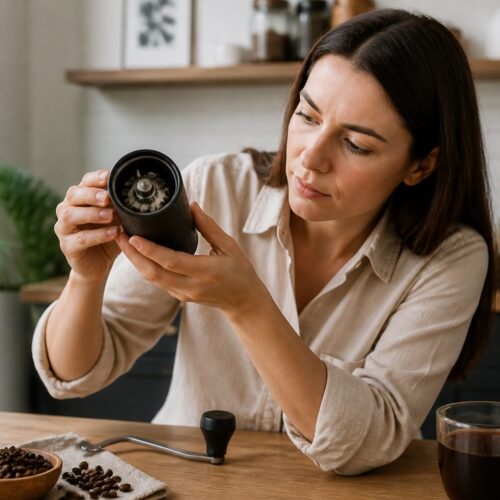
If the setting changes but the cup does not improve, check whether the grinder is clean and operating as expected.
Old grounds or oily residue can affect the aroma of fresh coffee, while worn or misaligned parts may make particle distribution less consistent; use the cleaning and maintenance guidance for the device.
Water amount and coffee dose set concentration, while grind affects the rate at which water interacts with grounds.
Brewing time and agitation also matter.
Think of these as related controls with different jobs, rather than treating a finer grind as the answer to every weak or bitter cup.
Use a different grind for a different brewing method when the method calls for it, and purge or brush residual grounds only in the way your grinder manual recommends.
Avoid putting water or cleaning products into a grinder unless the manufacturer explicitly permits that care method.
A practical way to choose your setting
Start with the brewer’s instructions or a trusted recipe written for your actual equipment, then adjust by small increments.
A coarse grind is a sensible description for immersion methods such as French press and many cold brew setups; pour-over and drip often begin around medium, while espresso needs a finer, machine-specific adjustment.
There is no single perfect grind size independent of method, coffee, and equipment.
Once you treat grind as an adjustable part of a repeatable recipe, the dial becomes less mysterious: hold other choices steady, make one small change, and let the cup tell you whether to keep it.
There is no perfect setting for all brewers. Use a grind description suited to your method as a starting point, then adjust in small steps while keeping the rest of the recipe steady.
It depends on the grinder’s dial design. Numbers are not standardized, so check the model instructions or observe which direction makes the particles finer.
A finer grind can change extraction and perceived intensity, but it does not simply guarantee stronger or better coffee. Dose-to-water ratio also affects concentration.
Start with the brewer’s directions or a recipe for your equipment. Brew consistently, then use taste and flow as clues to make one modest adjustment at a time.
If you make espresso, the Espresso Extraction Calculator helps you track dose, yield, and time as you adjust your grind.