

Burr and blade coffee grinders break beans into smaller particles in different ways, and that difference affects how much control you have over grind size; When weighing a burr vs blade coffee grinder, focus on your brewing routine, desired consistency, and willingness to adjust the grind rather than assuming that one machine automatically makes a better cup.
A burr grinder draws beans between abrasive surfaces to influence particle size, while a blade grinder chops beans with a spinning blade; Both can produce grounds for home brewing, but burr settings make repeatability easier.
How each grinder produces grounds
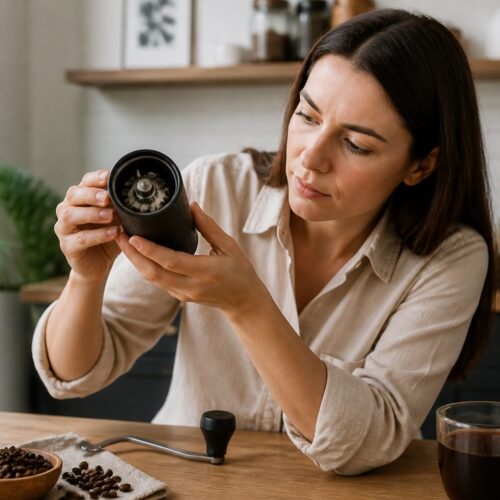
In a burr grinder, beans pass through a gap between two burrs; Moving them closer or farther apart changes particle size, and the settings are not universal measurements that translate directly between machines.
Burr grinders may use conical or flat burrs, terms that describe the shape and arrangement of the grinding surfaces; Design, alignment, construction, and adjustment range all matter, so the label alone does not tell you how well a grinder performs.
A blade grinder has a spinning blade that cuts and moves beans around the chamber; The final particle size depends partly on how long the blade runs and how the beans move, so a short pulse and a longer run can produce noticeably different results.
The blade does not sort particles into a chosen size range; A single batch can contain larger fragments and fine dust together, even when it looks reasonably uniform from above; That variation is the main reason a blade grinder can be harder to tune for different brew methods.
Why grind consistency affects brewing
Water extracts soluble material from the surface of coffee particles; Smaller particles expose more surface area relative to their size and tend to give up flavor more quickly, while larger pieces extract more slowly; When both sizes occur together in one brew bed, they do not all contribute at the same pace.
This unevenness can make a cup difficult to adjust; Fine particles may contribute more quickly and can make parts of a brew taste harsh, while larger chunks may contribute less; The final flavor depends on the coffee and brewing method too, so grind consistency is one variable rather than a sole explanation for taste.
An adjustable burr grinder makes it easier to repeat a setting and then move slightly finer or coarser when the brew calls for it; That control is especially useful with methods that respond clearly to grind changes, such as pour-over and espresso, but it does not eliminate the need to use a suitable ratio and technique.
| Feature | Burr grinder | Blade grinder |
|---|---|---|
| Grinding action | Beans pass between abrasive surfaces | A spinning blade chops beans in a chamber |
| Adjusting particle size | Usually adjusted with a setting or burr gap | Mostly changed by pulsing for different durations |
| Repeatability | Easier to return to a setting | More dependent on timing and bean movement |
| Typical tradeoff | More control, with more parts to maintain | Simple operation, but less precise control |
The comparison describes the grinder types generally, not every model; A poorly adjusted burr grinder can produce inconsistent results, and careful pulsing can make a blade grinder more useful than an uncontrolled long run.
When a burr grinder is a practical choice
A burr grinder suits someone who changes between brew methods or wants to make small, deliberate adjustments; If a cup tastes too sharp or thin, the ability to move finer and retest can be more helpful than repeating a blade-grinder timing guess.
It can also make sense when consistency matters across repeated batches; If you prepare coffee for more than one person or want the next morning’s brew to resemble the last one, a grinder with marked settings gives you a useful starting point.
Burr grinders vary widely in price, capacity, adjustment, noise, and cleaning requirements; Rather than assuming the most expensive device is necessary, consider the finest grind your method requires, how many servings you prepare, and whether the grinder’s instructions and replacement parts are accessible.
For espresso, the ability to adjust finely and make small changes is often important because the brew uses a compact bed and responds strongly to grind changes; A burr grinder is usually the more workable type for this purpose, but the device must have an appropriate adjustment range; the word burr alone does not prove that it can grind suitably for a particular machine.
When a blade grinder can still fit
A blade grinder can be a reasonable entry point if you already own one, brew with forgiving methods, or value a simple appliance more than fine adjustment; It is also possible to use pre-ground coffee instead of buying a grinder; the right choice depends on how much control you want and how you store your coffee.
To make a blade grinder more consistent, measure the same dose, use short pulses, and pause to let the chamber settle between pulses; If the appliance instructions allow it, gently shake the closed grinder between pulses so larger pieces can move toward the blade, keeping the unit secure and upright.
Do not run it for a different amount of time each morning and expect a stable result; Start with a repeatable pulse pattern, inspect the grounds, and note the brew’s taste; This will not create the same adjustment precision as burr spacing, but it can reduce variation from one batch to the next.
Avoid running any grinder beyond its manual’s recommended use; Heat, overfilling, and trapped grounds can affect operation, and a blade grinder should not be opened or cleaned while connected to power; Follow the appliance maker’s cleaning directions rather than putting electrical components under water.
Choose around your brewing method and habits
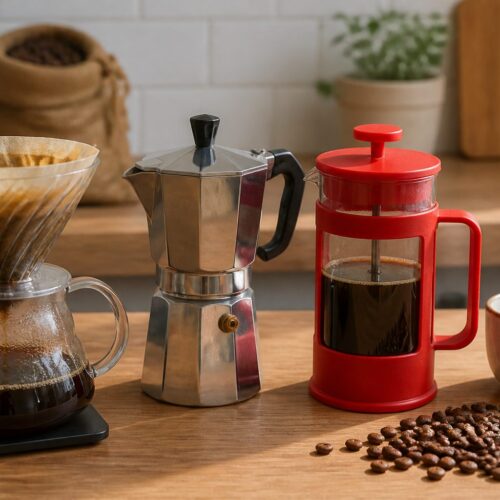
For a French press, a coarser grind is commonly used to make the grounds easier to separate from the drink; A burr grinder can help create and repeat a suitable setting; a blade grinder can still be used, but inspect for excessive fine particles and avoid assuming that a longer grind simply creates a clean coarse result.
For drip coffee or pour-over, a consistent medium-range grind is a useful starting point; If water drains much more slowly after a change, look at the grind and pouring pattern before changing several other parts of the recipe at once.
For espresso, check the machine and grinder requirements before selecting equipment; Espresso needs a narrow range of adjustment, and a grinder that is designed only for coarse brewing may not offer the control required, whether it uses burrs or not.
- Choose burr grinding when you want controlled settings and repeatable changes.
- Consider a blade grinder when simplicity and using existing equipment matter more than precision.
- Check adjustment range and care instructions for the actual model, not just its grinder category.
- Match the grinder to the brewing method you use most often.
A short buying checklist
Before choosing, decide what you brew on a normal day and whether you make one serving or several; Then check the grinder’s adjustment range, dose capacity, ease of cleaning, counter space, and whether its controls are simple enough for your routine.
If you already have a blade grinder, try a consistent pulse routine before replacing it; If the results remain difficult to control and that bothers you, a burr grinder may solve a real problem rather than merely adding another appliance to the counter.
The best choice is the one that meets your practical need; For a person who wants repeatable grind adjustments, burrs have a clear advantage; for someone who simply wants to grind beans occasionally and accepts some variation, a blade grinder can do the job.
Burr grinders generally make grind size easier to adjust and repeat, which helps when you want more control over brewing; Blade grinders are simpler, but their particle sizes are less predictable; The more suitable choice depends on your routine and method.
A burr grinder is a practical choice when repeatability and grind adjustment matter; Consider its adjustment range, capacity, and care instructions, then match those features to the way you brew.
A burr grinder with a suitably fine adjustment range is generally more workable for espresso; Not every burr grinder is designed for espresso, so check the model’s stated capability and your machine’s instructions.