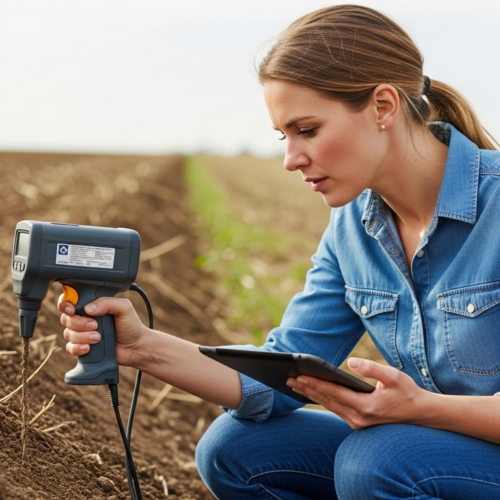


In today’s data-driven world, effective soil spectroscopy data management is essential for maximizing the value of soil analysis. Soil spectroscopy offers a rapid and cost-effective method for assessing soil properties, but the large volumes of data generated require careful handling.
This article explores the best practices for soil spectroscopy data management, covering data storage, analysis, quality control, sharing, security, and privacy. Implementing these strategies will ensure that your soil spectroscopy data is reliable, accessible, and can be used to support precision agriculture initiatives.
By adopting robust soil spectroscopy data management practices, researchers and practitioners can unlock the full potential of this technology. This leads to improved soil health monitoring, optimized fertilizer application, and enhanced crop yields.
The Importance of Data Management
Soil spectroscopy generates vast amounts of data, making effective data management crucial. Without proper management, this data can become overwhelming, difficult to analyze, and ultimately, less valuable.
Effective soil spectroscopy data management ensures data accuracy, accessibility, and usability. It enables researchers and practitioners to extract meaningful insights from the data, leading to better decision-making in precision agriculture.
Good data management practices also facilitate collaboration among researchers and stakeholders. When data is well-organized and easily accessible, it promotes knowledge sharing and accelerates the pace of scientific discovery.
Furthermore, proper data management helps to maintain data integrity and prevent data loss. This is essential for ensuring the long-term reliability of soil spectroscopy data and its use in future studies.
The sheer volume of data produced by modern soil spectroscopy techniques can quickly become unmanageable if not properly organized. Consider the data generated from a single field experiment involving hundreds of soil samples analyzed at multiple wavelengths. Without a systematic approach to data management, it becomes nearly impossible to track individual samples, their associated spectral data, and any corresponding metadata.

Effective data management also plays a critical role in reproducibility. Scientific research relies on the ability of other researchers to replicate experiments and validate findings. Well-managed soil spectroscopy data, complete with detailed metadata and clear documentation, allows for easier replication and verification of results.
Moreover, efficient data management saves time and resources. Researchers can quickly locate and access the data they need, reducing the time spent searching for files and re-analyzing data. This allows them to focus on more complex data analysis and interpretation, ultimately accelerating the pace of research.
Finally, consider the long-term value of soil spectroscopy data. Properly managed data can be used for future research projects, meta-analyses, and the development of new models and algorithms. Poorly managed data, on the other hand, may become unusable or lost over time, representing a significant loss of investment and potential knowledge.
Best Practices for Data Storage
Choosing the right data storage solution is a critical first step in effective soil spectroscopy data management. Data should be stored in a structured and organized manner to facilitate easy retrieval and analysis.
Consider using a combination of local storage and cloud-based solutions to ensure data redundancy and accessibility. Cloud storage offers scalability and backup capabilities, while local storage provides faster access for frequently used data.
Implement a consistent naming convention for files and folders to make it easier to locate specific datasets. Include relevant information such as date, location, and sample type in the filenames.
Regularly back up your data to prevent data loss due to hardware failure or other unforeseen events. Store backups in a separate location from the primary data to ensure that they are not affected by the same incidents.
When selecting a data storage solution, consider the size and type of data you will be storing. Soil spectroscopy data can be quite large, especially when dealing with hyperspectral data or large sample sets. Ensure that your storage solution has sufficient capacity to accommodate your current and future data needs.
A well-defined folder structure is crucial for organizing your data. Consider organizing your data by project, experiment, date, or location. Use subfolders to further categorize the data, such as raw data, processed data, and analysis results.
A consistent naming convention is essential for easy data retrieval. Use descriptive filenames that include key information about the data, such as the date, location, sample ID, and data type. Avoid using spaces or special characters in filenames, as this can cause problems with some software programs.
Regular data backups are critical for protecting your data from loss. Implement a backup schedule that ensures that your data is backed up frequently. Consider using both local and off-site backups to provide redundancy in case of a disaster.
Cloud-based storage solutions offer several advantages for soil spectroscopy data management. They provide scalability, accessibility, and automatic backups. However, it is important to consider the security and privacy implications of storing your data in the cloud.
Data Analysis Tools and Techniques
Analyzing soil spectroscopy data requires specialized tools and techniques. Software packages like R, Python, and MATLAB are commonly used for data processing, analysis, and visualization.
These tools offer a wide range of functions for spectral data manipulation, including baseline correction, smoothing, and normalization. Selecting the appropriate tools is key to extracting meaningful information from the raw soil spectroscopy data.
| Tool | Description | Key Features |
|---|---|---|
| R | Statistical computing and graphics | Extensive package library, data visualization capabilities |
| Python | General-purpose programming language | SciPy, NumPy, scikit-learn libraries for scientific computing |
| MATLAB | Numerical computing environment | Matrix manipulation, algorithm development, data plotting |
| ENVI | Remote sensing and image processing software | Hyperspectral data analysis, spectral feature extraction |
Multivariate analysis techniques, such as principal component analysis (PCA) and partial least squares regression (PLSR), are particularly useful for analyzing soil spectroscopy data. These methods can help to identify the key spectral features that are related to specific soil properties.
Machine learning algorithms, such as support vector machines (SVM) and random forests, can also be used to build predictive models for soil properties. These models can be used to estimate soil properties from spectral data, providing a rapid and cost-effective alternative to traditional laboratory analysis.
R is a powerful and versatile statistical computing environment that is widely used in soil spectroscopy. It offers a vast library of packages for data processing, analysis, and visualization. R is particularly well-suited for multivariate analysis, such as PCA and PLSR.
Python is a general-purpose programming language that is also popular in soil spectroscopy. It has a rich ecosystem of scientific computing libraries, such as NumPy, SciPy, and scikit-learn. Python is particularly well-suited for machine learning applications.
MATLAB is a numerical computing environment that is widely used in engineering and science. It offers a comprehensive set of tools for data analysis, visualization, and algorithm development. MATLAB is particularly well-suited for signal processing and image processing applications.
ENVI is a remote sensing and image processing software package that is specifically designed for analyzing hyperspectral data. It offers a wide range of tools for spectral feature extraction, classification, and analysis. ENVI is particularly well-suited for analyzing soil spectroscopy data collected from remote sensing platforms.
When selecting a data analysis tool, consider your specific needs and the type of data you are working with. Each tool has its own strengths and weaknesses. It is important to choose the tool that is best suited for your particular application.
Ensuring Data Quality and Consistency
Data quality is paramount in soil spectroscopy. Accurate and reliable data is essential for making informed decisions about soil management and crop production.
Implement rigorous quality control procedures at every stage of the data collection and analysis process. This includes calibrating instruments regularly, using standardized sampling protocols, and validating data against independent measurements.
Establish clear data quality standards and document them in a data management plan. This will help to ensure that all data meets the required quality standards and that any data quality issues are identified and addressed promptly.
Use appropriate data validation techniques to identify and correct errors in the data. This may include checking for outliers, verifying data ranges, and comparing data to known reference values.
Regular instrument calibration is crucial for ensuring data accuracy. Follow the manufacturer’s recommendations for calibration procedures and frequency. Keep detailed records of all calibration activities.
Standardized sampling protocols are essential for ensuring data consistency. Develop and implement a clear sampling plan that specifies the number of samples to be collected, the sampling locations, and the sampling methods. Train all personnel involved in data collection to follow the sampling protocol consistently.
Data validation is an important step in identifying and correcting errors in the data. Use appropriate data validation techniques to check for outliers, verify data ranges, and compare data to known reference values. Implement a system for tracking and resolving data quality issues.
Independent validation of data is crucial for ensuring data reliability. Compare your soil spectroscopy data to independent measurements of soil properties. This will help to identify any systematic errors or biases in your data.
Document all data quality control procedures in a data management plan. This will help to ensure that all data meets the required quality standards and that any data quality issues are identified and addressed promptly. Regularly review and update the data management plan to reflect changes in data collection and analysis methods.
Data Preprocessing Techniques
Preprocessing is a critical step in soil spectroscopy data analysis. Raw spectral data often contains noise and artifacts that can affect the accuracy of subsequent analysis.
Common preprocessing techniques include baseline correction, which removes the background signal from the spectra. Smoothing techniques, such as Savitzky-Golay smoothing, can reduce noise and improve the signal-to-noise ratio.
Normalization techniques, such as standard normal variate (SNV) transformation, can reduce the effects of particle size and scattering. These preprocessing steps are essential for preparing the data for multivariate analysis and machine learning.
Carefully select and apply preprocessing techniques based on the specific characteristics of your data. Over-processing can remove useful information, while under-processing can leave unwanted noise and artifacts in the data.
Baseline correction is essential for removing the background signal from spectral data. This can be caused by factors such as instrument drift or variations in sample preparation. Several baseline correction techniques are available, including polynomial fitting and rubber band correction.
Smoothing techniques are used to reduce noise in spectral data. Savitzky-Golay smoothing is a popular technique that uses a moving average filter to smooth the data. Other smoothing techniques include moving median filtering and wavelet denoising.
Normalization techniques are used to reduce the effects of particle size and scattering on spectral data. Standard normal variate (SNV) transformation is a common normalization technique that centers and scales the data to have a mean of zero and a standard deviation of one. Other normalization techniques include multiplicative scatter correction (MSC) and vector normalization.
Derivatives can be used to enhance spectral features and remove baseline effects. First and second derivatives are commonly used in soil spectroscopy. Derivatives can be calculated using various numerical methods.
When choosing preprocessing techniques, it is important to consider the specific characteristics of your data and the goals of your analysis. Experiment with different preprocessing techniques to find the combination that works best for your data.
Data Sharing and Collaboration
Sharing soil spectroscopy data can accelerate scientific discovery and promote collaboration among researchers. However, data sharing must be done in a responsible and ethical manner, respecting data privacy and intellectual property rights.
Use appropriate data sharing platforms and repositories to make your data accessible to others. These platforms often provide tools for managing data access, metadata, and data citation.
- Establish clear data sharing agreements
- Use standardized metadata formats
- Provide detailed documentation
- Obtain necessary permissions
- Protect sensitive data
When sharing data, it is important to provide detailed metadata that describes the data collection and analysis methods. This will help others to understand the data and use it appropriately.
Cite data properly when using it in publications or presentations. This gives credit to the data creators and helps to ensure the reproducibility of research findings. It also helps others to find the original data source.
Before sharing data, establish clear data sharing agreements with collaborators. These agreements should outline the roles and responsibilities of each party, as well as the terms of data use and access. Consider using a Creative Commons license to specify the conditions under which others can use your data.
Use standardized metadata formats to ensure that your data is easily discoverable and understandable by others. Dublin Core and ISO 19115 are two widely used metadata standards. Include information about the data provenance, data quality, and data processing methods.
Provide detailed documentation to help others understand and use your data. This documentation should include a description of the data collection methods, the data processing steps, and the data quality control procedures. Include sample code or scripts that demonstrate how to analyze the data.
Obtain necessary permissions before sharing data that contains sensitive information. This may include obtaining informed consent from individuals or complying with data privacy regulations. Anonymize or de-identify data when possible to protect privacy.
Protect sensitive data by implementing appropriate security measures. Use strong passwords and access controls to restrict access to data to authorized personnel only. Encrypt sensitive data to protect it from unauthorized access during storage and transmission.
Data Security and Privacy
Protecting data security and privacy is a critical aspect of soil spectroscopy data management. Implement appropriate security measures to prevent unauthorized access, use, or disclosure of data.
Use strong passwords and access controls to restrict access to data to authorized personnel only. Encrypt sensitive data to protect it from unauthorized access during storage and transmission.
Comply with all applicable data privacy regulations, such as the General Data Protection Regulation (GDPR). Obtain informed consent from individuals before collecting and using their personal data.
Regularly review and update your data security measures to address emerging threats and vulnerabilities. Conduct security audits to identify and address any weaknesses in your data security practices.
Implement a robust password policy that requires users to create strong passwords and change them regularly. Use multi-factor authentication to add an extra layer of security. Educate users about phishing scams and other security threats.
Use access controls to restrict access to data to authorized personnel only. Grant users the minimum level of access necessary to perform their job duties. Regularly review and update access controls to reflect changes in personnel and job responsibilities.
Encrypt sensitive data to protect it from unauthorized access during storage and transmission. Use strong encryption algorithms and key management practices. Regularly review and update encryption keys.
Comply with all applicable data privacy regulations, such as the General Data Protection Regulation (GDPR). Understand the requirements of these regulations and implement appropriate measures to protect personal data. Obtain informed consent from individuals before collecting and using their personal data.
Regularly review and update your data security measures to address emerging threats and vulnerabilities. Stay informed about the latest security threats and vulnerabilities. Conduct security audits to identify and address any weaknesses in your data security practices.
Metadata Standards and Documentation
Comprehensive metadata and documentation are vital for understanding and using soil spectroscopy data. Metadata provides information about the data, such as its origin, content, quality, and condition.
Use standardized metadata formats, such as Dublin Core or ISO 19115, to ensure interoperability with other datasets. Include information about the instrument used, the sampling protocol, the data processing methods, and the data quality control procedures.
Document all aspects of the data collection and analysis process in a data management plan. This plan should outline the data storage, backup, security, and sharing policies, as well as the roles and responsibilities of the data management team.
Keep the metadata and documentation up-to-date and easily accessible. This will help others to understand the data and use it effectively, and it will also ensure the long-term usability of the data.
Metadata should include information about the data provenance, such as the data creator, the data collection date, and the data collection location. This information is essential for understanding the context of the data and for assessing its reliability.
Metadata should also include information about the data content, such as the variables measured, the units of measurement, and the data format. This information is essential for understanding the meaning of the data and for using it in analysis.
Metadata should also include information about the data quality, such as the data accuracy, the data precision, and the data completeness. This information is essential for assessing the reliability of the data and for making informed decisions about its use.
Metadata should also include information about the data processing methods, such as the data cleaning steps, the data transformation steps, and the data analysis methods. This information is essential for understanding how the data was processed and for replicating the analysis.
A data management plan should outline the data storage, backup, security, and sharing policies. This plan should also define the roles and responsibilities of the data management team. The data management plan should be regularly reviewed and updated to reflect changes in data management practices.
Data Versioning and Audit Trails
Data versioning is an important aspect of soil spectroscopy data management. It allows you to track changes to the data over time and to revert to previous versions if necessary.
Implement a data versioning system that automatically tracks all changes to the data. This system should record who made the changes, when they were made, and what was changed.
Maintain audit trails that document all data access and modification events. These audit trails can be used to track down data quality issues, identify security breaches, and ensure compliance with data privacy regulations.
Regularly review the data versioning and audit trail information to identify any potential problems. This will help to ensure the integrity and security of your soil spectroscopy data.
A data versioning system allows you to track changes to data files over time. This is essential for maintaining data integrity and for ensuring that you can always access the correct version of the data. There are several different data versioning systems available, including Git and Subversion.
An audit trail is a record of all data access and modification events. This includes information about who accessed the data, when they accessed it, and what changes they made. Audit trails are essential for tracking down data quality issues, identifying security breaches, and ensuring compliance with data privacy regulations.
Regularly review the data versioning and audit trail information to identify any potential problems. This will help you to identify data quality issues, security breaches, and compliance violations. Take corrective action to address any problems that are identified.
Consider using a data management system that provides built-in data versioning and audit trail capabilities. This will simplify the process of managing your data and will help to ensure that your data is properly protected. Examples include specialized Laboratory Information Management Systems (LIMS).
Document your data versioning and audit trail procedures in your data management plan. This will help to ensure that everyone involved in data management understands the procedures and follows them consistently. Regularly review and update the data management plan to reflect changes in data management practices.
Data Visualization and Reporting
Data visualization is a powerful tool for exploring and communicating soil spectroscopy data. Use appropriate visualization techniques to present the data in a clear and informative manner.
Create interactive dashboards that allow users to explore the data and drill down into specific areas of interest. Use color-coding, charts, and graphs to highlight key trends and patterns in the data.
Generate reports that summarize the key findings from the data analysis. These reports should be tailored to the needs of the target audience and should provide actionable insights that can be used to improve soil management and crop production.
Use data visualization and reporting tools to communicate the value of soil spectroscopy data to stakeholders. This will help to build support for the use of this technology in precision agriculture.
Choose appropriate visualization techniques based on the type of data you are presenting. Line plots are useful for visualizing spectral data. Scatter plots are useful for visualizing relationships between variables.
Create interactive dashboards that allow users to explore the data and drill down into specific areas of interest. Use tools like Tableau or Power BI to create interactive dashboards. Allow users to filter the data, zoom in on specific areas, and view detailed information.
Generate reports that summarize the key findings from the data analysis. Tailor the reports to the needs of the target audience. Use clear and concise language. Include visuals to illustrate key findings.
Communicate the value of soil spectroscopy data to stakeholders. Explain how the data can be used to improve soil management and crop production. Provide examples of how the data has been used to solve real-world problems.
Consider using geographic information systems (GIS) to visualize soil spectroscopy data in a spatial context. This can be particularly useful for visualizing data collected from remote sensing platforms. Use color-coding to represent different soil properties or conditions.
Conclusion
Effective soil spectroscopy data management is essential for unlocking the full potential of this technology in precision agriculture. By implementing the best practices outlined in this article, you can ensure that your data is accurate, accessible, and secure.
Improved data management leads to better decision-making, enhanced collaboration, and accelerated scientific discovery. Embrace these strategies to maximize the value of your soil spectroscopy data and contribute to a more sustainable and productive agricultural future.
By prioritizing data quality, security, and accessibility, researchers and practitioners can leverage soil spectroscopy to its fullest extent. This includes not only improved soil health monitoring and optimized fertilizer application, but also a deeper understanding of complex soil processes.
The future of soil spectroscopy relies on the continued development and adoption of robust data management practices. As technology advances and data volumes increase, the need for effective data management will only become more critical.
Investing in data management infrastructure and training is essential for ensuring the long-term success of soil spectroscopy research and applications. This investment will pay off in the form of more reliable data, more efficient workflows, and more impactful results.
Ultimately, good soil spectroscopy data management is not just about managing data; it’s about managing knowledge. It’s about ensuring that the valuable information contained within soil spectroscopy data is preserved, accessible, and used to improve soil health and agricultural productivity for generations to come.