
Precision agriculture relies on detailed knowledge of soil properties to optimize crop production. Energy-dispersive x-ray spectroscopy soil, often referred to as EDS, provides a powerful method for determining the elemental composition of soil samples. This technique offers valuable insights into soil mineralogy and the distribution of elements within the soil matrix.
Understanding the elemental makeup of soil is crucial for assessing its fertility, identifying potential contaminants, and predicting plant nutrient availability. By using energy-dispersive x-ray spectroscopy soil, researchers and agricultural professionals can gain a comprehensive understanding of soil characteristics, leading to more informed management practices.
This article will explore the principles of EDS, its application in soil analysis, and its advantages and limitations. We will also discuss sample preparation techniques and how EDS data can be used to create elemental maps of soil.
Understanding Energy-Dispersive X-ray Spectroscopy (EDS)
Energy-dispersive x-ray spectroscopy soil is an analytical technique used to determine the elemental composition of a sample. It works by bombarding the sample with a focused electron beam, which causes the atoms in the sample to emit characteristic x-rays.
These x-rays are then detected and analyzed to identify the elements present and their relative abundance. The EDS principles are based on the unique electronic structure of each element, which results in the emission of x-rays with specific energies.
When an electron from the beam knocks out an inner-shell electron of an atom in the sample, an electron from a higher energy level fills the vacancy. This transition results in the release of energy in the form of an x-ray photon.
The energy of the emitted x-ray is equal to the difference in energy between the two electron shells involved in the transition. Since these energy differences are unique to each element, the emitted x-rays serve as a fingerprint for identifying the elements present in the sample.
How EDS Works with Scanning Electron Microscopy (SEM)
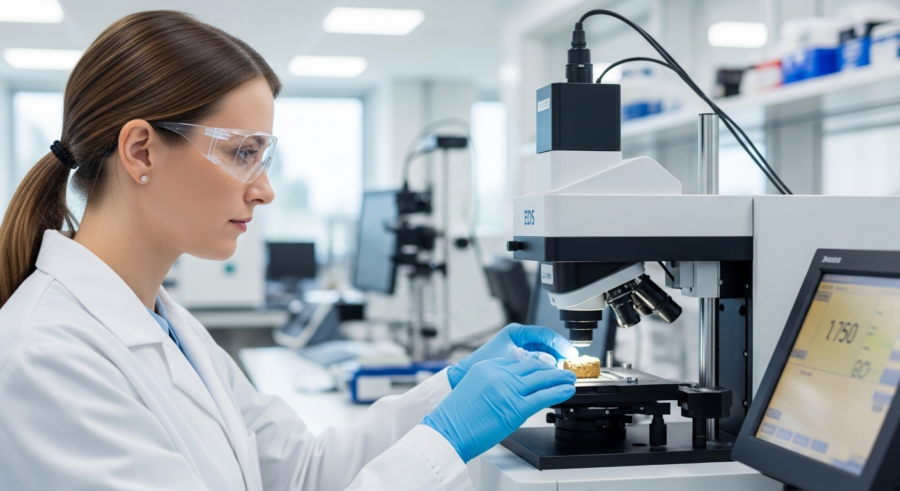
Energy-dispersive x-ray spectroscopy is often used in conjunction with scanning electron microscopy. Scanning electron microscopy provides high-resolution images of the sample’s surface, while EDS provides information about its elemental composition.
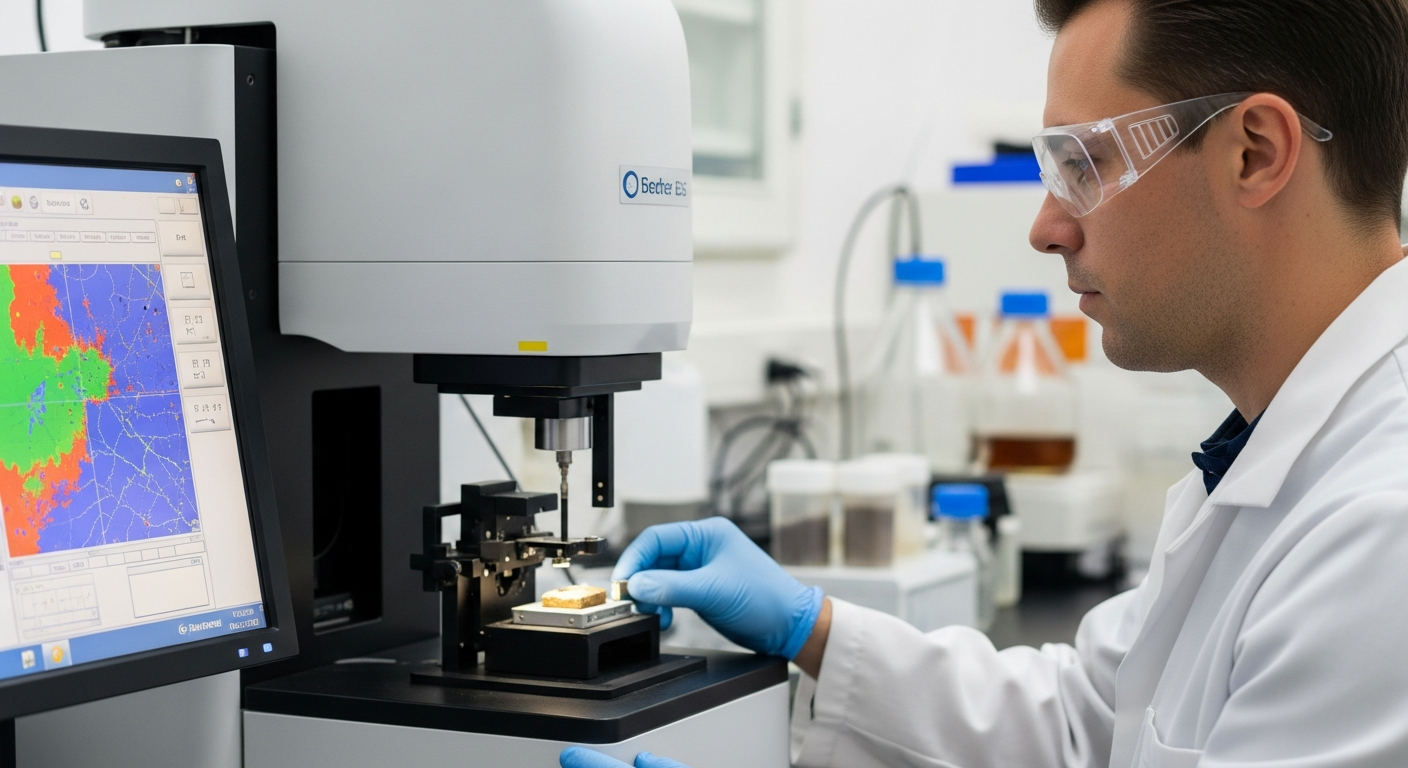
The SEM uses a focused electron beam to scan the surface of a sample, and the resulting signals are used to create an image. By combining SEM and EDS, researchers can correlate the morphology of the sample with its elemental composition, providing a more complete understanding of the material.
The electron beam in the SEM excites the atoms in the sample, causing them to emit x-rays that are detected by the EDS detector. The EDS detector measures the energy of the x-rays and counts the number of x-rays at each energy level.
This information is then used to generate a spectrum that shows the intensity of x-rays as a function of energy. The peaks in the spectrum correspond to the elements present in the sample, and the height of the peaks is proportional to the concentration of each element.
The integration of EDS with scanning electron microscopy (SEM) enhances the capabilities of both techniques. SEM provides detailed visual information about the sample’s microstructure, while EDS offers quantitative data on the elemental composition at specific locations on the sample.
This combination is particularly useful for analyzing heterogeneous materials like soil, where the distribution of elements can vary significantly across different regions. By using SEM-EDS, researchers can identify and characterize individual particles or phases within the soil matrix and determine their elemental makeup.
Preparing Soil Samples for EDS Analysis
Proper sample preparation is crucial for obtaining accurate and reliable results from EDS analysis. The goal of sample preparation is to create a smooth, clean surface that is representative of the bulk material.
Soil samples often require several steps to achieve this, including drying, grinding, and mounting. The specific preparation method will depend on the type of soil and the research question being addressed.
First, soil samples are typically air-dried or oven-dried at a low temperature to remove moisture. This step is important because water can interfere with the electron beam and affect the accuracy of the EDS analysis.
Once the soil is dry, it is usually ground into a fine powder to ensure homogeneity. Grinding helps to reduce particle size and increase the surface area available for analysis.
| Preparation Step | Description | Purpose |
|---|---|---|
| Drying | Air-drying or oven-drying at low temperature | Removes moisture to prevent interference with the electron beam |
| Grinding | Milling the soil into a fine powder | Increases homogeneity and surface area for analysis |
| Mounting | Securing the sample on a conductive stub | Provides electrical conductivity and stability |
| Coating | Applying a thin layer of conductive material (e.g., carbon or gold) | Enhances electron conductivity and reduces charging effects |
After grinding, the soil powder is mounted onto a conductive stub, typically made of aluminum or carbon. The stub provides electrical conductivity and helps to dissipate charge buildup during analysis.
Finally, the sample is often coated with a thin layer of conductive material, such as carbon or gold. Coating enhances electron conductivity and reduces charging effects, which can distort the EDS spectrum.
Mapping Elemental Distribution in Soil Using EDS
One of the most powerful applications of energy-dispersive x-ray spectroscopy soil is the ability to create elemental maps of soil samples. These maps show the spatial distribution of different elements within the soil matrix.
Elemental mapping can provide valuable insights into soil formation processes, nutrient cycling, and the distribution of contaminants. To create an elemental map, the SEM-EDS system scans the surface of the sample and acquires an EDS spectrum at each point.
The intensity of the x-ray signal for each element is then plotted as a function of position, creating a map that shows the concentration of that element at each location. These maps can be displayed in various colors to represent different concentration levels, providing a visual representation of the elemental distribution.
For example, an elemental map of phosphorus might show areas of high phosphorus concentration associated with fertilizer granules or organic matter. An elemental map of heavy metals might reveal hotspots of contamination near industrial sites or roadways.
The resolution of the elemental map depends on the spot size of the electron beam and the step size used during scanning. Smaller spot sizes and step sizes result in higher resolution maps, but also require longer acquisition times.
Elemental mapping can be used to study the distribution of essential nutrients like nitrogen, phosphorus, and potassium, as well as trace elements and pollutants. This information can help farmers optimize fertilizer application, manage soil fertility, and remediate contaminated sites.
Quantitative Analysis with EDS
In addition to qualitative identification of elements, energy-dispersive x-ray spectroscopy soil can also be used for quantitative analysis. Quantitative analysis involves determining the concentration of each element in the sample.
This is typically done by comparing the intensity of the x-ray signal for each element to that of a known standard. Quantitative EDS analysis requires careful calibration and correction for various factors that can affect the accuracy of the results.
One important correction is the ZAF correction, which accounts for the effects of atomic number (Z), absorption (A), and fluorescence (F) on the x-ray signal. The atomic number correction accounts for differences in the efficiency of x-ray production for different elements.
The absorption correction accounts for the attenuation of x-rays as they travel through the sample. The fluorescence correction accounts for the excitation of x-rays by other x-rays within the sample.
After applying these corrections, the concentration of each element can be determined by comparing the corrected x-ray intensity to that of a known standard. Standards are materials with well-defined elemental compositions that are analyzed under the same conditions as the unknown sample.
Quantitative EDS analysis can provide valuable information about the nutrient content of soil, the concentration of pollutants, and the mineralogical composition. This data can be used to assess soil fertility, identify potential environmental hazards, and guide soil management practices.
Advantages and Limitations of EDS
Energy-dispersive x-ray spectroscopy soil offers several advantages for soil analysis. It is a relatively fast and non-destructive technique that can provide information about the elemental composition of a sample in a matter of minutes.
EDS can be used to analyze a wide range of elements, from beryllium to uranium, and can be applied to various types of soil samples. However, EDS also has some limitations that should be considered.
- Relatively low sensitivity for light elements (e.g., hydrogen, lithium)
- Spectral overlap between some elements can complicate analysis
- Matrix effects can affect the accuracy of quantitative results
- Sample preparation can be time-consuming and require specialized equipment
- Limited information about chemical bonding and mineral structure
One limitation is that EDS has relatively low sensitivity for light elements, such as hydrogen, lithium, and boron. This is because these elements emit x-rays with low energies that are easily absorbed by the sample or the detector.
Another limitation is that spectral overlap between some elements can complicate the analysis. For example, the x-ray peaks for iron and manganese are very close together, making it difficult to distinguish between them in some cases.
Applications in Precision Agriculture
Energy-dispersive x-ray spectroscopy soil plays a key role in advancing precision agriculture techniques. By providing detailed elemental analysis, EDS helps optimize crop production and resource management.
Understanding the elemental composition of soil is crucial for tailoring fertilizer applications to meet specific crop needs. EDS can identify nutrient deficiencies or excesses, allowing farmers to apply the right amount of fertilizer in the right place at the right time.
This targeted approach minimizes waste, reduces environmental impact, and maximizes crop yields. Furthermore, EDS assists in monitoring soil health by tracking changes in elemental composition over time.
This is particularly useful for detecting the accumulation of pollutants or the depletion of essential nutrients. By regularly analyzing soil samples with EDS, farmers can identify potential problems early and take corrective action before they impact crop production.
EDS data can also be integrated with other precision agriculture technologies, such as GPS and remote sensing. This integration enables the creation of detailed maps showing the spatial variability of soil properties across a field.
These maps can then be used to guide variable-rate fertilizer applications, irrigation, and other management practices. The use of energy-dispersive x-ray spectroscopy soil in precision agriculture leads to more efficient and sustainable crop production systems.
Case Studies and Examples
Several case studies illustrate the practical applications of energy-dispersive x-ray spectroscopy soil in agriculture. A study in California used EDS to analyze soil samples from vineyards affected by grapevine decline.
The analysis revealed elevated levels of certain elements, such as aluminum and iron, in the affected soils, suggesting a possible link between soil composition and the disease. In another study, researchers used EDS to map the distribution of heavy metals in soils near a former industrial site.
The resulting maps showed hotspots of contamination in specific areas, allowing for targeted remediation efforts. A third example involves the use of EDS to assess the effectiveness of different soil amendments.
Researchers analyzed soil samples treated with various organic and inorganic amendments to determine their impact on elemental composition and nutrient availability. The results showed that certain amendments were more effective at increasing the concentration of essential nutrients in the soil.
These case studies demonstrate the versatility of energy-dispersive x-ray spectroscopy soil as a tool for addressing a wide range of agricultural and environmental challenges. By providing detailed information about soil elemental composition, EDS helps researchers and practitioners make informed decisions about soil management and remediation.
EDS is also used to optimize fertilizer strategies. By analyzing the elemental composition of soil, farmers can determine which nutrients are lacking and apply fertilizers accordingly, maximizing crop yields and minimizing environmental impact.
Future Trends in EDS for Soil Analysis
The field of energy-dispersive x-ray spectroscopy soil is constantly evolving, with new developments and applications emerging regularly. One trend is the development of portable EDS instruments that can be used in the field.
These portable instruments allow for rapid on-site analysis of soil samples, eliminating the need to transport samples to a laboratory. Another trend is the development of more advanced data analysis techniques that can extract more information from EDS spectra.
For example, machine learning algorithms are being used to identify subtle differences in EDS spectra that are not apparent to the human eye. These algorithms can also be used to predict soil properties based on EDS data.
Improvements in detector technology are also enhancing the capabilities of EDS. New detectors with higher sensitivity and energy resolution are enabling the analysis of lighter elements and the separation of overlapping x-ray peaks.
These advances are expanding the range of applications for EDS in soil science and precision agriculture. The integration of EDS with other analytical techniques, such as laser-induced breakdown spectroscopy (LIBS) and X-ray diffraction (XRD), is also gaining traction.
Combining these techniques provides a more comprehensive characterization of soil properties, including elemental composition, mineralogy, and chemical bonding. These trends suggest a bright future for energy-dispersive x-ray spectroscopy soil as a tool for soil analysis and precision agriculture.
Conclusion
Energy-dispersive x-ray spectroscopy soil is a valuable tool for characterizing the elemental composition of soil. Its ability to provide detailed information about elemental distribution and concentration makes it an indispensable technique for precision agriculture.
By understanding EDS principles and applications, researchers and practitioners can better manage soil resources and optimize crop production. The integration of EDS with scanning electron microscopy enhances its capabilities, providing a comprehensive understanding of soil properties at the microscale.
Proper sample preparation is essential for accurate EDS analysis, and quantitative analysis requires careful calibration and correction. While EDS has some limitations, its advantages outweigh these drawbacks, making it a powerful tool for soil science.
As technology continues to advance, energy-dispersive x-ray spectroscopy soil will likely play an even greater role in precision agriculture, enabling more sustainable and efficient crop production systems. The continued development of portable instruments and advanced data analysis techniques will further expand its applications.