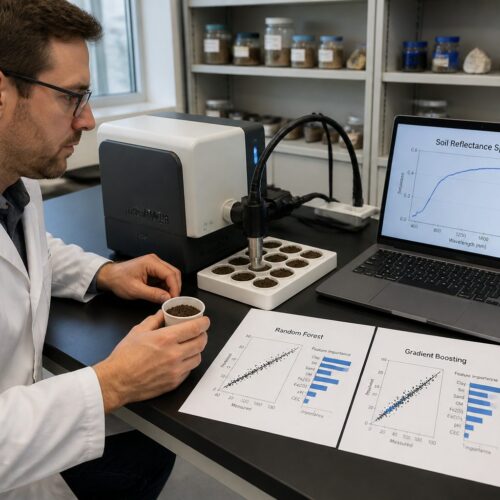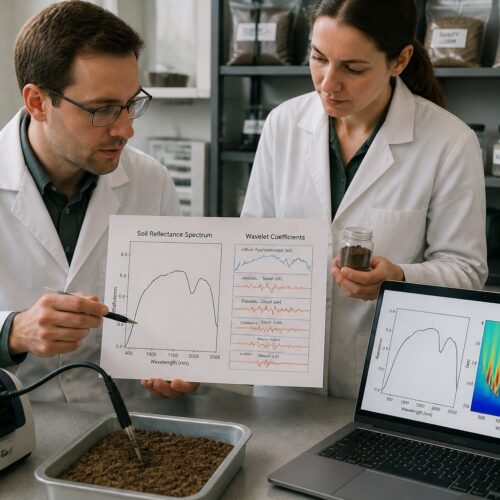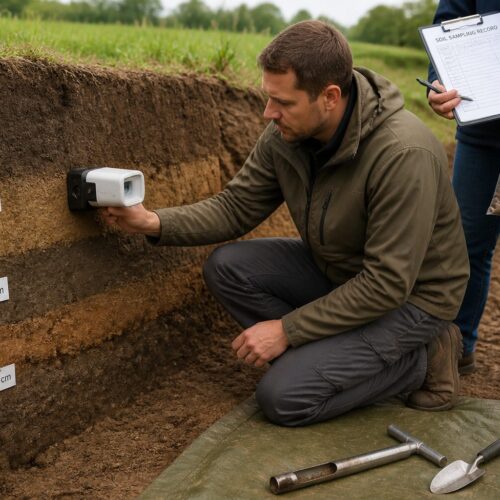

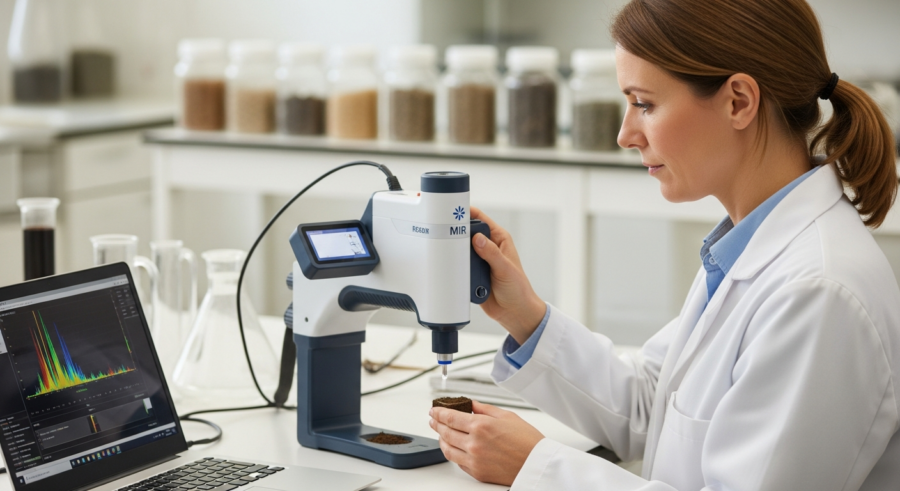
In the realm of precision agriculture, understanding soil composition is paramount for optimizing crop yields and resource management. Traditional soil analysis methods can be time-consuming and costly, often involving laboratory procedures that limit the scale and speed of assessment. Fortunately, spectroscopic techniques offer a rapid and non-destructive alternative for detailed soil characterization.
Among these, mid-infrared spectroscopy soil analysis emerges as a powerful tool, providing valuable insights into soil organic matter, mineral content, and overall soil health. This article will explore the principles, applications, and benefits of mid-infrared (MIR) spectroscopy in precision agriculture, focusing on its ability to deliver detailed soil composition analysis for informed decision-making.
By understanding the capabilities of mid-infrared spectroscopy soil analysis, agricultural professionals can harness its potential to improve soil management practices, enhance crop productivity, and promote sustainable farming.
Exploring Mid-Infrared (MIR) Spectroscopy
Mid-infrared (MIR) spectroscopy is a technique that analyzes the interaction of mid-infrared radiation with matter. When MIR radiation interacts with a soil sample, molecules within the soil absorb energy at specific wavelengths, causing vibrations in their chemical bonds.
These vibrations are unique to the types of bonds present, such as C-H, N-H, and O-H, which are characteristic of organic and inorganic soil components. The resulting absorption spectrum, a plot of absorbance versus wavelength, provides a fingerprint of the soil’s composition.
The MIR region of the electromagnetic spectrum typically spans from 4000 to 400 cm-1, a range where many fundamental vibrations of soil constituents occur. MIR spectroscopy principles rely on the fact that different soil components absorb MIR radiation at different wavelengths, depending on their molecular structure and composition.
By analyzing the specific wavelengths and intensities of absorption, we can identify and quantify the various organic and inorganic components present in the soil sample. This information is valuable for assessing soil fertility, organic matter content, and mineral composition.
The fundamental principle behind MIR spectroscopy is the absorption of infrared radiation by molecules, causing them to vibrate at specific frequencies. These frequencies are directly related to the types of chemical bonds present within the molecule.
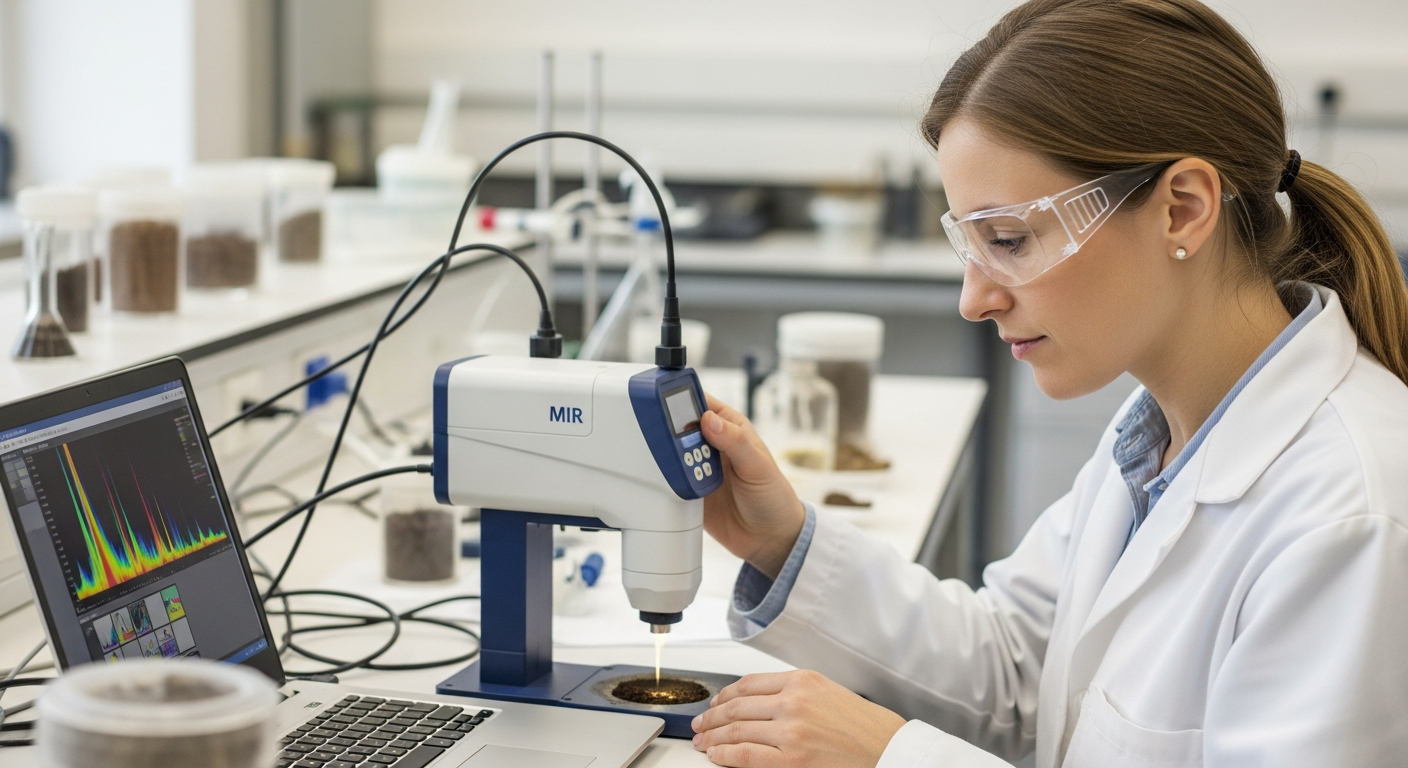
Therefore, by analyzing the pattern of absorption, we can determine the presence and quantity of different molecules within a soil sample. The intensity of the absorption peak is directly proportional to the concentration of the molecule.
This makes MIR spectroscopy a powerful quantitative tool. The technique is also non-destructive, meaning the soil sample can be used for further analysis after the MIR spectrum has been obtained.
Furthermore, MIR spectroscopy can be applied to a wide variety of soil types and conditions. This versatility makes it a valuable tool for agricultural research and soil management practices.
MIR Spectroscopy for Soil Organic Matter Characterization
Soil organic matter (SOM) is a critical component of soil health, influencing soil structure, water retention, nutrient availability, and overall soil fertility. Characterizing SOM is essential for understanding soil quality and its impact on crop productivity.
MIR spectroscopy offers a rapid and effective method for assessing SOM content and composition. The technique can identify and quantify various organic compounds present in the soil, such as humic acids, fulvic acids, and polysaccharides.
The absorption bands in the MIR spectra associated with C-H, C=O, and O-H bonds are particularly useful for quantifying SOM. By analyzing the intensities of these bands, researchers can estimate the total organic carbon (TOC) content of the soil.
Furthermore, MIR spectroscopy can provide insights into the quality and stability of SOM. The ratios of different absorption bands can be used to assess the degree of humification, which is an indicator of the stability and decomposition stage of organic matter.
Specifically, the region between 1600 and 1700 cm-1 is often associated with C=O stretching vibrations in carbonyl and carboxyl groups, which are characteristic of humic substances. The intensity of this band can be correlated with the concentration of humified organic matter in the soil.
The region between 1000 and 1200 cm-1 is associated with C-O stretching vibrations in polysaccharides and other carbohydrate-like compounds. This region can provide information about the presence of fresh plant residues and microbial biomass in the soil.
By analyzing the relative intensities of these different absorption bands, we can gain a more complete understanding of the composition and dynamics of SOM. This information is crucial for developing sustainable soil management practices that promote soil health and carbon sequestration.
MIR spectroscopy is also useful for assessing the impact of different agricultural practices on SOM. For example, the technique can be used to monitor the changes in SOM content and composition following the adoption of conservation tillage practices or the application of organic amendments.
Identifying Soil Minerals Using MIR Spectroscopy
Soil minerals play a crucial role in soil fertility, influencing nutrient retention, water-holding capacity, and overall soil structure. Identifying and quantifying these minerals is essential for understanding soil properties and their impact on plant growth.
MIR spectroscopy can be used to identify a wide range of soil minerals, including clay minerals, oxides, and carbonates. Each mineral has a unique MIR spectral signature based on its chemical composition and crystal structure.
| Mineral Group | Specific Minerals | Diagnostic MIR Absorption Bands (cm-1) |
|---|---|---|
| Clay Minerals | Kaolinite, Montmorillonite, Illite | 3695, 3620, 1030 |
| Oxides | Goethite, Hematite | 895, 795, 630 |
| Carbonates | Calcite, Dolomite | 1430, 875, 712 |
| Silicates | Quartz, Feldspar | 1080, 798, 465 |
For example, clay minerals such as kaolinite, montmorillonite, and illite exhibit characteristic absorption bands in the MIR spectra due to the vibrations of hydroxyl (OH) groups and Si-O bonds. Similarly, oxides like goethite and hematite show distinct absorption bands related to Fe-O vibrations, while carbonates such as calcite and dolomite display absorption bands associated with C-O vibrations.
The presence and abundance of specific clay minerals can significantly affect soil properties such as cation exchange capacity (CEC) and water retention. For instance, montmorillonite has a high CEC and can hold large amounts of water, while kaolinite has a lower CEC and water-holding capacity.
Identifying the types and amounts of clay minerals present in a soil can help predict its behavior under different environmental conditions. This information is crucial for managing soil fertility and irrigation practices.
The presence of oxides, such as goethite and hematite, can also influence soil color and nutrient availability. These minerals can bind to phosphorus, making it less available to plants.
Carbonates, such as calcite and dolomite, can affect soil pH and buffering capacity. Soils with high carbonate content tend to be alkaline and resistant to acidification.
Sample Preparation Techniques for MIR Analysis
Proper sample preparation is crucial for obtaining accurate and reliable MIR spectra of soil samples. The goal is to create a homogeneous and representative sample that minimizes scattering and maximizes the signal-to-noise ratio.
One common method is air-drying the soil sample to remove moisture, followed by grinding it to a fine powder using a mortar and pestle or a ball mill. The fine powder ensures a uniform particle size distribution, which reduces scattering effects during MIR analysis.
Another technique involves mixing the soil powder with a non-absorbing matrix such as potassium bromide (KBr) and pressing the mixture into a transparent pellet. The KBr pellet method is particularly useful for obtaining high-quality spectra with minimal background interference.
Alternatively, soil samples can be analyzed directly using attenuated total reflectance (ATR) accessories, which require minimal sample preparation. ATR involves placing the soil sample in direct contact with a crystal, such as diamond or germanium, and measuring the reflected MIR radiation.
The air-drying step is important to remove water, as water strongly absorbs MIR radiation and can interfere with the analysis of other soil components. However, it is important to avoid oven-drying at high temperatures, as this can alter the chemical composition of SOM.
Grinding the soil sample to a fine powder increases the surface area and ensures that the MIR radiation interacts with a representative portion of the sample. The particle size should be less than the wavelength of the MIR radiation to minimize scattering effects.
The KBr pellet method involves mixing a small amount of soil powder with a large excess of KBr and pressing the mixture into a transparent pellet using a hydraulic press. KBr is transparent in the MIR region and does not interfere with the analysis of the soil components.
ATR is a convenient method for analyzing soil samples directly without any sample preparation. However, the penetration depth of the MIR radiation is limited in ATR, so it is important to ensure that the soil sample is in good contact with the ATR crystal.
Understanding MIR Spectral Data and Interpretation
Interpreting MIR spectral data involves analyzing the absorption bands and their intensities to identify and quantify the various components present in the soil sample. Each absorption band corresponds to a specific vibrational mode of a chemical bond, providing information about the molecular structure and composition of the soil.
Spectral interpretation often involves comparing the sample spectrum to reference spectra of known compounds or minerals. This comparison helps identify the presence of specific components in the soil sample.
Quantitative analysis can be performed by measuring the intensities of specific absorption bands and correlating them to the concentrations of the corresponding components. Calibration models, developed using known standards, are often used to predict the concentrations of soil organic matter, minerals, and other constituents.
Multivariate statistical techniques, such as principal component analysis (PCA) and partial least squares regression (PLSR), can also be used to analyze MIR spectral data. These methods allow for the simultaneous analysis of multiple variables and can improve the accuracy and precision of soil composition predictions.
The process of interpreting MIR spectra often begins with identifying the major absorption bands and assigning them to specific chemical bonds or functional groups. This requires a good understanding of the relationship between molecular structure and vibrational frequencies.
Reference spectra of pure compounds and minerals can be used to aid in the identification of unknown components in the soil sample. Spectral databases are available that contain a large collection of reference spectra.
Calibration models are essential for quantitative analysis using MIR spectroscopy. These models are developed by correlating the intensities of specific absorption bands to the concentrations of the corresponding components in a set of known standards.
Multivariate statistical techniques, such as PCA and PLSR, can be used to extract the relevant information from the MIR spectra and develop robust calibration models. These techniques can also be used to identify outliers and assess the quality of the spectral data.
Comparing MIR with Other Spectroscopic Methods
While MIR spectroscopy is a powerful tool for soil analysis, it is essential to compare it with other spectroscopic methods to understand its strengths and limitations. Other common spectroscopic techniques used in soil analysis include near-infrared (NIR) spectroscopy, X-ray diffraction (XRD), and X-ray fluorescence (XRF).
NIR spectroscopy is similar to MIR spectroscopy but uses the near-infrared region of the electromagnetic spectrum. NIR spectroscopy is advantageous for its ability to analyze samples directly without extensive sample preparation.
- MIR provides more detailed information about specific chemical bonds
- NIR is better for rapid, high-throughput analysis
- XRD is used for identifying crystalline minerals based on their diffraction patterns
- XRF is used for elemental analysis
- Each method provides unique information about soil composition
MIR spectroscopy excels at providing detailed information about organic matter composition and specific mineral functional groups. XRD is particularly useful for identifying crystalline minerals based on their diffraction patterns, while XRF is used for elemental analysis.
NIR spectroscopy is often used for rapid, high-throughput analysis of soil properties, such as moisture content, organic matter, and total nitrogen. However, NIR spectra are typically less detailed than MIR spectra, making it more difficult to identify specific compounds.
XRD is a powerful technique for identifying the crystalline phases present in soil samples. It provides information about the types and amounts of different minerals, but it does not provide information about organic matter or amorphous materials.
XRF is used to determine the elemental composition of soil samples. It is particularly useful for measuring the concentrations of heavy metals and other pollutants.
The choice of spectroscopic method depends on the specific research question and the type of information required. In some cases, a combination of different techniques may be necessary to obtain a complete understanding of soil composition.
Applications in Precision Agriculture
Mid-infrared spectroscopy soil analysis has numerous applications in precision agriculture, enabling farmers and agricultural professionals to make informed decisions based on detailed soil information. One key application is soil mapping, where MIR spectroscopy is used to create high-resolution maps of soil properties across a field.
These maps can guide variable-rate fertilization, allowing farmers to apply the right amount of nutrients to different areas of the field based on their specific needs. This approach optimizes nutrient use efficiency, reduces fertilizer costs, and minimizes environmental impacts.
MIR spectroscopy can also be used to monitor soil health over time, tracking changes in organic matter content, mineral composition, and other key indicators. This information helps farmers assess the impact of different management practices on soil quality and make adjustments as needed to maintain or improve soil health.
Additionally, MIR spectroscopy can be used for rapid soil testing, providing quick and accurate information about soil fertility and nutrient availability. This allows farmers to make timely decisions about fertilizer applications and other soil amendments, optimizing crop yields and quality.
Beyond fertilization, MIR-based soil maps can also inform decisions about irrigation management. By identifying areas with different water-holding capacities, farmers can optimize irrigation schedules to ensure that crops receive adequate water without overwatering.
MIR spectroscopy can also be used to assess the impact of different tillage practices on soil health. Conservation tillage practices, such as no-till farming, can improve soil organic matter content and reduce soil erosion.
MIR spectroscopy can be used to monitor the changes in soil organic matter content and other soil properties following the adoption of conservation tillage practices. This information can help farmers evaluate the effectiveness of these practices and make adjustments as needed.
Furthermore, MIR spectroscopy can be used to assess the impact of different crop rotations on soil health. Crop rotations can improve soil fertility and reduce the incidence of pests and diseases.
Advantages and Limitations of MIR Spectroscopy
MIR spectroscopy offers several advantages for soil analysis, including its speed, non-destructive nature, and ability to provide detailed information about soil composition. The technique requires minimal sample preparation and can be used to analyze a wide range of soil properties.
However, MIR spectroscopy also has some limitations. The interpretation of MIR spectra can be complex, requiring specialized knowledge and expertise.
The accuracy of MIR-based predictions depends on the quality of the calibration models used, which must be developed using representative soil samples and validated against independent measurements. Additionally, MIR spectroscopy may be less sensitive to certain soil properties, such as micronutrient concentrations, compared to other analytical techniques.
Despite these limitations, the benefits of MIR spectroscopy often outweigh the drawbacks, making it a valuable tool for soil analysis in precision agriculture. With proper calibration and interpretation, MIR spectroscopy can provide accurate and reliable information about soil composition, enabling farmers to make informed decisions and improve soil management practices.
Another limitation is the potential for matrix effects, where the spectral signal of one component is influenced by the presence of other components. This can complicate the interpretation of MIR spectra and reduce the accuracy of quantitative analysis.
The cost of MIR spectrometers can also be a barrier to adoption for some users. However, the cost of analysis is relatively low compared to traditional laboratory methods.
Despite these limitations, MIR spectroscopy is a valuable tool for soil analysis, particularly in the context of precision agriculture. The ability to rapidly and non-destructively analyze a wide range of soil properties makes it a powerful tool for soil mapping, monitoring soil health, and optimizing nutrient management.
The ongoing development of new and improved MIR spectrometers and data analysis techniques is further expanding the capabilities of this technology. As the cost of MIR spectrometers decreases and the ease of use increases, it is likely that MIR spectroscopy will become an increasingly important tool for soil analysis in the future.
Conclusion
Mid-infrared spectroscopy soil analysis is a powerful tool for detailed soil composition analysis in precision agriculture. By providing rapid, non-destructive, and accurate information about soil organic matter, mineral content, and other key properties, MIR spectroscopy enables farmers to make informed decisions about soil management and crop production.
As technology continues to advance, MIR spectroscopy is expected to play an increasingly important role in promoting sustainable and efficient agricultural practices. Integrating MIR spectroscopy into precision agriculture workflows can lead to improved soil health, optimized nutrient use, and enhanced crop yields, benefiting both farmers and the environment.
The future of MIR spectroscopy in soil analysis is bright. Continued research and development efforts are focused on improving the accuracy, precision, and ease of use of this technology.
The development of portable and handheld MIR spectrometers is making it possible to perform soil analysis in the field, providing real-time information to farmers and agricultural professionals.
The integration of MIR spectroscopy with other technologies, such as remote sensing and geographic information systems (GIS), is further enhancing its capabilities. This is leading to the development of more sophisticated soil mapping and monitoring systems.
Ultimately, the goal is to use MIR spectroscopy to create more sustainable and resilient agricultural systems that can meet the growing demand for food while protecting the environment.